A Floyd Rose, an Ibanez Edge or any locking tremolo is set up in a different order from other guitars, because the strings are clamped at both ends and the bridge floats on two knife edges. Everything you change moves the bridge, and the bridge moves everything else. This level walks through it. The full story of these bridges, restringing them, and their common faults is in the On the Bench: Floyd Rose series.
Starting-Point Specs
These are places to start, not rules. Action is measured at the 12th fret.
| Measurement | Where | Starting point |
|---|---|---|
| Bridge level | the top of the base plate, side view | parallel to the body |
| Neck relief | low E, capo at fret 1, fretted where the neck meets the body, gap at fret 7 or 8 | 0.008 to 0.012 in (0.2 to 0.3 mm) |
| Action, treble side | high E at the 12th fret | 1.5 mm (about 3.5/64 in) |
| Action, bass side | low E at the 12th fret | 1.8 mm (about 4.5/64 in) |
| Nut clearance | fret at 3, gap over fret 1 | just visible, measured with the nut clamps off |
| Bridge pickup | string held at the last fret | bass side 2.4 mm, treble side 1.6 mm |
Before You Start
- Fresh strings, stretched in, of the gauge you'll use. A gauge change on a locking tremolo always needs the bridge rebalanced.
- Loosen the three nut clamps and leave them off until the end. Tune with the tuners while you work.
- Set every fine tuner to the middle of its travel, so there's room to fine-tune both ways at the end.
- Have the Allen keys for the nut clamps, the saddle clamps and the saddle lock bolts.
Step 1: Balance the Bridge (Level)
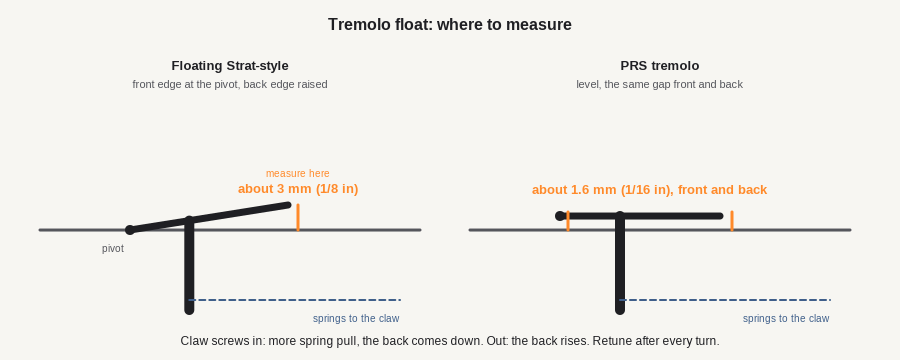
The strings pull the bridge forward; the springs in the back pull it back. A locking tremolo is set so the base plate is parallel to the body.
- Tune to pitch with the tuners.
- Look at the bridge from the side. Tilted forward (back edge up): the strings are winning. Turn the two claw screws in a quarter turn each. Tilted back (back edge down): back them out.
- Retune all six strings and look again. It takes several rounds, because each change pulls every string out of tune.
Blocking: a wedge behind the tremolo block holds the bridge still while you work on the neck or the saddles; take it out before the final balance.
Step 2: Neck Relief
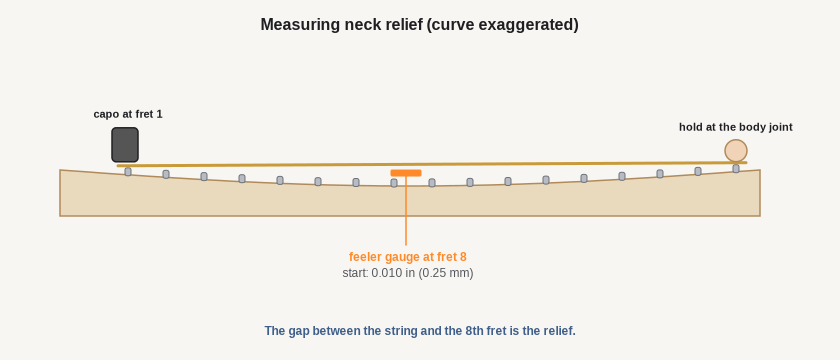
Measure and adjust as in Level 2A. The truss rod on most locking-tremolo guitars is at the headstock, behind the nut. Retune after every adjustment, then check the bridge is still level.
Step 3: Action at the Pivot Studs
There are no height screws on the saddles. The whole bridge rises and falls on its two pivot studs.
- On an Ibanez Edge or Lo-Pro Edge, loosen the small stud lock screws first: they lock the pivot studs from the side.
- Push the tremolo bar down to take the pressure off the knife edges, and turn each stud a little. Turning against the knife edges under full tension wears them.
- Raise or lower the bass side and treble side to the starting points, then lock the stud screws again.
- Check the bridge is still level (Step 1); action changes move it slightly.
Worn knife edges (the sharp edges of the base plate where it rocks on the studs) make the bridge return out of tune. If they're rounded or chipped, the base plate or the studs need replacing.
Step 4: Nut
The locking nut clamps the strings, so the slots have nothing to do with tuning. Check the gap with the clamps off. Many locking nuts are raised or lowered with shims underneath. If a string buzzes open, the nut may need a shim.
Step 5: Pickup Height
Hold each string at the last fret and measure from the bottom of the string to the top of the pickup. Lower the neck pickup a little further than the bridge pickup, and balance them by ear.
Step 6: Intonation
The saddles slide on the base plate and are held by a lock bolt each.
- Compare the 12th-fret harmonic with the fretted note.
- Detune the string first (or take the pressure off with the bar). Loosen the saddle's lock bolt, slide the saddle back if the fretted note is sharp, forward if it's flat, and tighten the bolt.
- Retune and check again.
Moving a saddle under tension is hard and scratches the base plate. An intonation tool that hooks onto the saddle and pushes it with a screw makes this much easier.
Step 7: Lock Up and Fine-Tune
- Retune with the tuners until the bridge sits level and every string is at pitch.
- Put the nut clamps on and tighten them snug, not hard. Clamping pulls each string slightly sharp.
- Fine-tune with the fine tuners only from here on.
- Do a few dives and pulls, retune with the fine tuners, and check the bridge is still level.
Try It
Open the Guitar Setup tool and choose Floyd Rose or locking tremolo. The first reading is the bridge level: type in how much higher or lower the back edge sits than the front, and the tool tells you which way to turn the claw screws. Changing strings? The Stringing tool has the full Floyd Rose routine.