The Custom 24 sets up like a cross between its two influences: a glued-in neck and a truss rod at the headstock like a Gibson, and a six-screw tremolo with a saddle for each string like a Fender. PRS publishes its own factory specs, and they're tighter than most: a flatter neck and lower action. This page has those specs and what's different. The full procedure, with a diagram at every step, is in On the Bench: Guitar Setup, Level 2A.
Starting-Point Specs
These are places to start, from PRS's own factory specs for its Maryland-made guitars, not rules.
| Measurement | Where | Starting point |
|---|---|---|
| Tremolo float | gap between the bridge plate and the body, front and back | about 1/16 in (1.6 mm), with the bridge level |
| Neck relief | low E, capo at fret 1, fretted where the neck meets the body, gap at fret 7 or 8 | 0.005 to 0.010 in (0.13 to 0.25 mm) |
| Action, treble side | high E, top of the 12th fret to the bottom of the string | 1.4 to 1.8 mm (about 3.5/64 to 4.5/64 in) |
| Action, bass side | low E, same place | 1.5 to 1.9 mm, rising steadily from the high E to the low E |
| Nut clearance | each string fretted at fret 3, gap over fret 1 | just visible: 0.002 to 0.004 in |
| Humbucker height | string held at the last fret, string to the top of the cover or bobbin | high E side 2.0 mm (2.5/32 in), low E side 2.8 mm (3.5/32 in) |
PRS sets its guitars up for the string gauge they ship with, and the nut slots are cut for it. A gauge change means a full setup, and a big one may mean a new nut.
The Custom 24, Step by Step
Step 0, the tremolo. PRS sets its tremolo level, floating about 1/16 in off the body at both the front and the back edge. That leaves room to pull up a little and push down a lot.
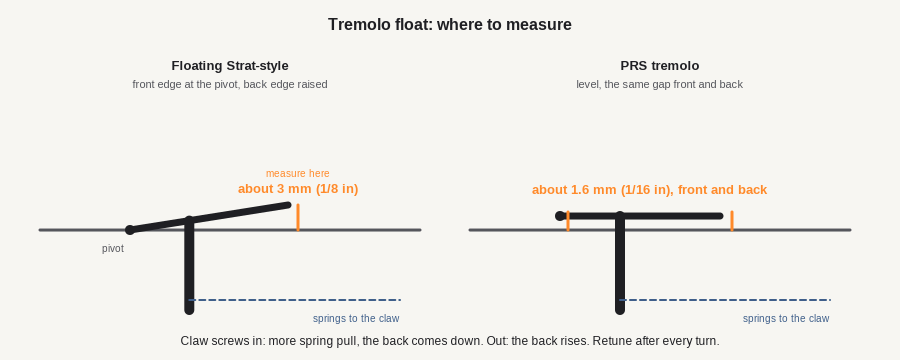
- Tune to pitch, take off the back plate, and turn the two claw screws about a quarter turn at a time until the back edge is 1/16 in up. Retune after every turn.
- The six pivot screws along the front edge set the front height. They come set from the factory, level with each other; leave them unless the front edge isn't 1/16 in up or isn't level.
Relief. The truss rod nut is at the headstock, under the cover. PRS likes a flat neck: 0.005 in is a normal starting point.
Action. Each saddle has height screws; most PRS bridges take a 1/16 in hex key there. Set the high E and low E, then the middle strings so the heights rise evenly from treble to bass.
Pickups. Two screws each. Measure to the cover, or to the top of the bobbin on uncovered pickups, at the center of the pickup.
Intonation. Retune all six strings after each saddle move: one saddle changes the pull on the whole floating bridge.
Custom 24 Quirks
- 24 frets push the neck pickup toward the bridge compared with a 22-fret guitar. Set it by ear against the bridge pickup rather than to a number.
- Coil splits (a push/pull knob, a rotary or mini switches, depending on the year) give single-coil sounds that are quieter. Balance pickup heights in the humbucker positions first, then check the split sounds.
- Locking tuners (on many models) make restringing faster and keep the tremolo steadier. Pull the string through, lock it, and tune with less than a full wrap.
Buying One Used
- Check the tremolo sits level and floats: a bridge pulled down onto the body or tilted forward has been set up for a different gauge or tuning.
- Look at the pivot screws for wear, and at the neck joint for finish cracks.
- Check the truss rod has adjustment left, and ask what string gauge it's set up for.
Try It
Open the Guitar Setup tool, choose PRS Custom 24, and type in your numbers, starting with the tremolo float. Each reading turns green, orange or red against these starting points.