The ES-330 looks like an ES-335, but it's a different guitar on the bench. The body is fully hollow, with no center block; the pickups are P-90 single coils; the tailpiece is a trapeze; and on most vintage examples and their reissues the neck joins the body at the 16th fret, not the 19th. This page has its starting-point specs and what's different. The full procedure, with a diagram at every step, is in On the Bench: Guitar Setup, Level 2A.
Starting-Point Specs
These are places to start, the figures long used for Gibson electrics, not rules.
| Measurement | Where | Starting point |
|---|---|---|
| Neck relief | low E, capo at fret 1, fretted where the neck meets the body (fret 16, or 19 on later "L" versions), gap at fret 7 | 0.010 in (0.25 mm) |
| Action, treble side | high E, top of the 12th fret to the bottom of the string | 1.2 mm (3/64 in); a little higher if you play hard |
| Action, bass side | low E, same place | 2.0 mm (5/64 in) |
| Nut clearance | each string fretted at fret 3, gap over fret 1 | just visible: 0.002 to 0.004 in |
| Bridge P-90 | string held at the last fret, string to the top of the pole screw | bass side 2.8 mm (about 7/64 in), treble side 2.4 mm (3/32 in) |
| Neck P-90 | same | a little further than the bridge |
P-90s have strong magnets under wide coils, so start them a little further from the strings than a humbucker.
The ES-330, Step by Step
Relief. The truss rod nut is at the headstock under the bell cover; most take a 5/16 in nut driver. Fret the low E where the neck meets the body: on a 16th-fret neck that's well before the end of the fretboard.
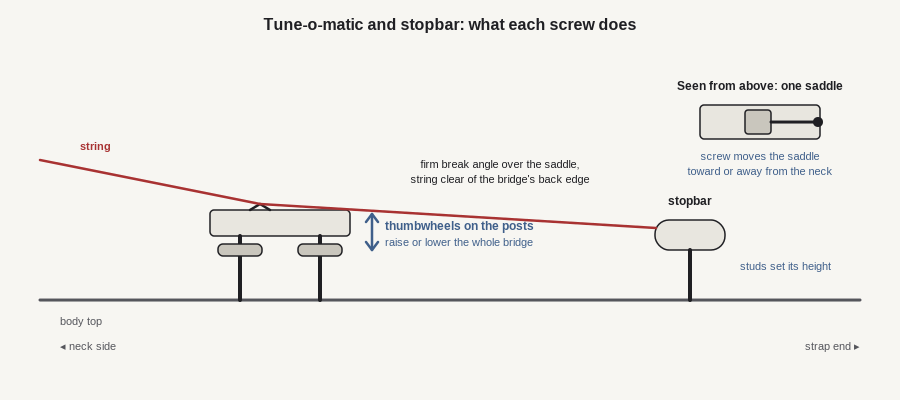
Action. The tune-o-matic's thumbwheels set the height, as on any Gibson. On a hollow body the posts are anchored in the top itself, so make big changes with the strings slack.
Trapeze tailpiece. The strings pull from the end of the body and cross the bridge at a shallow angle, so they press down on the saddles less than on a stopbar guitar. The saddle slots have to hold them: a string that jumps out of its slot when you dig in needs a slightly deeper slot. The bridge sits a long way from the tailpiece, so check it stays square to the strings after restringing.
Pickups. Dogear P-90s mount through their ears onto the top and often have little or no height travel. Set the sound with the pole screws, one under each string, and if the whole pickup needs to come up, a thin shim underneath does it. Raise the pole screws to follow the fretboard's curve, a little higher under the middle strings.
Intonation. A screw in each saddle, as on any tune-o-matic. Retune after each move.
ES-330 Quirks
- Feedback comes sooner than on a 335: the whole body is an acoustic chamber. Lower volume, a little more distance from the amp, or turning the guitar away from the speaker all help. Some owners fit a foam or a soundpost under the bridge, which changes the guitar's sound; it's a choice, not a fix.
- Hum: P-90s are single coils, so they hum near transformers and lights. Turning on the spot finds the quietest direction.
- The 16th-fret neck puts the bridge where Gibson wanted it on the hollow body, at the cost of easy access above the 15th fret. Later versions (and the ES-330L reissues) join at the 19th.
Buying One Used
- Look for top sinking or cracking around the bridge: hold a straightedge across the top beside the bridge.
- Check the trapeze tailpiece for cracks at the hinge, and look through the f-holes for loose wiring.
- Check behind the nut for a headstock repair, and that the truss rod has adjustment left.
Try It
Open the Guitar Setup tool, choose Gibson ES-330, and type in your numbers. Each reading turns green, orange or red against these starting points.