The ES-335 sets up much like a Les Paul: a glued-in neck, a tune-o-matic bridge and a truss rod at the headstock. The difference is the body. It's thin and hollow at the sides, with a solid maple center block running down the middle that carries the bridge and the tailpiece. This page has its starting-point specs and what's different. The full procedure, with a diagram at every step, is in On the Bench: Guitar Setup, Level 2A.
Starting-Point Specs
These are places to start, the figures long used for Gibson electrics, not rules.
| Measurement | Where | Starting point |
|---|---|---|
| Neck relief | low E, capo at fret 1, fretted at fret 19 (where the neck meets the body), gap at fret 7 | 0.010 in (0.25 mm); many players like 0.006 to 0.008 in |
| Action, treble side | high E, top of the 12th fret to the bottom of the string | 1.2 mm (3/64 in) |
| Action, bass side | low E, same place | 2.0 mm (5/64 in) |
| Nut clearance | each string fretted at fret 3, gap over fret 1 | just visible: 0.002 to 0.004 in |
| Bridge pickup | string held at the last fret, string to the top of the pickup | bass side 2.4 mm (3/32 in), treble side 1.6 mm (1/16 in) |
| Neck pickup | same | about 2.4 mm (3/32 in); a little further than the bridge |
The ES-335, Step by Step
Relief. The truss rod nut is at the headstock, under the bell cover; most take a 5/16 in nut driver. The neck joins the body at the 19th fret, so fret the low E there when you measure.
Action. Turn the thumbwheels on the two bridge posts. On a 335 the posts go into the center block, so the bridge is as solid as a Les Paul's. Slacken the strings a little before big adjustments, so the posts don't lean.
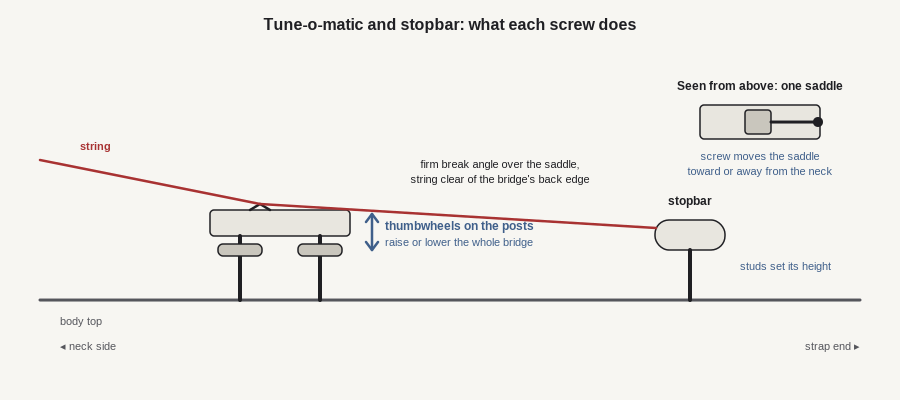
Tailpiece. Most 335s have a stopbar, set as low as it goes with the strings still clear of the back edge of the bridge. Some years and versions have a trapeze tailpiece or a Bigsby. With those, the strings cross the bridge at a lower angle, so the saddle slots have to hold them: a string that jumps out of its slot when you dig in needs a slightly deeper slot.
Pickups. Set them like any Gibson humbucker. The height screws are reachable from the top. Anything inside (pots, wiring, the output jack) comes out through the f-holes, which is slow work: leave it for when it's needed.
Intonation. A screw in each saddle, as on any tune-o-matic.
ES-335 Quirks
- Feedback: the center block keeps it far more feedback-resistant than a fully hollow guitar, but the hollow wings still sing at high volume. If it starts to howl, step away from the amp or turn so the guitar doesn't face the speaker.
- Neck heel binding and the binding along the body can shrink and crack with age. It's cosmetic until it lifts and catches.
- The neck feel changed a lot over the years, from fat 1950s profiles to thin 1960s ones; that doesn't change the setup, but it changes what low action feels like.
Buying One Used
- Check behind the nut for a headstock repair.
- Look through the f-holes with a light: loose wiring, a wandering output jack or a crack in the top around the bridge are all worth knowing about.
- Check the bridge posts aren't leaning and the truss rod has adjustment left.
Try It
Open the Guitar Setup tool, choose Gibson ES-335, and type in your numbers. Each reading turns green, orange or red against these starting points.