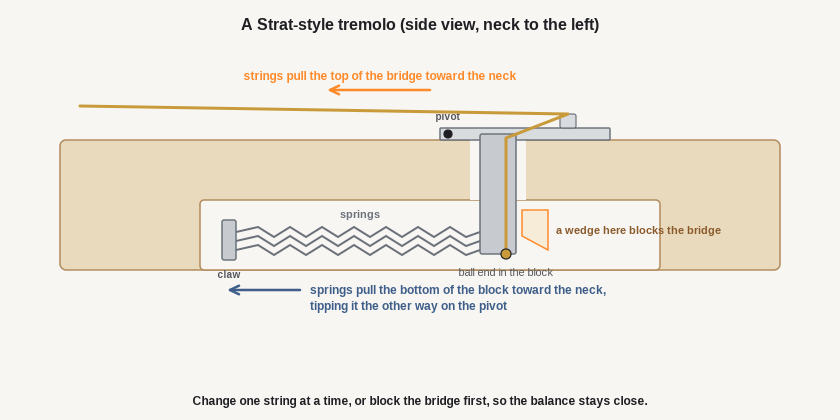
The Stratocaster sets up like a Telecaster with one big difference: the tremolo. The bridge floats between the pull of the strings and the pull of the springs, so its angle has to be set first, and every other adjustment depends on it. This page has the Strat's starting-point specs and what's different about it. The full procedure, with a diagram at every step, is in On the Bench: Guitar Setup, Level 2A.
Starting-Point Specs
These are places to start, close to what Fender ships, not rules.
| Measurement | Where | Starting point |
|---|---|---|
| Tremolo float | gap between the back edge of the bridge plate and the body | about 1/8 in (3 mm), on bridges set to float |
| Neck relief | low E, capo at fret 1, fretted at the last fret, gap at fret 8 | 7.25 in radius: 0.012 in (0.3 mm). 9.5 to 12 in: 0.010 in (0.25 mm). 15 to 17 in: 0.008 in (0.2 mm) |
| Action, treble side | high E, top of the 12th fret to the bottom of the string | 1.6 mm (about 4/64 in) |
| Action, bass side | low E, same place | 2.0 mm (about 5/64 in) |
| Nut clearance | each string fretted at fret 3, gap over fret 1 | just visible: 0.002 to 0.004 in |
| Pickup height, vintage-style | string held at the last fret, string to pole piece | bass side 2.4 mm (6/64 in), treble side 2.0 mm (5/64 in) |
| Pickup height, hotter pickups | same | Texas Special style: bass 3.2 mm (8/64 in), treble 2.4 mm (6/64 in) |
Fender measures its own string height at the 17th fret. This library measures action at the 12th on every guitar, so the action figures above are 12th-fret starting points.
The Stratocaster, Step by Step
Step 0, the tremolo. Tune to pitch. Take off the back plate and look at the bridge from the side.
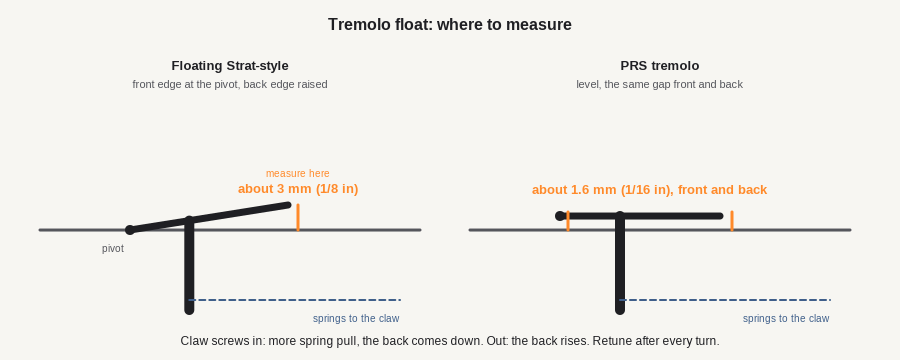
- Back edge too high: turn both claw screws in a little, for more spring pull. Too low: back them out. Retune after every turn; it takes a few rounds.
- Vintage six-screw bridges pivot on six screws along the front edge. Many players back the four inside screws off a little so the bridge pivots on the outer two only, which keeps it smoother and returning to pitch.
- Two-point bridges (most American Strats since the mid 1980s) pivot on two posts. The posts also set the overall bridge height: don't use them to fix action on a single string.
- Decked bridges sit flat on the body, held there by extra spring pull. That's a valid choice: the bar only goes down, and tuning is more stable. Skip the float reading if that's how you like it.
Relief. Vintage-style necks adjust at the heel, often under the pickguard edge or behind it; you may need to loosen the neck to reach the nut. Many modern Strats have a wheel at the headstock, by the nut, which turns with a small rod or screwdriver.
Action. Six saddles, two small height screws each. Set the outside strings, then the middle four to the fretboard's curve. Check the tremolo angle again afterwards: action changes move it slightly.
Pickups. Three pickups, two screws each. Set the neck and middle pickups lower than the bridge: Strat single coils have strong magnets, and close to the strings they pull hard enough to make notes warble and go out of tune (players call it "Stratitis"). If the low E sounds sour high on the neck, lower the neck pickup's bass side first.
Intonation. After each saddle move, retune all six strings: one saddle changes the pull on the whole bridge.
Stratocaster Quirks
- Tuning that drifts after bar use is usually friction: at the nut, at the string trees, or at the pivot. Graphite in the nut slots and a smooth pivot cure most of it before you reach for locking parts.
- Springs: three is standard; heavier strings or a decked bridge may need four or five.
- Changing string gauge changes the bridge angle. Rebalance the tremolo before you touch anything else.
Buying One Used
- Look at the tremolo screws or posts for wear and at the pivot edge for burrs.
- Check the claw is firmly screwed into the body and the springs aren't rusted.
- As on any bolt-on, check the neck pocket for shims and the neck screws for stripped holes, and check the truss rod still has adjustment left.
Try It
Open the Guitar Setup tool, choose Fender Stratocaster, and type in your numbers, starting with the tremolo float. Each reading turns green, orange or red against these starting points.