Most Gibson electrics share a recipe: a glued-in mahogany neck with a 24.75 in scale, a headstock angled back, a truss rod adjusted at the headstock, and a tune-o-matic bridge. Set one up and the others follow. This page covers what they have in common and the SG, which has its own quirks. The Les Paul, ES-335 and ES-330 have their own Level 3X pages. The full procedure, with a diagram at every step, is in On the Bench: Guitar Setup, Level 2A.
Starting-Point Specs
These are places to start, the figures long used for Gibson electrics, not rules.
| Measurement | Where | Starting point |
|---|---|---|
| Neck relief | low E, capo at fret 1, fretted where the neck meets the body, gap at fret 7 | 0.010 in (0.25 mm); many players like 0.006 to 0.008 in |
| Action, treble side | high E, top of the 12th fret to the bottom of the string | 1.2 mm (3/64 in) |
| Action, bass side | low E, same place | 2.0 mm (5/64 in) |
| Nut clearance | each string fretted at fret 3, gap over fret 1 | just visible: 0.002 to 0.004 in |
| Bridge pickup | string held at the last fret, string to the top of the pickup | bass side 2.4 mm (3/32 in), treble side 1.6 mm (1/16 in) |
| Neck pickup | same | about 2.4 mm (3/32 in); a little further than the bridge |
What Every Gibson Shares
- Truss rod at the headstock, under the bell-shaped cover; most take a 5/16 in nut driver.
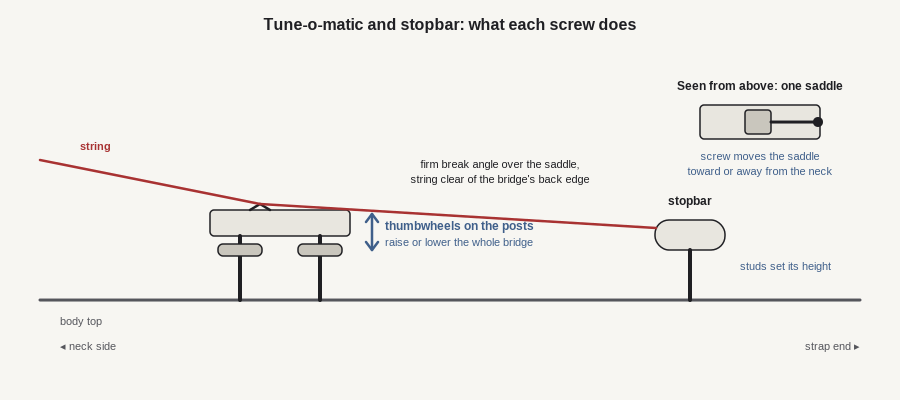
- Tune-o-matic: thumbwheels on two posts set the height of the whole bridge; the saddle curve is built in. A screw in each saddle sets intonation.
- Stopbar on most solid bodies: as low as it goes with the strings still clear of the back edge of the bridge.
- The angled headstock presses the strings hard into the nut, so slots that bind and ping are common: graphite in the slots helps.
- The neck angle is set when the neck is glued in. If the bridge runs out of adjustment, that's a job for a technician, not a shim.
The SG
The SG is light and thin, with a neck that joins the body far up, at about the 22nd fret on most models. That gives easy access to the top frets, and a few things to watch.
- Relief: fret the low E where the neck meets the body, which on an SG is near the last fret. The slender neck has little wood at the joint, so check the relief more often through the seasons, and expect it to move a little more than a Les Paul's.
- Neck dive: the body is light and the neck long, so an SG tips headstock-down on a strap. That doesn't change the setup, but it explains why SGs often get knocked: check the headstock and the neck joint.
- Bridge: tune-o-matic and stopbar on most; some have a Maestro vibrola or a Bigsby. With those, the strings run over the bridge at a low angle, so the saddles need slots deep enough to hold the strings, and tuning stability depends on a smooth nut.
- Pickups: set like any Gibson humbucker. The neck pickup sits close to the end of the fretboard, so set it further away than the bridge.
Buying One Used
- Look closely at the neck joint for cracks in the finish around the heel, and behind the nut for a headstock repair.
- Check the bridge posts aren't leaning toward the neck.
- Check the truss rod still turns and has adjustment left.
Try It
Open the Guitar Setup tool, choose Gibson SG, and type in your numbers. Each reading turns green, orange or red against these starting points.