Every Modern Eagle sets up the PRS way: a glued-in neck, a 25 in scale, a truss rod at the headstock, PRS's own flat-neck, low-action factory specs, and locking tuners. What changes between generations is the bridge and the pickups. This page covers the Modern Eagle III and the Modern Eagle V, with notes for the others. The full procedure, with a diagram at every step, is in On the Bench: Guitar Setup, Level 2A.
Which Modern Eagle Is It?
| Model | Years | What matters for setup |
|---|---|---|
| Modern Eagle | from 2004 | stoptail, or a PRS tremolo as an option |
| Modern Eagle II | from about 2008 | stoptail or tremolo |
| Modern Eagle III | 2009 to 2010 (25th Anniversary) | three Narrowfield pickups; check whether yours has a stoptail or a tremolo |
| Modern Eagle Quatro | 2010 to about 2012 | its own pickups and switching |
| Modern Eagle V | Private Stock from 2018, Core from 2023 | Gen III tremolo, two humbuckers and a middle single coil |
The truss rod cover names the model on most of them.
Starting-Point Specs
These are places to start, from PRS's own factory specs for its Maryland-made guitars, not rules.
| Measurement | Where | Starting point |
|---|---|---|
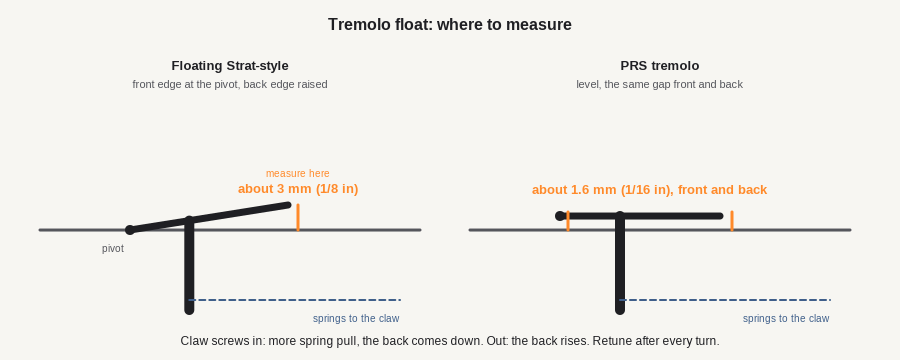
| Tremolo float | gap between the bridge plate and the body, front and back | about 1/16 in (1.6 mm), with the bridge level (tremolo models) |
| Neck relief | low E, capo at fret 1, fretted where the neck meets the body, gap at fret 7 or 8 | 0.005 to 0.010 in (0.13 to 0.25 mm) |
| Action, treble side | high E, top of the 12th fret to the bottom of the string | 1.4 to 1.8 mm |
| Action, bass side | low E, same place | 1.5 to 1.9 mm, rising steadily from the high E to the low E |
| Nut clearance | each string fretted at fret 3, gap over fret 1 | just visible: 0.002 to 0.004 in |
| Humbucker and Narrowfield height | string held at the last fret, string to the top of the cover or bobbin | high E side 2.0 mm (2.5/32 in), low E side 2.8 mm (3.5/32 in) |
| Middle single coil (ME V) | same | high E side 2.8 mm (3.5/32 in), low E side 3.2 mm (4/32 in) |
Step by Step
Tremolo models (ME V, and tremolo-equipped earlier models). Set the bridge first: level, about 1/16 in off the body front and back. The claw screws in the back cavity set the back edge; the pivot screws along the front come set from the factory, level with each other. Retune after every adjustment.
Stoptail models. The two studs set the height of the whole bridge; most of the intonation is built into the bar. Skip the tremolo float reading.
Relief. At the headstock, under the cover with the model name. Start flat, at about 0.005 in.
Action. On tremolo models, each saddle has height screws (most take a 1/16 in hex key); set the heights to rise evenly from the high E to the low E.
Pickups. - ME III: three Narrowfields, all set to the humbucker figures. Narrowfields are narrow and focused under the strings, so balance them by ear across all the switch positions. - ME V: two humbuckers and a middle single coil. Set the middle one lower than the humbuckers (the single-coil figures above): its magnets pull on the strings at the point where they swing widest. Then check the split sounds on the mini toggles, which use one coil of each humbucker.
Intonation. On tremolo models, retune all six strings after each saddle move.
Modern Eagle Quirks
- Phase III locking tuners (ME V) clamp the string inside the post: pull it through taut, lock it, and tune up with less than a full wrap. Fewer wraps keep the tremolo steadier.
- The Gen III tremolo on the ME V is brass throughout and very stable once set; most tuning trouble on these guitars comes from a new string not yet stretched in.
- Gauge changes need a full setup: the nut slots are cut for the factory gauge.
Buying One Used
- Check which generation it is (truss rod cover, pickups, bridge) and that the pickups and switching match it.
- On tremolo models, check the bridge sits level and floats.
- Check the neck joint for finish cracks, and that the truss rod has adjustment left.
Try It
Open the Guitar Setup tool, choose PRS Modern Eagle, and type in your numbers. Each reading turns green, orange or red against these starting points.