A Les Paul sets up differently from a Fender: a glued-in neck, a tune-o-matic bridge with its own built-in curve, a stopbar tailpiece, and a headstock angled back sharply. There's less to adjust, and some of it (the neck angle) isn't adjustable at all. This page has its starting-point specs and what's different. The full procedure, with a diagram at every step, is in On the Bench: Guitar Setup, Level 2A.
Starting-Point Specs
These are places to start, the figures long used for Gibson electrics, not rules.
| Measurement | Where | Starting point |
|---|---|---|
| Neck relief | low E, capo at fret 1, fretted at fret 15, gap at fret 7 | 0.010 in (0.25 mm); many players like 0.006 to 0.008 in |
| Action, treble side | high E, top of the 12th fret to the bottom of the string | 1.2 mm (3/64 in) |
| Action, bass side | low E, same place | 2.0 mm (5/64 in) |
| Nut clearance | each string fretted at fret 3, gap over fret 1 | just visible: 0.002 to 0.004 in |
| Bridge pickup | string held at the last fret, string to the top of the pickup | bass side 2.4 mm (3/32 in), treble side 1.6 mm (1/16 in) |
| Neck pickup | same | about 2.4 mm (3/32 in) on both sides; a little further than the bridge |
The Les Paul, Step by Step
Relief. The truss rod nut is at the headstock, under the bell-shaped cover (two or three small screws). Most take a 5/16 in nut driver or box wrench. The nut sits in a deep channel, so a thin-walled driver is easier than a wrench and won't chip the finish around the opening.
Action. Turn the thumbwheels on the two bridge posts. Each one lifts one side of the whole bridge; the saddle curve is built in (about a 12 in radius, matching the fretboard). Slacken the strings a little before turning a wheel more than a quarter turn: under full tension, the posts lean forward over time.
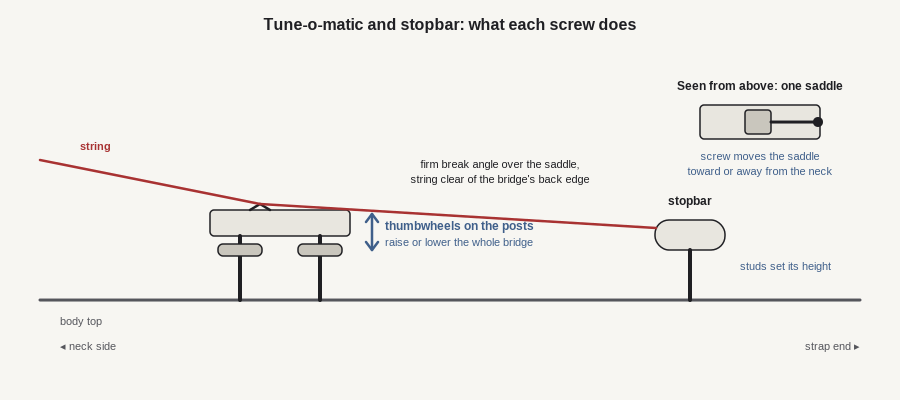
Stopbar. Its two studs set its height. Lower gives a steeper angle over the saddles and a firmer feel; too low and the strings touch the back edge of the bridge. A good rule: as low as it goes with the strings still clear of the bridge. Some players top-wrap instead (strings through the stopbar from the front, over the top), which softens the feel.
Nut. The steep headstock angle presses the strings hard into the slots, so a string that pings while tuning is common. Graphite in the slots usually cures it.
Pickups. Two screws each, with springs underneath. Set the neck pickup a little further away than the bridge. The pole screws on one coil can be raised to balance a string that's quiet, but most Les Pauls ship with them flat.
Intonation. Each saddle has a screw: on most bridges the screw head faces the pickups. If a saddle runs out of travel, it can be turned around in the bridge; check which way your bridge is built before you take it apart.
Les Paul Quirks
- Headstock breaks are the Les Paul's best-known weak point: the angled headstock and the thin wood behind the nut. Never lean it against an amp or a wall; lay it down or use a stand that holds the neck.
- ABR-1 or Nashville bridge: vintage-style ABR-1 bridges sit on thin posts with thumbwheels, and many have a retaining wire over the saddles; Nashville bridges sit on wider posts screwed into metal inserts. Both adjust the same way.
- Weight varies a lot between years and models; it doesn't change the setup, but it changes how long you'll want to hold it while you work. A neck rest helps.
Buying One Used
- Look under the finish behind the nut for a headstock repair: a line across the grain, or new finish that looks different from the rest.
- Check the bridge posts aren't leaning toward the neck.
- Check the truss rod still turns and has adjustment left, and look at the binding over the frets for cracks or lifting.
Try It
Open the Guitar Setup tool, choose Gibson Les Paul, and type in your guitar's numbers. Each reading turns green, orange or red against these starting points, with what to do about anything that's off.