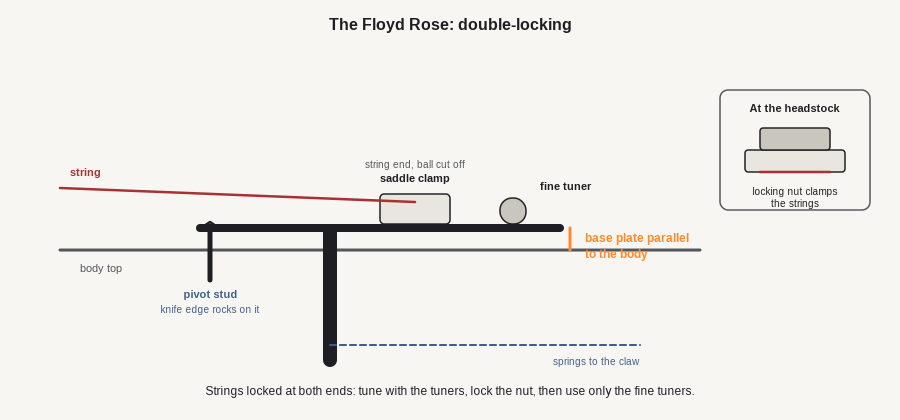
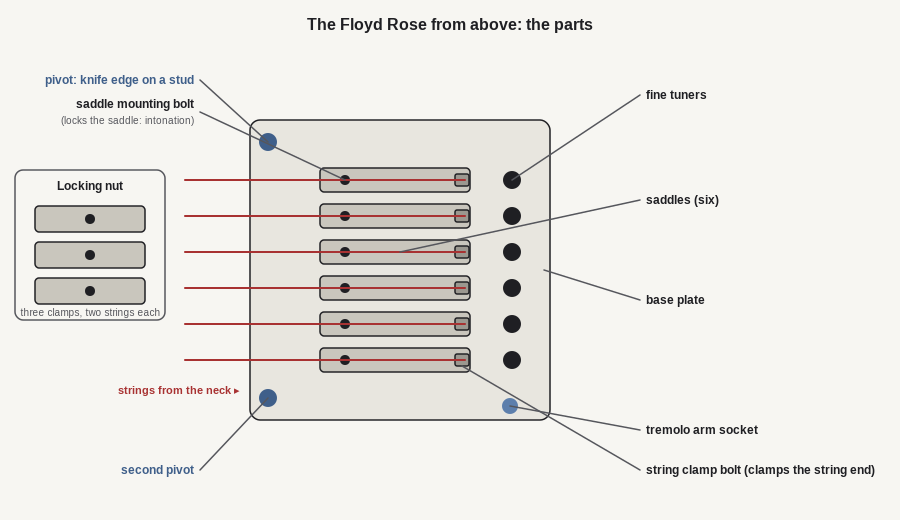
Restringing a Floyd Rose takes longer than any other guitar the first time, and it's quick once you know the routine. Each string is clamped at both ends: in its saddle on the bridge, with the ball end cut off, and under a clamp at the locking nut. The bridge floats, balanced against the springs, so every string you change pulls on the others. The same routine works on bridges built the same way under license, such as the Ibanez Edge family and Gotoh and Schaller Floyd-style bridges.
Tools
| Tool | What for |
|---|---|
| Allen keys | the nut clamps, the saddle clamp bolts and the saddle mounting bolts; check the sizes on your guitar, they vary by maker |
| Side cutters | cutting the ball ends off and trimming at the headstock |
| A block | a piece of wood or a purpose-made tremolo block, to hold the bridge level while the strings are off |
| A string winder and a tuner | as for any guitar |
Before You Start
- Tune up the old strings and look at the bridge from the side. Note where it sits: on most Floyds the base plate is set parallel to the body. That's where you want it to end up.
- Loosen the three nut clamps and take them off. Keep the clamps and their bolts somewhere safe: they're small and easy to lose.
- Wind every fine tuner to the middle of its travel, so there's room to fine-tune both ways at the end.
One at a Time, or Block It
- One at a time keeps the bridge near its balance point, so the new strings come up to pitch close to where they belong. It's the safe way, and the best way the first few times.
- All at once is fine if you block the bridge first: with the strings at pitch, slip the block between the back of the tremolo block and the body (in the back cavity), so the bridge can't tip forward when the strings come off. You can then clean the fretboard, and the bridge stays put.
Old String Off
- Slacken the string at the tuner until it's loose.
- Loosen the string clamp bolt at the back of its saddle. The string end comes free.
- Unwind it from the tuner and pull it out.
New String On
- Cut the ball end off the new string, just past the twisted wrap at the end, so the clamp grips plain string, not the twist.
- Push the cut end into the saddle as far as it goes, and tighten the string clamp bolt snug, not hard. Overtightening cracks the small clamp block inside the saddle, and a cracked block lets the string slip.
- Run the string under its nut clamp (with the clamp off) and over its slot to the tuner.
- Wind it on the tuner: about two wraps. With the nut locked, the tuner doesn't hold the tuning, so a lot of wraps isn't needed.
- Tune it to pitch with the tuner, not the fine tuner.
- Stretch it in: pull gently along its length, retune, two or three times.
Repeat for each string. After each one, retune the strings you've already done: every new string pulls the bridge, and the bridge pulls the others flat.
Balance and Lock
- Take the block out, if you used one.
- Retune all six with the tuners, several passes, until they hold pitch.
- Look at the bridge from the side. Back edge up: the strings are pulling harder than the springs, so turn the two claw screws in, a quarter turn each. Back edge down: back them out. Retune and look again. A gauge or tuning change always needs this; the full routine is in On the Bench: Guitar Setup, Level 2C.
- Put the nut clamps back and tighten them snug. Clamping pulls each string a little sharp.
- Fine-tune with the fine tuners only. Do a few dives and pulls with the bar, then fine-tune again.
- Trim the string ends at the headstock.
When the Fine Tuners Run Out
If a fine tuner is wound all the way in or out and the string still isn't in tune, unlock the nut, center that fine tuner, retune with the tuner, and lock the nut again. It happens most after new strings stretch, or after a change of tuning.
Common Problems
- A string slips in its saddle and goes flat on bends: the clamp block is worn or cracked, or the string end was cut too short. Replace the block (they're sold separately) and leave the cut end long enough to fill the clamp.
- Strings break at the saddle: a sharp edge on the clamp or the saddle. Smooth it, or replace the part.
- The bridge won't return to pitch: worn knife edges or pivot studs, or friction. See On the Bench: Guitar Setup, Level 2C.
- A fine tuner won't turn: dirt in the thread; a drop of light oil and a gentle turn usually frees it.
Try It
Next string change, do one string completely first: ball end cut, clamped in the saddle, tuned and stretched. Then look at the bridge before you move on. The Stringing tool has this routine as a checklist: choose Electric, Floyd Rose. For the setup, see On the Bench: Guitar Setup, Level 2C: Floyd Rose.