Changing strings is the most common job on any guitar, and doing it well is what keeps a guitar in tune. This level covers the basics that apply to every guitar: tools, getting the old strings off, winding on the tuner posts, and stretching the new set in. It also covers the two jobs that are different on acoustic and classical guitars: bridge pins and the tie block. Level 2 covers fixed bridges on electric guitars, and Level 3 covers tremolos.
Tools
| Tool | What for |
|---|---|
| String winder | turns the tuners fast; the notch in most winders also pulls acoustic bridge pins |
| Side cutters | trims the string ends; a pair made for guitar strings cuts cleanly |
| Tuner | clip-on or pedal |
| A soft cloth and a neck rest | protects the finish and holds the neck steady |
| Fretboard cleaner or conditioner | optional, while the strings are off |
Old Strings Off: All at Once or One at a Time?
- All at once gives you a chance to clean the fretboard and frets and polish the body. Fine for most fixed-bridge guitars.
- One at a time keeps the tension on the neck and keeps loose parts in place. Use it when the bridge is held on only by string pressure (archtops and some vintage guitars with a floating bridge), on guitars with a floating tremolo, and when you don't want to disturb the setup.
Loosen each string until it is slack before cutting it. Cutting a string at full tension can whip, and it shocks the neck.
Winding on the Post
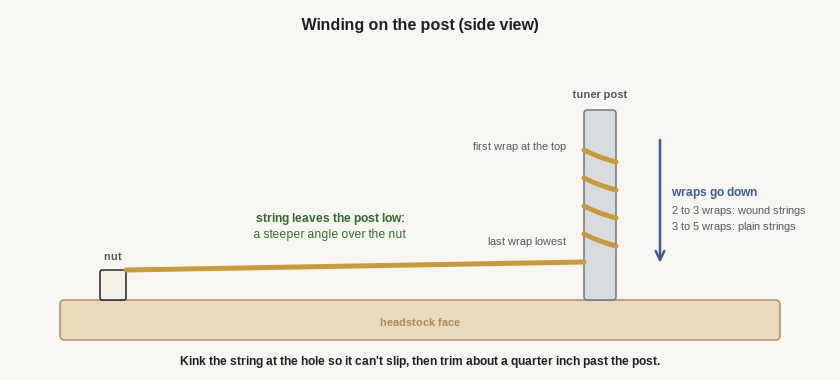
- Pull the string through the post hole and pull it tight toward the tuner.
- Leave slack for the wraps: about two to three inches past the post for wound strings, a little more for plain strings. A common trick is to pull the string tight, then back it off to the next tuner post along.
- Kink the string sharply at the hole so it can't slip.
- Wind so the wraps go downward, each wrap below the last. The string leaves the post low, which gives it a steeper angle over the nut: better tone and tuning stability.
- Aim for two to three wraps on wound strings and three to five on plain strings. Plain strings are slippery and need the extra grip; too many wraps on a wound string can stretch and slip.
- Trim the end about a quarter inch past the post.
Vintage Split-Shaft Tuners
Kluson-style tuners on many Fenders have a slot down the middle of the post and a hole in the center top. Cut the string to length first (to the next post along is a good guide), push the end down into the center hole, bend it into the slot, and wind. No sharp ends stick out.
Locking Tuners
Locking tuners clamp the string inside the post. Pull the string through tight, lock it, and tune up: no wraps are needed, which makes changes fast and tuning very stable.
Which Way to Turn
On most guitars the strings run around the inside of the posts (toward the center of the headstock) and the tuner turns so that tightening pulls the string toward the center. If the string rubs against another post or the headstock on the way to the nut, it is wound the wrong way.
Stretching In
New strings stretch, and until they do, they go flat again and again.
- Tune the string to pitch.
- Hook a finger under it and pull it gently away from the fretboard, moving along its length. Firm, not violent.
- Retune. Repeat two or three times, until it stays at pitch.
Plain strings and nylon strings stretch the most. Nylon can take a day of retuning to settle.
Acoustic: Bridge Pins
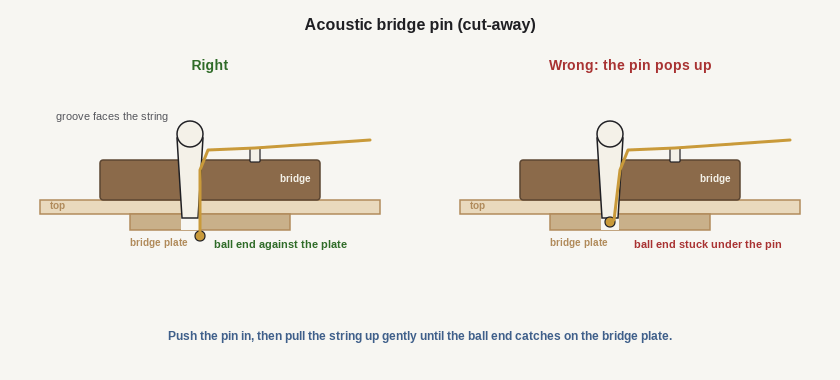
- Pull each old pin with the notch in a string winder, pushing the string in slightly first to free the ball end.
- Drop the new string's ball end into the hole and push the pin in, groove facing the string.
- Hold the pin down and pull the string up gently until you feel the ball end catch against the bridge plate under the top. Then push the pin home.
- Bring the string up to tension while keeping a thumb on the pin.
If the ball end sits on the bottom of the pin instead of the bridge plate, the pin can pop out and the string won't hold tune.
Classical: The Tie Block
Classical strings have no ball end; they are tied at the bridge.
- Pass the string through the bridge hole from the soundhole side, leaving about two inches out the back.
- Bring the short end back over the tie block and loop it under the string where it enters the hole.
- Wrap the short end around itself, three times for the trebles and twice for the basses, then pull it tight so the wraps lock against the back edge of the tie block. Some players add a bead to the end of the slippery treble strings.
- At the headstock, pass the string through the roller hole and wrap it over itself once so it locks, then wind on.
Nylon needs plenty of wraps on the roller, and plenty of retuning while it settles.
Try It
Next time you change strings, count your wraps as you go: two to three on the wound strings, three to five on the plain ones, all going downward. Check that each string leaves its post low and runs straight to its nut slot.
Level 2 covers fixed bridges on electric guitars: string-through bodies, top-loaders, the Telecaster, tune-o-matic and stopbar, archtop trapeze tailpieces and the Bigsby.