A string is a simple part with a big job: it is the thing that actually vibrates. What it is made of and how it is wound decide how bright it sounds, how it feels under the fingers, how long it lasts, and, on an electric guitar, how strongly the pickups hear it. This series is organized by type of string, not by brand: the same handful of materials and windings show up in every maker's catalog.
Two Parts: Core and Wrap
Every string has a core. The thin treble strings are just the core: a single plain wire of steel (or nylon on a classical guitar). The bass strings add a wrap: a second wire wound tightly around the core to add mass, so the string can vibrate at a low pitch without being stiff as a rod.
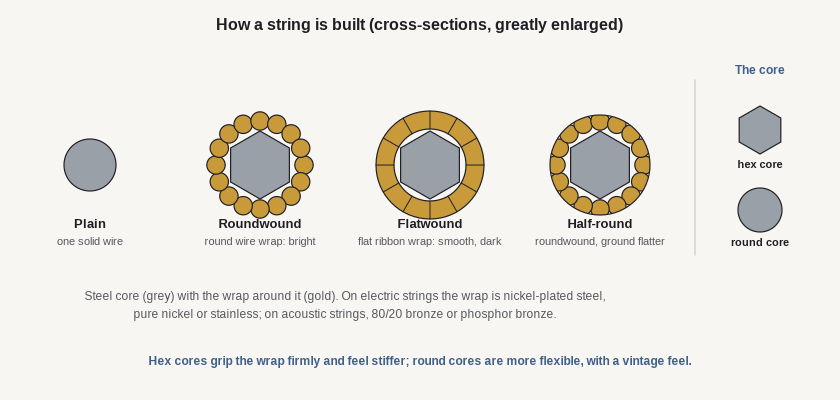
On a steel-string guitar, the core is high-carbon steel, usually tin-plated on the plain strings to resist rust. The material of the wrap is what most of the names on the packet are about.
Electric Guitar Strings
An electric guitar's magnetic pickup only hears metal that it can magnetize, so electric wraps are made of magnetic material.
| Wrap | Sound and feel | Notes |
|---|---|---|
| Nickel-plated steel | balanced: bright attack, warm body | by far the most common electric string |
| Pure nickel | warmer, smoother, a little lower output | the material of the 1950s and 1960s; a favorite for vintage tones |
| Stainless steel | brightest, crisp, slick feel | resists sweat and rust well; harder on frets over time |
| Coated | close to the uncoated version, slightly smoother feel | a thin polymer layer keeps out sweat and dirt, so they last much longer |
Acoustic Guitar Strings
An acoustic guitar has no pickup to please, so its wraps are chosen purely for tone and life.
| Wrap | Sound and feel | Notes |
|---|---|---|
| 80/20 bronze | very bright and crisp when new | really a brass (80% copper, 20% zinc); loses its sparkle fairly quickly |
| Phosphor bronze | warmer, fuller, still clear | copper and tin with a trace of phosphorus; holds its tone longer |
| Silk and steel | soft, mellow, low tension | a steel core with silk or nylon filament under the wrap; gentle on fingers, good for fingerstyle and older guitars |
| Coated | as the uncoated version, longer life | the same idea as coated electric strings |
Acoustic strings will make an electric guitar's pickups sound thin and quiet on the wound strings. Electric strings on an acoustic sound thin and metallic. Use the type made for the guitar.
Classical Guitar Strings
Classical guitars use nylon, at far lower tension than steel strings.
- Trebles: plain nylon, either clear or "rectified" (ground for a smooth, even surface). Some sets use fluorocarbon, which is brighter and denser.
- Basses: a core of fine nylon filaments, wrapped in silver-plated copper wire.
- No ball ends on most sets: the strings are tied at the bridge (Restringing Level 1 shows how).
- Never fit steel strings to a classical guitar. Its neck and bridge are not built for the tension, and the guitar can be damaged.
How the Wrap Is Wound
| Winding | Sound and feel | Where you find it |
|---|---|---|
| Roundwound | brightest, most sustain, a textured feel | nearly every electric and acoustic set |
| Flatwound | dark, smooth, short and thumpy; almost no finger squeak | jazz, vintage rock and roll, many bass players |
| Half-round (ground wound) | in between: roundwound, then ground partly flat | players who want less squeak without the full flatwound thump |
The Core: Hex or Round
Most modern strings use a hex core: a six-sided core wire that grips the wrap firmly, so the string is consistent and stiff. A round core is the older construction: a little more flexible, easier to bend, and with a slightly warmer, more vintage character. Both are good; it is a feel preference.
Plain or Wound Third
On most electric sets the third string (G) is plain. Heavier electric sets, and nearly every acoustic set, use a wound third. A wound G sounds fuller and stays in tune better with heavy gauges, but it is much harder to bend.
Try It
Look at your guitar's wound strings in good light. A roundwound string has a ridged surface you can feel with a fingernail; a flatwound is smooth. Then check the packet or the maker's page for your set: the wrap material is almost always printed right on it.
Level 2 covers gauges and tension: what the numbers on the packet mean, how scale length changes the feel, and choosing strings for drop tunings.