Levels 1 and 2 covered winding, stretching and fixed bridges. A tremolo adds one more thing to think about: the bridge is balanced between the pull of the strings and the pull of the springs in the back. Take the strings off carelessly and that balance goes with them. This level covers the vintage Stratocaster tremolo, the two-point tremolo, and blocking a bridge. Locking systems such as the Floyd Rose have their own series, On the Bench: Floyd Rose.
How a Tremolo Is Balanced
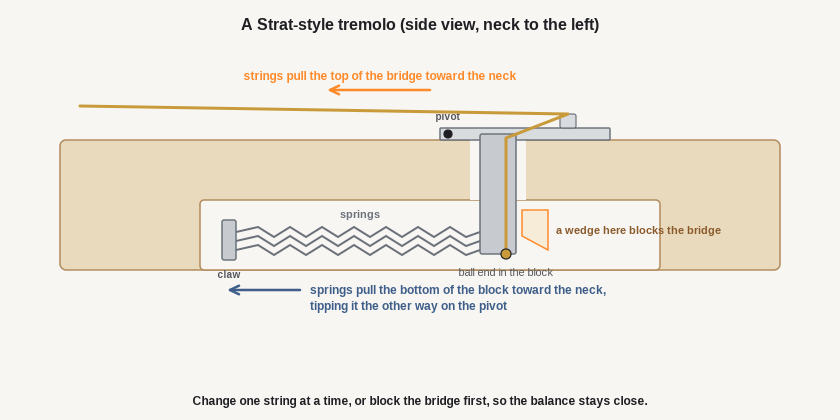
A Strat-style tremolo is a bridge plate with a heavy block hanging under it, through a hole in the body. The strings pull the top of the bridge toward the neck. Springs in a cavity on the back, anchored to a claw screwed into the body, pull the bottom of the block toward the neck too, which tips the bridge the other way on its pivot. When the two pulls match, the bridge sits where it was set up: flat on the body, or tilted slightly forward ("floating") so you can bend up as well as down.
Change the pull on one side and the bridge moves:
- Take all the strings off and the springs pull the bridge back, flat against the body or into the cavity.
- Fit heavier strings and the bridge tilts forward. Fit lighter strings and it pulls back. Either way, the springs need adjusting (On the Bench: Guitar Setup covers it).
Vintage Six-Screw Tremolo
- Change one string at a time. This keeps the balance close and the bridge near where it was. If you want all the strings off to clean the fretboard, block the bridge first (below).
- Feed the string from the back, through the hole in the tremolo block. On most Strats the holes are reached through the back cavity, either with the back cover off or through the openings in it.
- Pull the string through until the ball end seats in the block, guide it over its saddle, and wind on as in Level 1.
- Stretch in well. A tremolo guitar goes out of tune easily: every string that stretches lets the bridge move a little, which detunes the others. Stretch, retune, and repeat until all six hold.
Two-Point Tremolo
Modern Fender and many other guitars pivot on two studs instead of six screws. Restringing is the same: through the block from the back, one string at a time. A two-point bridge rocks on knife edges against the studs, so keep it seated: if the bridge has lifted off the studs, it will not return to pitch reliably.
Blocking the Bridge
Blocking fixes the bridge in place so it can't move while you work, or permanently if you never use the tremolo arm.
- For a string change: with the strings at pitch, slip a wedge (a folded cloth, a block of soft wood, or a purpose-made tremolo block) into the cavity behind the tremolo block, between the block and the body. Now the bridge can't tilt forward when tension changes, and you can take all six strings off.
- Permanently: fit a hardwood block cut to fill the gap behind the tremolo block, or tighten the claw screws until the bridge sits hard on the body. A blocked tremolo tunes like a hardtail and stays in tune through heavy bends, at the cost of the vibrato.
Tuning a Tremolo Guitar
Tuning one string changes the others, because the bridge moves a little each time.
- Tune all six strings roughly.
- Go around again, and again. Each pass, the changes get smaller.
- Three or four passes usually settle it. If the bridge floats, tune slightly sharp at first: as the strings settle, they come down to pitch.
When It Won't Stay in Tune
If a tremolo guitar keeps going out after a good stretch-in, the cause is usually friction, not the strings:
- Nut slots that pinch, so strings stick and then jump. A little graphite in the slots helps.
- Strings binding at the saddles or string trees.
- Too many wraps on the posts, letting strings slip.
The On the Bench: Guitar Setup series covers the nut and the tremolo springs.
Try It
With your Strat-style guitar in tune, look at the bridge from the side. Note whether it is flat on the body or tilted forward, and by how much. After restringing one string at a time, look again: it should be in the same place. If it has moved, the new strings are a different tension from the old ones, and the springs need adjusting.