Level 1 covered what strings are made of. This level is about the numbers on the packet: gauge, how gauge becomes tension, how the guitar's scale length changes the feel of the same set, and what happens when you tune down.
What the Numbers Mean
A string's gauge is its diameter in thousandths of an inch. A ".010" high E is ten thousandths of an inch thick. Sets are named by the thinnest and thickest string: "10-46" runs from a .010 high E to a .046 low E, and players shorten that to "10s".
Electric Sets
| Set | Common name | Feel |
|---|---|---|
| 8-38 | extra light | very easy bends, thin tone, slips out of tune with a heavy hand |
| 9-42 | super light | easy bends; a common factory set on Fender-style guitars |
| 10-46 | regular light | the most common electric set; a balance of bendability and body |
| 11-49 or 11-50 | medium | fuller tone, firmer feel; popular for blues and drop tunings |
| 12-52, 13-56 | heavy | big tone and tension; jazz (often flatwound with a wound third) and low tunings |
Acoustic Sets
| Set | Common name | Notes |
|---|---|---|
| 10-47 | extra light | easiest playing, thinner sound |
| 11-52 | custom light | a popular middle ground, kind to smaller guitars |
| 12-53 or 12-54 | light | the standard acoustic set; fills out a dreadnought |
| 13-56 | medium | the most volume and bass; hard work for the fingers, and more pull on the top |
Classical Sets
Classical strings are sold by tension, not gauge: low, normal and high (or hard) tension. Higher tension gives more projection and a firmer feel; lower tension is easier to play and gentler on older instruments.
From Gauge to Tension
A string's tension, the pull it puts on the neck when tuned to pitch, depends on three things:
- How heavy the string is per inch of length (its gauge and its construction).
- The pitch it is tuned to.
- The scale length: the vibrating length from nut to saddle.
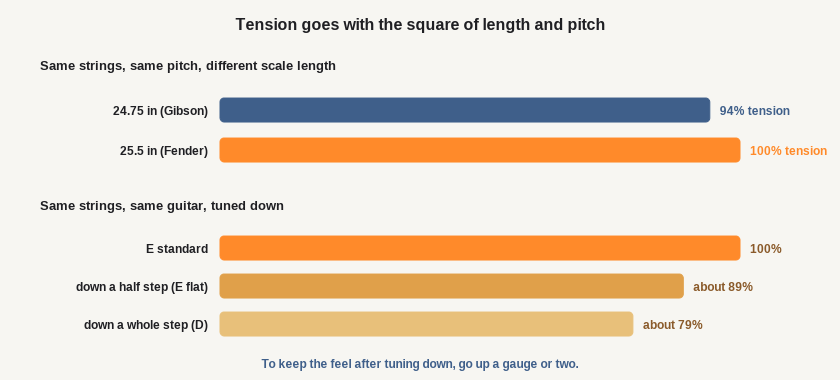
Tension goes up with the square of both pitch and scale length. That squaring is why small changes feel bigger than you'd expect. A set of 10s on a 25.5 in Fender-scale neck pulls roughly 100 lb in total; 9s pull noticeably less, 11s noticeably more.
Scale Length Changes the Feel
| Scale length | Typical guitars | Same set feels |
|---|---|---|
| 24 in and shorter | short-scale guitars (Mustang, Jaguar, many student guitars) | looser and easier to bend |
| 24.75 in | Gibson Les Paul, SG, ES-335 and ES-330 | about 6% less tension than 25.5 in |
| 25 in | PRS (most models) | in between |
| 25.5 in | Fender Stratocaster and Telecaster; most dreadnought acoustics are close, at about 25.4 in | firmer, brighter, more snap |
| 27 in and longer | baritones | needs a heavy set to hold low tunings |
That is why many players use 10s on a Gibson and 9s on a Fender to get a similar feel, or the reverse to get a similar tension.
Tuning Down
Dropping the pitch drops the tension, and the string gets floppy.
| Tuning change | Tension change, same strings |
|---|---|
| Down a half step (E flat) | about 11% less |
| Down a whole step (D standard) | about 21% less |
To keep the feel the same, go up in gauge: a step or two heavier for a whole-step drop. Many makers sell sets for exactly this, with a heavy low end for drop tunings.
Balanced-tension sets choose each string's gauge so that all six pull about the same, instead of following the traditional pattern. They feel more even across the neck, especially for bending.
Changing Gauge Means a Setup
A heavier or lighter set changes the pull on the neck, so the neck bends a little more or a little less. Expect to check:
- Neck relief (the truss rod).
- String height.
- Intonation: heavier strings usually need the saddles moved back.
- Nut slots: much heavier strings may bind or sit too high in slots cut for thinner ones.
- Tremolo springs, on guitars with a tremolo.
The On the Bench: Guitar Setup series covers each of these.
Try It
Find your guitar's scale length (the maker's page lists it) and your string set. If it's a 24.75 in guitar with 10s, a 25.5 in guitar with the same 10s will feel firmer. If you tune down a whole step, note how much the low E loosens: that's the 21%.
Level 3 is about where each kind of string shines: flatwounds for jazz, light sets for bends, heavy bottoms for low tunings, and strings for slide, fingerstyle and strumming.