Level 1 covered the basics every guitar shares: winding on the posts, stretching in, bridge pins and tie blocks. This level covers the fixed bridges on electric guitars, where the job is mostly about getting the ball end anchored in the right place.
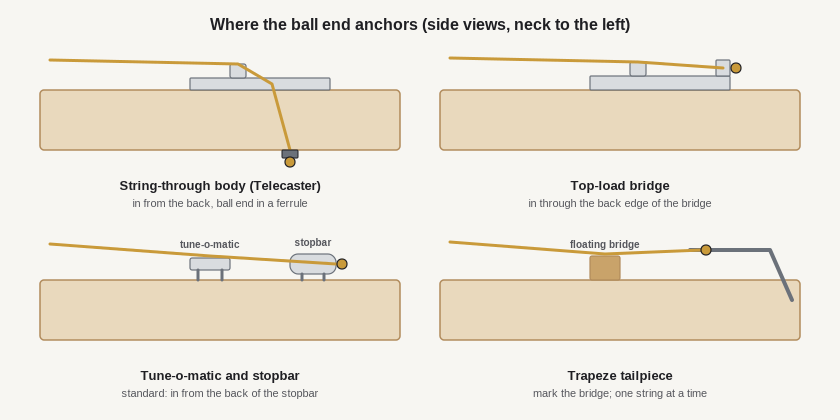
String-Through Body
Many hardtails, including the classic Telecaster, anchor the strings at the back of the body. Each string goes in from the back, through a steel ferrule, up through the body and the bridge plate, and over its saddle.
- Feed the string in from the back and pull it all the way through until the ball end seats in its ferrule. A ball end that sits on the edge of the ferrule instead of inside it will slip and lose tune.
- Guide the string over its own saddle and into its own nut slot before winding.
Top-Load Bridges
On a top-load bridge the strings go in through holes in the back edge of the bridge itself. It's quicker than string-through, and some players find the strings feel a little slinkier because the angle over the saddles is lower. Some Telecaster-style bridges accept both: through the body or top-loaded.
The Telecaster
The Telecaster is string-through, with a few things of its own:
- Three-saddle bridges carry two strings per saddle. The strings sit in grooves on the barrel; check each string is in its groove before tuning up.
- Saddles can shift when all the strings are off, because nothing but string pressure holds them in place. If you take all six off, note or photograph the saddle heights and positions first.
- The ferrules on the back can work loose over the years; push any that stand proud back in before restringing.
Setting the saddles after a gauge change is in On the Bench: Guitar Setup, Level 2A.
Tune-o-Matic and Stopbar
Les Paul, SG, ES-335 and ES-330 style guitars use a tune-o-matic bridge with a separate stopbar tailpiece.
- The standard way: the string goes into the stopbar from the back (the strap-button side), so the ball end rests against the back face, and the string comes out the front straight to the bridge. Some players top-wrap instead: in from the front, out the back, then back over the top of the stopbar to the bridge. Both work; top-wrapping lowers the angle over the bridge and feels a little slinkier.
- Change one at a time, or tape the bridge down. With all the strings off, the tune-o-matic and stopbar can lift off their posts, and the small saddles can fall out.
- The stopbar's height changes the string angle over the bridge. Lower gives more angle and more pressure; too low and the strings touch the back of the bridge.
Archtop and Trapeze Tailpieces
Many hollow-body jazz guitars and the ES-330 use a trapeze tailpiece and, on many archtops, a floating bridge held in place only by string pressure.
- Mark the bridge position first, with low-tack tape on each side of the bridge foot. Its position sets the intonation.
- Change one string at a time so the bridge never loses all its pressure.
- Hook each ball end into its slot on the trapeze and keep light tension on it as you bring it up to pitch, so it doesn't slip out.
Bigsby
A Bigsby vibrato anchors the strings on pins on a rolling bar, which makes it the fiddliest fixed tailpiece to restring.
- Hook the ball end over its pin on the bar.
- Bend the string just past the ball end, so it holds its shape and stays on the pin while you bring the slack to the tuner. Some players hold it with a small piece of tape or a folded card wedged under the bar.
- Keep a little tension on the string with one hand while winding with the other.
- Bring the string up to pitch, then remove anything holding it.
Change one string at a time, so the others keep the bar and the bridge in place.
Try It
Before your next change on a Telecaster or tune-o-matic guitar, take a photo of the bridge from the side. After restringing, compare: every saddle should be where it was, every string in its groove, and the bridge sitting square.
Level 3 covers tremolos: the vintage Stratocaster tremolo, the two-point tremolo, and blocking a bridge.