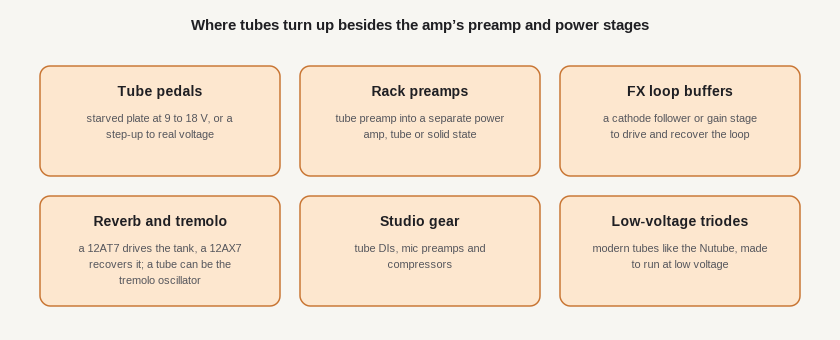
Tubes turn up in more places than the preamp and power stages of a guitar amp: pedals, rack preamps, effects loop buffers, reverb and tremolo circuits, studio gear and a new generation of low-voltage tubes. This level covers what each does, and how to tell a tube that is doing real work from one that is mostly for show.
Where Tubes Turn Up
Tube Pedals: Real Voltage or Starved Plate
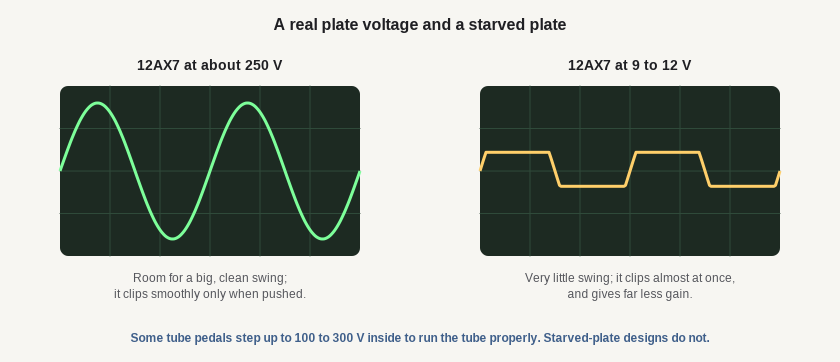
A 12AX7 is designed for a plate supply of around 250 V. A pedal runs on 9 V to 18 V. There are two ways to put a tube in a pedal:
- A step-up converter: a small circuit inside the pedal raises the supply to around 100 V to 300 V, so the tube runs much as it would in an amp. These pedals draw a lot more current from the supply (often several hundred milliamps), need a supply that can deliver it, and carry real high voltage inside.
- Starved plate: the tube runs on the pedal's own 9 V to 18 V. It can still amplify a little, and it clips very early, which gives a distortion of its own. Often the gain and much of the tone come from op-amps or transistors around it, with the tube adding character.
Neither is wrong; they just do different jobs. The pedal's power requirement is a good clue: a tube pedal that draws a few hundred milliamps or more at 12 V or 18 V is likely stepping up the voltage.
The tube's heater still needs its full current: about 150 mA at 12.6 V or 300 mA at 6.3 V for a 12AX7. That is why most tube pedals need a dedicated supply output rather than a daisy chain (see the Power series).
DANGER: LETHAL VOLTAGE. Pedals with a step-up converter can hold over 200 V inside. Treat them like an amp: unplug and let the caps drain before opening one, and don't build one without experience of high-voltage circuits.
Low-Voltage Tubes
Some modern tubes are built to run at low voltage from the start. The best known, the Nutube, is a dual triode made with vacuum fluorescent display technology. It runs from a few volts up to tens of volts and appears in amps and pedals that want tube behavior without high voltage. It is small, efficient and doesn't need a step-up supply, though it behaves differently from a 12AX7 and circuits are designed around it.
Rack Preamps and Power Amps
A tube preamp in a rack does the job of an amp's preamp section: gain stages, tone stack and often several channels. It feeds a separate power amp, which may be tube or solid state. Splitting them lets a player mix, say, a tube preamp's distortion with a clean, powerful solid-state power amp. A tube power amp does the reverse: it takes a line-level signal from a preamp or modeler and adds the power tubes' feel and output transformer.
Effects Loops and Buffers
An amp's effects loop needs a stage to send the signal out at a level pedals can handle, and another to bring it back up. In tube amps both are often tube stages: a cathode follower for the send and a gain stage for the return. Tube buffer pedals and loop boxes use a cathode follower for the same reason: a strong, low-impedance signal that can drive long cables and many pedals. The Buffered FX Loops series in Pedals covers loop design and tube buffers in depth.
Reverb and Tremolo
- Tube spring reverb: a tube (often a 12AT7, or the low-gain half of a 12DW7) drives a small transformer that drives the spring tank. A second triode, usually a 12AX7, recovers the very weak signal from the tank's output and mixes it back in.
- Tube tremolo: a triode wired as an oscillator makes a slow wave that varies the gain of a stage (bias vibrato), or flashes a lamp or LED onto a light-dependent resistor (optical tremolo). The famous blackface Fender "vibrato" is an optical tremolo.
Studio Gear
Tube microphones, mic preamps, compressors and direct boxes use the same triodes and circuits. A tube DI or mic preamp adds the same gradual saturation when driven, and many players use one to record bass or a guitar modeler.
Spotting a Tube That Is Really Working
| Clue | Likely real voltage | Likely starved or for show |
|---|---|---|
| Supply current | hundreds of mA, often a specific supply | a normal pedal draw, apart from the heater |
| Internal voltage | high-voltage warnings, a converter on the board | 9 V to 18 V throughout |
| Sound | changes with the tube; a different tube sounds different | the tube makes little difference |
| Glow | visible in both; a glow says nothing about the plate voltage |
Some designs light the tube from below with an LED for looks. A glow alone proves nothing: it is the heater, and only the plate voltage says whether the tube is working hard.
Try It
Look up the power requirements of any tube pedal you own or are considering: a current draw in the hundreds of milliamps points to a step-up supply. Then check your power supply's outputs can deliver it with the Power (W) Calculator.