A vacuum tube (a valve, in British English) is a glass bottle with the air pumped out and a few metal parts inside. Heat one part, put a small voltage on another, and it controls a much larger current. That is amplification, and for the first half of the twentieth century tubes were the only way to do it. Transistors replaced them almost everywhere, except in guitar amps, where the way tubes behave when pushed hard became the sound of electric guitar.
This series covers the tube as a component: what is inside, how it works in a circuit, the common types, and where tubes turn up besides the amp. For the history and the famous amps, see the Tube/Valve Guitar Amplifiers series in Amps.
DANGER: LETHAL VOLTAGE. Tube circuits run at high voltage: often 250 V to 500 V DC, and more in big amps. The filter capacitors can hold a lethal charge for minutes or days after the amp is unplugged. Never reach inside a tube amp unless you know how to drain it safely. The Cap Drain & Bleeder Calculator explains how long the charge lasts and how it is drained.
What's Inside
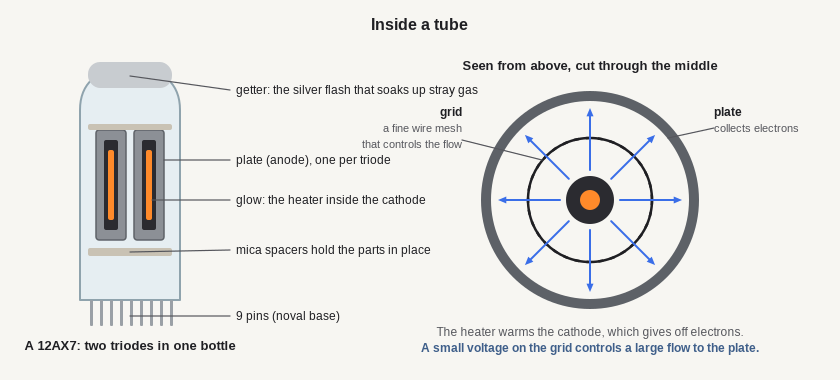
| Part | What it does |
|---|---|
| Heater (filament) | a fine wire that glows orange, like a dim light bulb. It heats the cathode. |
| Cathode | a small metal sleeve around the heater. When hot, it gives off electrons. |
| Grid | a fine wire mesh around the cathode. The voltage on it controls how many electrons get through. |
| Plate (anode) | the outer metal box. It sits at a high positive voltage and collects the electrons. |
| Getter | the silver or dark patch on the glass. It soaks up stray gas left inside. |
| Pins | connect each part to the socket. Small tubes have 9 pins; big ones have 8 on a plastic base. |
The orange glow you see is the heater, not the tube "working hard". The plate never glows in normal use; a power tube plate glowing red means it is overloaded (Level 3B covers this).
How It Amplifies
Electrons leave the hot cathode and fly to the positive plate. The grid sits in their path. Make the grid a little more negative and fewer electrons get through; make it a little less negative and more get through. A guitar signal of a fraction of a volt on the grid swings the plate current, and so the plate voltage, by tens of volts. The tube has turned a small signal into a big copy of it.
When the signal gets too big for the tube to follow, the peaks flatten. Tubes do this gradually, adding mostly smooth, musical harmonics. That gradual clipping is a large part of why tube amps sound the way they do when turned up.
The Four Kinds
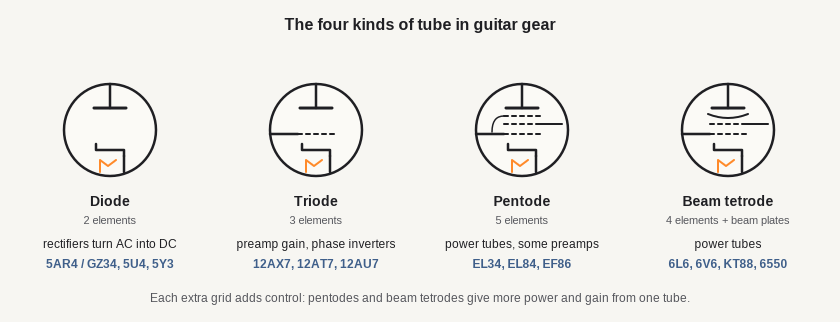
- Diode: a cathode and a plate. Current flows one way only, so it turns AC into DC. Used as a rectifier (5AR4/GZ34, 5U4, 5Y3).
- Triode: adds a grid. The workhorse of preamps (12AX7, 12AT7, 12AU7). Most small tubes hold two triodes in one bottle.
- Pentode: adds two more grids that make it more efficient and powerful. Power tubes like the EL34 and EL84, and a few preamp tubes like the EF86.
- Beam tetrode: like a pentode, but uses shaped plates instead of the fifth grid. Power tubes like the 6L6, 6V6, KT88 and 6550. In practice they are treated much like pentodes.
Preamp, Power and Rectifier Tubes
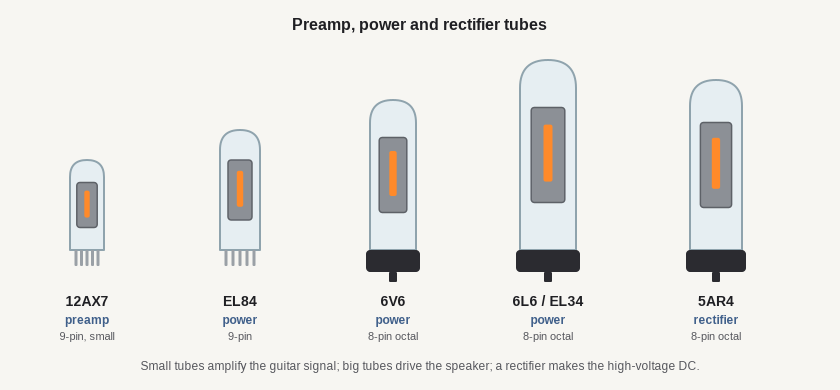
| Job | What it does | Common types | How many in an amp |
|---|---|---|---|
| Preamp | amplifies the weak guitar signal, adds gain and distortion, drives the tone controls | 12AX7, 12AT7, 12AU7 | two to five |
| Phase inverter | splits the signal to drive a pair of power tubes | 12AX7, 12AT7 | one |
| Power | drives the output transformer and speaker | EL84, 6V6, 6L6, EL34, KT88 | one, two, four or six |
| Rectifier | turns the power transformer's AC into high-voltage DC | 5AR4, 5U4, 5Y3 | none or one (many amps use silicon diodes instead) |
The tubes are usually labeled V1, V2 and so on, from the input onward. V1 is the first preamp tube the guitar sees.
Why Tubes Wear Out
The cathode slowly loses its ability to give off electrons, so a tube gradually loses gain and power. Power tubes work hardest and wear fastest: a gigging amp may want new ones every year or two. Preamp tubes can last many years. A tube can also fail suddenly: a short, a broken heater, or a noisy or microphonic tube that rings when you tap the amp.
Where Tubes Are Found
- Guitar and bass amps: preamp, phase inverter, power, sometimes a rectifier, reverb and tremolo.
- Rack preamps and power amps for guitar and bass.
- Pedals: some run a real tube; Level 3C explains the difference between real high-voltage designs and "starved plate" ones.
- Effects loops and buffers: a tube buffer can drive an amp's effects loop (see the Buffered FX Loops series in Pedals).
- Studio gear: microphones, mic preamps, compressors and DIs.
Try It
Open the Tube Bias Calculator. Its simulated power tubes glow brighter as you turn the bias pots, and their plates turn red past 100%: the overload this article warns about, safely on screen.
Level 2 covers how tubes work in circuits: the gain stage, the cathode follower, the phase inverter, output stages and bias.