This level is the reference for the small tubes: the 12AX7 and its relatives, the pinout they share, the numbers that matter, how to swap them to change an amp's gain, and how to choose, test and buy them.
The 12AX7 Family
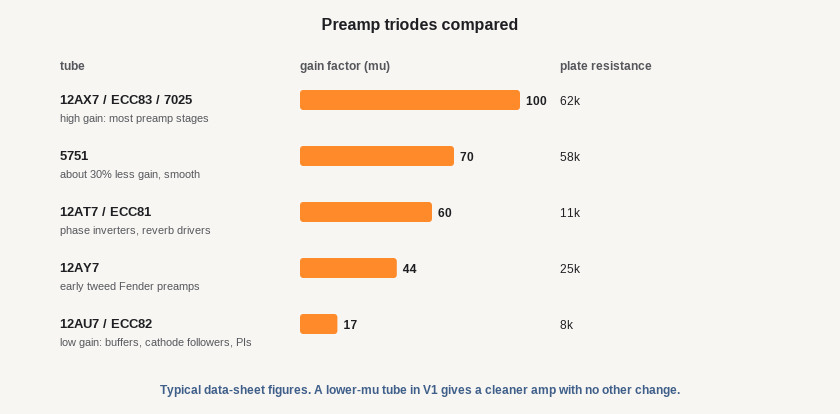
| Tube | Also sold as | Gain factor (mu) | Plate resistance | Typical uses |
|---|---|---|---|---|
| 12AX7 | ECC83, 7025 | 100 | 62k | most preamp stages; phase inverters |
| 5751 | 70 | 58k | a lower-gain 12AX7 substitute | |
| 12AT7 | ECC81 | 60 | 11k | phase inverters, reverb drivers, effects loops |
| 12AY7 | 6072 | 44 | 25k | V1 in tweed Fender Deluxes; a mild-gain substitute |
| 12AU7 | ECC82 | 17 | 8k | low gain: buffers, cathode followers, some phase inverters |
| 12DW7 | ECC832 | 100 and 17 | one 12AX7 triode and one 12AU7 triode in one bottle; some reverb and phase inverter circuits | |
| EF86 | 6267 | pentode | a high-gain single-stage preamp in early Vox AC15s and some boutique amps; prone to microphonics |
Gain factor (mu) is the most a triode can multiply a signal. Real stages get less: a 12AX7 with typical values gains about 35 to 60 (see Level 2).
Plate resistance is how stiff the tube's output is. A low-resistance tube like the 12AT7 can drive a heavier load, which is why it drives reverb tanks and phase inverters.
The Pinout
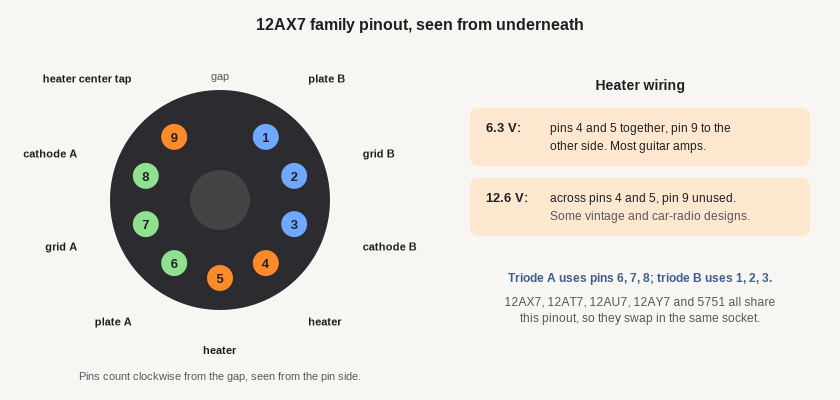
All the 12A?7 tubes share one 9-pin (noval) pinout. Each holds two triodes, A (pins 6, 7, 8) and B (pins 1, 2, 3). The heater is split in two: wired in parallel for 6.3 V (pins 4 and 5 joined, pin 9 to the other side) or in series for 12.6 V (across 4 and 5). Almost every guitar amp uses 6.3 V. A 12AX7 draws about 300 mA of heater current at 6.3 V.
Swapping Tubes to Change the Gain
Because they share a pinout and heater, the family members swap freely in the same socket. It is the cheapest tone change there is:
- V1 to a 5751 or 12AY7: a little less gain and a little more clean headroom, with the same voicing.
- V1 to a 12AT7: noticeably cleaner. A 12AU7 cleaner still, and darker.
- Phase inverter: most amps were designed around a 12AX7 or a 12AT7; swapping changes how hard the power tubes are driven and how the amp breaks up. Try it by ear, and go back if it gets thin or harsh.
- Reverb driver: keep the type the amp was designed for (often a 12AT7). It drives a transformer, and a higher-resistance tube will barely drive the tank.
Swapping preamp tubes doesn't need a bias adjustment: preamp stages bias themselves. A low-gain tube in a stage designed around a 12AX7 can sound thin, so treat swaps as experiments.
What to Listen and Look For
| Problem | Symptom | Check |
|---|---|---|
| Microphonics | the amp rings, squeals or "pings" when you tap the tube or the chassis | tap each tube gently with a chopstick while the amp idles; the one that rings is it |
| Noise or hiss | hiss or crackle, worst in V1 because everything after it amplifies it | swap V1 with another tube and listen |
| Low gain | the amp sounds weak or clean where it used to break up | swap in a known-good tube |
| Heater out | no glow, no sound from that stage | look for the glow; check the heater with a meter, power off |
V1 matters most: it sees the weakest signal, so its noise and microphonics are amplified most. Put your quietest tube there. A tube that is too noisy for V1 may be fine as a phase inverter.
Buying Preamp Tubes
- Current production tubes come from a few factories in Russia, Slovakia and China, sold under many brand names. Brands often select and test tubes from these factories.
- New old stock (NOS) is unused vintage stock. Some is excellent; prices are high and fakes and used tubes sold as new exist.
- Graded tubes are tested for gain, noise or microphonics. A tube graded for low noise is worth having for V1.
- Matching is rarely needed for preamp tubes, except sometimes in a phase inverter.
Life and Testing
Preamp tubes work gently and often last many years. They fade slowly rather than failing outright, so an amp can lose sparkle without anyone noticing. Keep one known-good 12AX7 as a reference and swap it in one position at a time. A tube tester measures gain and checks for shorts, but your ears are the final test for noise and microphonics.
Try It
With the amp idling and the volume at a normal level, tap each preamp tube gently with a pencil eraser or chopstick and listen. A faint tick is normal; a ring that sustains or feeds back means a microphonic tube.
Level 3B covers power tubes and rectifiers.