This level is the reference for the big tubes: the common power tubes and how they compare, the pinout they share, what can safely swap for what, biasing and matching, and rectifier tubes and sag.
DANGER: LETHAL VOLTAGE. Power tube sockets carry the full B+, often 400 V to 500 V, and the plate pins are live whenever the amp is on or the caps are charged. Change power tubes only with the amp unplugged and the tubes cool. Biasing is done with the amp on, at lethal voltage: if you are not trained for it, have a technician do it. Never run a tube amp without a speaker load, which can destroy the output transformer (see the Output Transformers series).
The Common Power Tubes
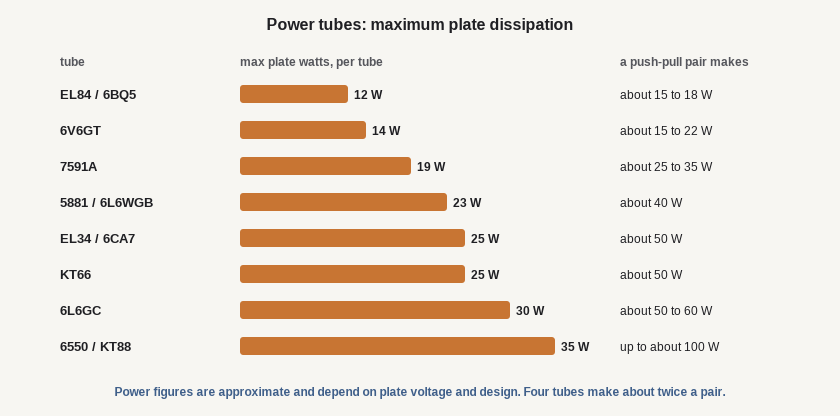
| Tube | Max plate dissipation | Base | Heater current (6.3 V) | Character, and where |
|---|---|---|---|---|
| EL84 (6BQ5) | 12 W | 9-pin | about 0.76 A | chimey, early breakup: Vox AC15 and AC30, many small amps |
| 6V6GT | 14 W | octal | about 0.45 A | sweet, compressed: Fender Deluxe, Princeton, Champ |
| 6L6GC | 30 W | octal | about 0.9 A | clean, deep, big headroom: Fender Twin and Bassman, Mesa |
| 5881 (6L6WGB) | 23 W | octal | about 0.9 A | a lower-rated 6L6 type; bias for its own rating |
| EL34 (6CA7) | 25 W | octal | about 1.5 A | aggressive midrange crunch: Marshall, Hiwatt, Orange |
| KT66 | 25 W | octal | about 1.3 A | warm, smooth: early Marshall JTM45 |
| 6550 | 35 W | octal | about 1.6 A | huge, clean, firm lows: Ampeg SVT and other bass amps |
| KT88 | 35 W | octal | about 1.6 A | like the 6550: high-power and hi-fi amps |
Maximum plate dissipation is the most heat the plate can safely handle. It sets how much power the tube can make: the bigger the rating, the bigger the amp.
The Octal Pinout
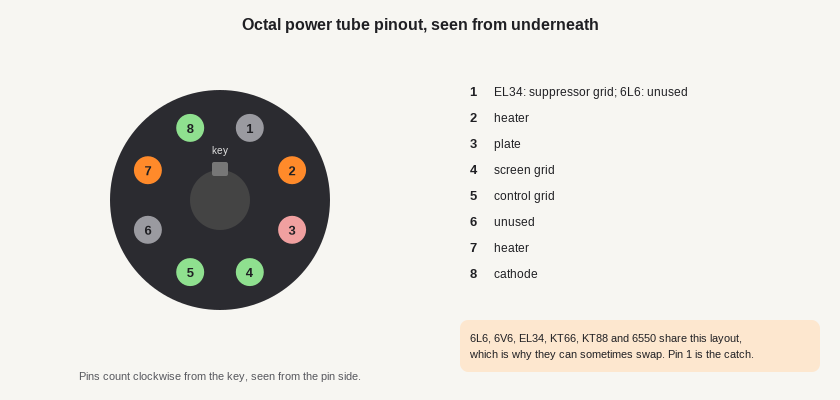
The octal power tubes share one layout: heater on 2 and 7, plate on 3, screen grid on 4, control grid on 5 and cathode on 8. The difference is pin 1: unused on a 6L6 or 6V6, but the suppressor grid on an EL34, which must be connected to the cathode. Some amps tie pin 1 to pin 8 so either type works; others use pin 1 as a tie point for other parts, which an EL34 would then connect to.
The screen grid sits between the control grid and the plate. It needs its own supply and usually its own resistor (about 470 Ω to 1.5k) to protect the tube.
What Can Swap for What
Fitting a different power tube type is a real change, not a tube roll. Check these first:
| Check | Why |
|---|---|
| Pin 1 | an EL34 needs pin 1 tied to the cathode; a 6L6 ignores it |
| Heater current | an EL34 draws about 1.5 A against a 6L6's 0.9 A: four of them add over 2 A to the power transformer's heater winding (see the Power Transformers series) |
| Plate dissipation | a 6V6 in a 6L6 amp, or a 5881 in a 6L6GC amp, can be overloaded by the higher voltage and bias |
| Bias | every type needs rebiasing for its own rating |
Many amps can take more than one type, and some have a switch for it. If the maker doesn't say a swap is safe, ask a technician. Plug-in adapters that convert an EL84 socket to take a 6V6, or that fit an EL84 into an octal socket, exist; they change the bias and loading and need the same care.
Biasing and Matching
- Matched sets: in push-pull, the tubes on each side of the output transformer should draw the same current, so a set is tested and sold matched. A mismatched pair hums more and can saturate the output transformer.
- When to rebias: a fixed-bias amp needs checking whenever power tubes are changed, even for the same type, because each set draws slightly differently. Cathode-biased amps only need a matched set.
- The target: 60% to 70% of maximum plate dissipation is the usual range for class AB. The Tube Bias Calculator works out the target current from the tube type and plate voltage, and the Power (W) Calculator checks the watts from a voltage and current.
Signs a Power Tube Is Failing
| Symptom | Likely cause |
|---|---|
| Plate glowing red at idle | bias too hot, or a failing tube drawing too much current. Turn the amp off. |
| Blue or purple flashes inside, or a pop and a blown fuse | the tube is arcing or shorted |
| A steady blue glow on the glass | usually harmless fluorescence; a glow filling the inside of the tube means gas: replace it |
| Lost volume or a thin, fizzy sound | worn tubes |
| Hum that gets worse over time | a worn or mismatched tube, or a failing filter cap |
Rectifier Tubes
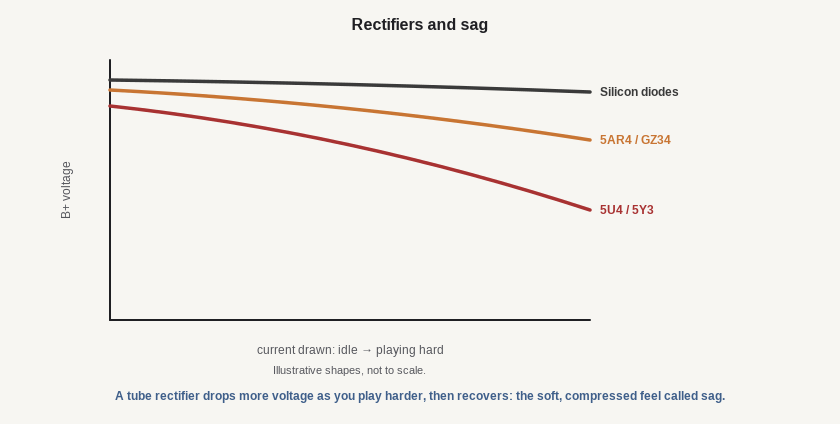
A rectifier turns the power transformer's high AC into DC. Silicon diodes drop about a volt and hold firm. A tube rectifier drops much more, and drops further as the amp draws more current, then recovers: the soft, compressed feel called sag.
| Rectifier | Voltage drop | Heater (5 V winding) | Feel |
|---|---|---|---|
| 5AR4 / GZ34 | small, about 15 V to 20 V | about 1.9 A | firm, a little sag; slow warm-up protects the filter caps |
| 5U4 | large, about 40 V to 60 V | about 3 A | lots of sag; used in big tweed and blackface amps |
| 5Y3 | large | about 2 A | the most sag, for small amps |
| Silicon diodes | about 1 V | none | tight, punchy, highest voltage |
Swapping rectifier types in the same socket changes the B+, and so the bias, the headroom and the feel. Check that the power transformer's 5 V winding can supply the heater current, and recheck the bias afterwards.
Life
Power tubes work hard. A gigging amp played loud may want new power tubes every year or two; an amp played at home lasts longer. Replace them as a matched set, and keep the old set as a spare: a worn set that still works will get you through a gig.
Try It
In the Tube Bias Calculator, set four EL34s at 460 V with one pot for all four and a test point on each tube. Switch Tubes to Unmatched and press Swap in new tubes: each tube reads differently on the same pot, which is why power tubes are bought as matched sets. Then set Load on the output to Nothing connected and read the warning.