Level 3A covered the classic ultra-linear amps. This level is about design possibilities rather than products: what a builder can do with the connection today, with modern tubes, a switch or two, and some care with feedback.
DANGER: LETHAL VOLTAGE. Everything in this article happens at B+, often 450 V to over 600 V. Mode switches and feedback changes are builder's work inside a live chassis. Drain the filter caps before touching anything, never work on a powered amp, and if you are not trained for it, have a technician do it.
A Pentode / Ultra-Linear / Triode Switch
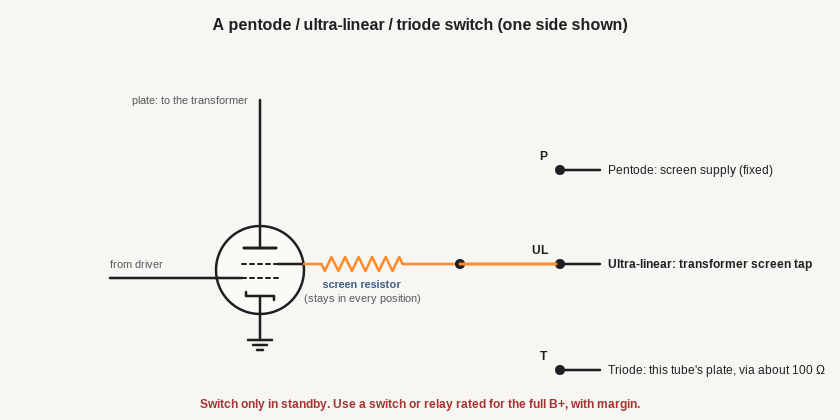
One switch per side of the push-pull pair can give all three connections from Level 1:
| Position | Screen connects to | Result |
|---|---|---|
| Pentode | the screen supply (B+ or a dropped screen node) | full power, most gain, most grind |
| Ultra-linear | the screen tap on that side of the transformer | most of the power, far less distortion, tighter low end |
| Triode | that tube's own plate, through a small resistor (about 100 Ω) | about half power, lowest distortion, softest feel |
Rules for doing it safely:
- Switch only in standby, or with the amp off. Switching under power makes the screens jump between voltages and can arc the switch.
- Use a switch rated for the full B+, with real margin. Many builders use a relay with high-voltage contacts, driven from a low-voltage switch on the panel, so the high voltage never reaches the front panel.
- Keep the screen resistor in every position, between the switch and the socket.
- Rebias after switching if the idle current shifts; check it with the Tube Bias Calculator.
- The tube's screen rating applies in ultra-linear and triode, since both put the screen at about the plate voltage.
A Guitar-Friendly Tap
The classic 43% hi-fi tap is very clean and very controlled. For a guitar amp, a lighter tap of about 20% to 30% of the turns keeps more of the pentode's power and bite while still tightening the low end and taking the edge off the breakup. It is the natural choice for a modern clean-platform guitar head, and a transformer maker can wind it to order.
The Big Modern Tubes
The KT120 and KT150 are built for high plate and screen voltages, the same service the KT88 was famous for. In a new ultra-linear design they offer more power per tube and more margin on the screens. Check heater current and the room inside the chassis: both are larger than a KT88's. The KT90, KT120 and KT150 series covers them in detail.
How far a pair can go: a pair of KT88s wired ultra-linear can make about 100 W with a high plate supply. That is the territory of the big 1950s and 1960s amps, from two bottles.
The 6146: A Great Tube Little Used in Audio
The 6146 was designed as a radio transmitter tube, and it makes a strong, clean audio output tube. Acrosound published a 100 W ultra-linear design built around 6146s.
Its best-known appearance in music is the first Ampeg SVT bass head (1969 to 1970), which used six 6146Bs before Ampeg changed to 6550s in mid-1970. The SVT fed its screens from a fixed supply, so it isn't an ultra-linear example, but it shows the tube can make serious power.
Things to know before building with it:
- The plate connects to a cap on top of the tube. That top cap sits at full B+. It must be covered and out of reach.
- Plate dissipation is about 35 W for the 6146B. A cool, safe starting point for idle bias is about 20 mA per tube; work out the real target from the plate voltage and the tube's rating with the Tube Bias Calculator.
- It is a fast, high-gain tube, so grid and screen stoppers at the socket and a careful layout matter. The first SVTs had a reputation for 6146 failures, often blamed on the driver circuit rather than the tube itself.
Less Feedback, Made Adjustable
Most amps use overall negative feedback: a little of the speaker signal is sent back to the phase inverter to lower distortion and tighten the sound. Ultra-linear already has local feedback inside the tubes, so it needs less overall feedback than a pentode amp, and many players find a big clean amp sounds more open with less.
The simplest way to let the player choose is a feedback control:
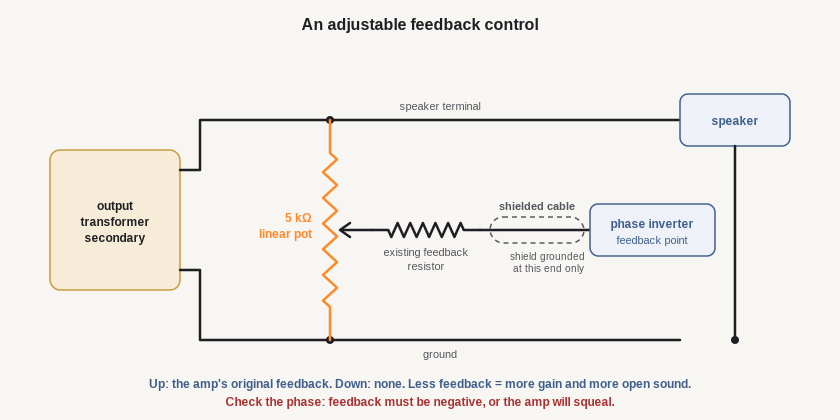
- A linear-taper pot across the speaker output, from the speaker terminal to ground, with its wiper feeding the amp's existing feedback resistor. Turned fully up, the amp has its original feedback; turned fully down, none. About 5 kΩ is a good value: low enough to keep the feedback path quiet, and it only takes about 0.2 W at 100 W into 8 Ω.
- Run the feedback line in shielded cable, from the speaker terminal to the phase inverter. This is not optional. The feedback line carries the full output signal past the sensitive front of the amp, and an unshielded run can couple into the input and make the amp unstable. Ground the shield at one end only, at the phase inverter end.
- Less feedback means more gain, so the amp gets louder and brighter as the control is turned down. That is part of the effect.
A pot is simple, cheap and easy, and for most builds it is the best choice.
The switched alternative. If you want fixed settings with the same overall gain in each, use a double-pole switch: one pole selects the feedback level, the other switches a resistor divider at the amp's input to cut the gain by the same amount, much like the high and low-gain inputs on many Fender amps. Use a shorting (make-before-break) switch, so the feedback circuit is never left open for an instant between positions. Expect to experiment with the divider values to get the levels to match.
Check the phase. Feedback only works if it is negative. If an output transformer is replaced or its secondary leads are swapped, the feedback can become positive and the amp will squeal or motorboat at turn-on. If that happens, switch off at once and reverse the secondary leads (or the feedback connection).
Clean Pedal-Platform Amps
A modern ultra-linear head with a guitar-friendly tap, KT88-class tubes and adjustable feedback makes an ideal pedal platform: a loud, clean, flat amp that lets drive and modulation pedals sound like themselves at stage volume. The preamp stays simple, a master volume is optional, and the power amp's job is to stay clean.
Rebuilding the Big Heads
The Marshall Major and the original Sunn Model T are both worth bringing back, and both are the natural starting points for a rebuild:
- Restore the ultra-linear connection on amps that were converted to pentode, if the output transformer's taps are still there.
- Add a mode switch for pentode grind when wanted.
- Fit a feedback control, as above.
- Use KT88 or KT120 tubes rated for the screen voltage, and rebias for them.
- Check the screen resistors and add stoppers at the sockets. Big ultra-linear heads run their screens at full voltage, and the series on screen and grid stability covers how to keep them reliable.
Try It
Find the feedback resistor in your amp's schematic: it runs from a speaker output tap back to the phase inverter. Note which tap it comes from and its value. That is the point a feedback control would go, and the Power (W) Calculator shows how much power a pot across that tap would take at your amp's rated output.