Levels 1 and 2 covered what ultra-linear is and how it works in an amp. This level is about the jobs it does best, the reasons why, the jobs it is wrong for, and the classic amps that used it.
Where It Shines
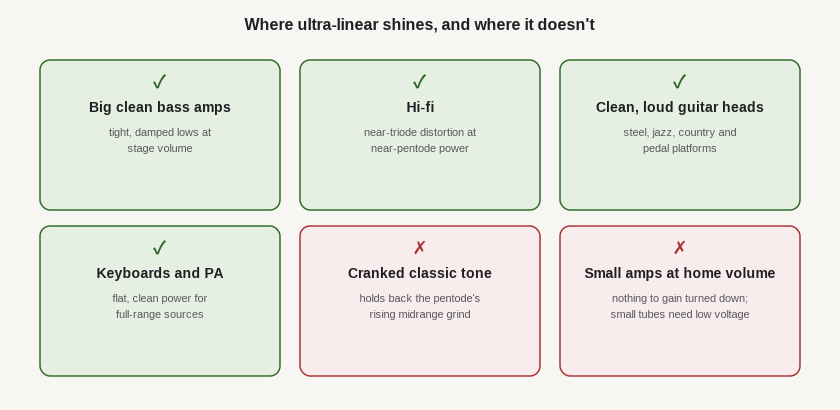
Big Clean Bass Amps
The job: a lot of clean, solid low end at stage volume.
Why it shines: low notes ask the most of a power stage, and a loose stage lets the speaker cone flap and the bass go woolly. Ultra-linear's lower output impedance damps the speaker, so bass notes start and stop where they should. Its low distortion keeps a big bass tone clear, and with KT88-class tubes it still makes big power.
Hi-Fi
The job: tens of watts at very low distortion into loudspeakers, not guitar speakers.
Why it shines: this is what the connection was revived for in 1951. It gets close to triode distortion at close to pentode power, and that combination made the ultra-linear kit amp the standard hi-fi power amp of the 1950s and 1960s.
Clean, Loud Guitar Heads
The job: a guitar amp that stays clean at very high volume, with a tight low end, for players who take their dirt from pedals or not at all.
Why it shines: the same headroom and control that suit bass suit a big clean guitar tone: steel guitar, clean jazz and country, and loud clean chords on big stages. Ultra-linear with KT88s gives a lot of clean watts from a quad, and the bottom end stays firm.
Keyboards and PA
The job: amplifying a full-range source (organ, electric piano, vocals) cleanly and loudly.
Why it shines: these sources need a flat, clean amplifier, not a guitar amp's colored breakup. Several big ultra-linear heads were sold in PA versions for exactly this.
Where It Doesn't
- Cranked classic guitar tone. When the power tubes are meant to make the distortion, the pentode's early, rising midrange grind is the sound. Ultra-linear holds that back and then breaks up abruptly. Players chasing a cranked British crunch are better served by a pentode amp.
- Small amps at home volume. Its strengths are headroom and control at power. In a small amp turned down, there is little to gain, and the tubes small amps use (6V6, EL84) only take it at low voltage anyway.
- Pushed hard as a distortion box. Driving a big ultra-linear head into heavy clipping with a boost pedal works the screens and grids very hard. These amps are clean platforms first.
The Classic Amps
| Amp | Years | Tubes | Power | Notes |
|---|---|---|---|---|
| Dynaco Mark III | from 1957 | 2 KT88 or 6550 | 60 W mono | the KT88 ultra-linear amp that set the pattern for hi-fi |
| Dynaco Stereo 70 | from 1959 | 4 EL34 | about 35 W per channel | one of the best-selling tube amps ever made, as a kit and built |
| Marshall Major | 1967 to 1974 | 4 KT88 | 200 W | the best-known ultra-linear guitar amp; lead, bass and PA versions |
| Sunn Model T (original) | late 1960s to 1970s | 4 KT88-family | 150 W rated | big clean American head, ultra-linear output transformer |
The Marshall Major
The Major was Marshall's answer to the demand for more clean power than a 100 W head could give. Its output stage is four KT88s wired ultra-linear, with large screen resistors bolted to the chassis and screen-tap leads coming off the output transformer. It is loud, deep and clean to a very high level, and it is famously hard on tubes when cranked into distortion. Some have since been converted to pentode with the taps disconnected, so a used Major is worth checking before you assume what you have. The On the Bench article for Marshall covers checking and biasing one.
The Sunn Model T, and the One That Isn't
The original Sunn Model T, from the late 1960s and 1970s, runs four KT88-family power tubes into an ultra-linear output transformer. It is rated at 150 W, and in practice makes about 120 W to 130 W at the point of clipping. Its reputation is for huge, clean, solid power.
The Sunn Model T reissue made in the 1990s under Fender ownership shares the name and little else. It uses 6L6s in ordinary pentode connection, has two channels with a high-gain channel, is built on one large circuit board, and makes about 105 W to 115 W clean. It is a loud, conventional amp, not an ultra-linear one. When a Model T comes up for sale, check which one it is.
Try It
If you have an ultra-linear amp or its schematic, find the output transformer's screen-tap leads and follow each to its screen resistor and socket. Check that each screen is on the tap from its own side of the primary. Then look up the screen voltage rating of the tubes fitted against the amp's B+, using the table in Level 2.
Level 3B looks forward: what a modern ultra-linear amp could be, from mode switches and guitar-friendly taps to adjustable feedback and the big new power tubes.