Level 1 covered the three ways to wire a screen and why the ultra-linear tap works. This level is about the real amp: the output transformer that makes it possible, the screen voltage the tubes have to survive, what the rest of the amp has to provide, how it behaves pushed hard, and how the idea got here.
DANGER: LETHAL VOLTAGE. In an ultra-linear amp the screens run at nearly the full plate voltage, often 450 V to well over 600 V in big amps. The screen taps on the output transformer carry that voltage too. Never work inside a powered amp, drain the filter caps before touching anything (see the Cap Drain & Bleeder Calculator), and never run the amp without a speaker or dummy load.
The Transformer Makes It
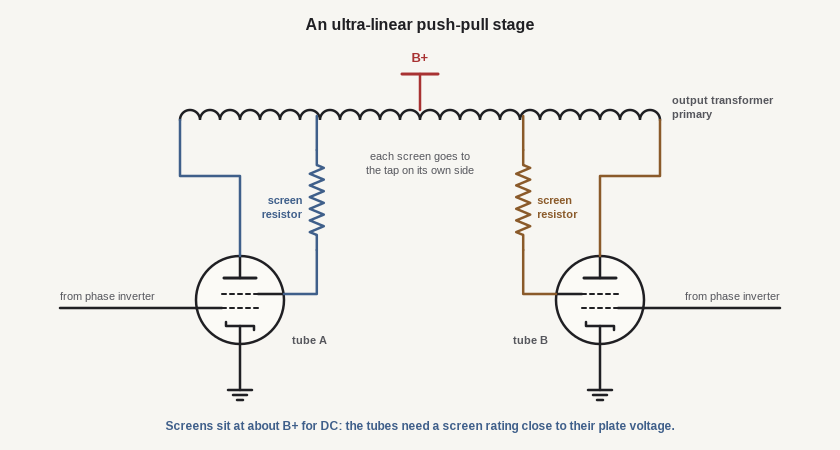
An ultra-linear amp needs an output transformer wound with screen taps: two extra leads, one on each half of the primary, placed at the chosen percentage of the turns. A transformer without them can't be made ultra-linear. The taps are part of the winding, not something added afterward.
The wiring rules:
- Each screen goes to the tap on its own side. The screen of the tube whose plate is on the blue end goes to the blue-side tap, and the same for the brown side (lead colors vary by maker; follow the transformer's data). Cross them and the screens get the opposite tube's signal, which turns the local feedback positive: the stage can oscillate and destroy tubes in seconds.
- Each screen has its own screen resistor, usually 100 Ω to 1 kΩ, often 5 W in big amps, mounted at or near the socket. It limits screen current and helps keep the stage from oscillating.
- B+ comes in at the center tap, as in any push-pull amp.
Since both screen taps sit on the primary, they are at nearly B+ for DC. There is no separate, lower screen supply as there is in many pentode guitar amps. That is the price of the connection.
Screen Voltage Limits by Tube
The screen is the most fragile part of a power tube. In ultra-linear, it has to live at about the plate voltage, so the tube's screen voltage rating decides how much B+ the amp can use.
| Tube | Screen voltage rating (about) | Suits ultra-linear? |
|---|---|---|
| KT88 | 600 V | yes: the classic choice for big ultra-linear amps |
| KT120 / KT150 | 600 V and up | yes: modern tubes built for high voltage |
| 6550 | 400 V to 450 V, depending on the version | yes, at moderate B+ |
| 6L6GC | 450 V | yes, at moderate B+ |
| EL34 | 425 V | yes, at moderate B+: the tube in many classic hi-fi amps |
| 6V6GT | 315 V | only in small, low-voltage designs |
| EL84 | 300 V | only in small, low-voltage designs |
These are typical makers' ratings; versions and makers differ, so check the data for the exact tube in your amp. The pattern is what matters: the KT88 was built with a screen that can take nearly its plate voltage, which is why it is the natural tube for big ultra-linear amps. An EL34 or 6L6GC makes a fine ultra-linear amp at 400 V to 450 V of B+, but past that, its screen is the first thing to fail.
The 6550 deserves a note. It is the American cousin of the KT88 and often swaps with it, but many versions carry a lower screen rating. In an amp running its screens at 550 V or more, a KT88 is the safer tube.
What It Needs from the Rest of the Amp
| Need | Why |
|---|---|
| Tubes rated for the screen voltage | see the table above; this sets the safe B+ |
| A stiff B+ supply | the screens draw their current through the primary, from the same supply as the plates; a supply that sags under load lets the screens sag with it |
| A driver with enough swing | ultra-linear has less gain than pentode, so the phase inverter has to deliver a bigger signal to reach full power |
| The right bias range | fixed bias as usual, set from the plate voltage with the Tube Bias Calculator; KT88-class tubes need a more negative bias than an EL34 or 6L6 |
| Good layout | short screen and grid leads, resistors at the sockets, and the screen tap leads kept away from the input. Big, high-gain power tubes oscillate easily when the layout is careless |
How It Sounds Pushed Hard
Up to near full power, an ultra-linear stage stays clean, tight and quiet. Then it runs into the same limits as any push-pull stage: the plates run out of room to swing, the grids start drawing current, and the output clips.
The difference from a pentode amp is in the approach. A pentode amp starts to grind early and keeps getting dirtier as it goes. An ultra-linear amp holds on, then breaks up more suddenly and more harshly. Because its screens swing down with the plates, they are spared some of the current surges that punish a pentode stage at clipping, but at full voltage and full drive the screens and grids still work very hard.
That is the background to the reputation of big ultra-linear guitar heads like the Marshall Major: wonderful as a loud, clean platform, hard on tubes when cranked and fed a boost pedal for distortion. The amp was built for clean power, and a series on screen and grid stability covers what happens to the tubes when it's pushed past that.
History
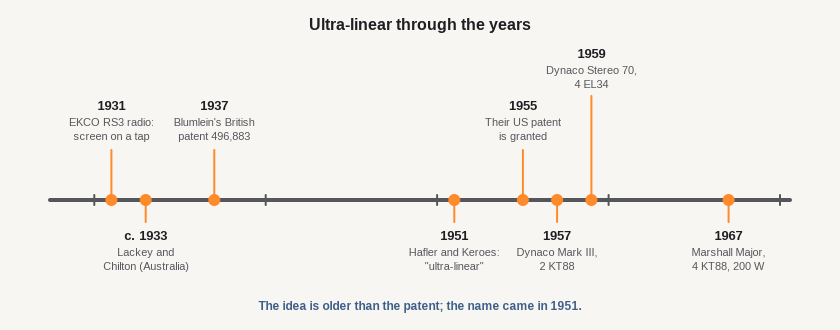
Before the patent. Feeding a pentode's screen from a tap on its own output transformer is older than its famous name. EKCO's RS3 radio receiver, made in Britain in 1931, used a pentode output tube with its screen fed from a tap on the transformer primary, and the circuit was published in Wireless World that August. In Australia, R. Lackey and R. R. Chilton are credited with the same idea around 1933. Who designed the EKCO circuit isn't documented.
The patent. Alan Blumlein, the British engineer also known for stereo recording, filed British patent 496,883 in June 1937. It describes feeding the screens from a point on the transformer carrying between 25% and 50% of the plate signal. Blumlein died in 1942, and the idea stayed in the background through the war.
The revival and the name. In November 1951, David Hafler and Herbert Keroes published their "ultra-linear" amplifier in Audio Engineering, choosing the tap for the lowest distortion. Their company, Acrosound, sold output transformers wound with the taps, and their US patent was granted in 1955. The name stuck.
The boom. Hafler went on to found Dynaco, whose kits put ultra-linear amps into homes everywhere: the Mark III mono amp (1957) with a pair of KT88s or 6550s, and the Stereo 70 (1959) with four EL34s. In Britain, Mullard's 5-20 design did the same for the EL34, and GEC's KT88, introduced in 1956, became the favorite tube for big ultra-linear amps.
Into guitar amps. The best-known guitar amp to use it is the Marshall Major (1967 to 1974), with four KT88s wired ultra-linear for 200 W of clean power. Level 3A covers it and the other amps where the connection shines.
Try It
In the Tube Bias Calculator, set four KT88s at 600 V and note the target current. Now picture the same 600 V on the screens of four EL34s: well past their rating. That is the whole case for the KT88 in big ultra-linear amps.
Further Reading
- OESTEX: Ultra-Linear History and Design, a detailed history of the ultra-linear connection and its tap ratios.
Level 3A covers where ultra-linear shines and where it doesn't, with the classic amps that used it.