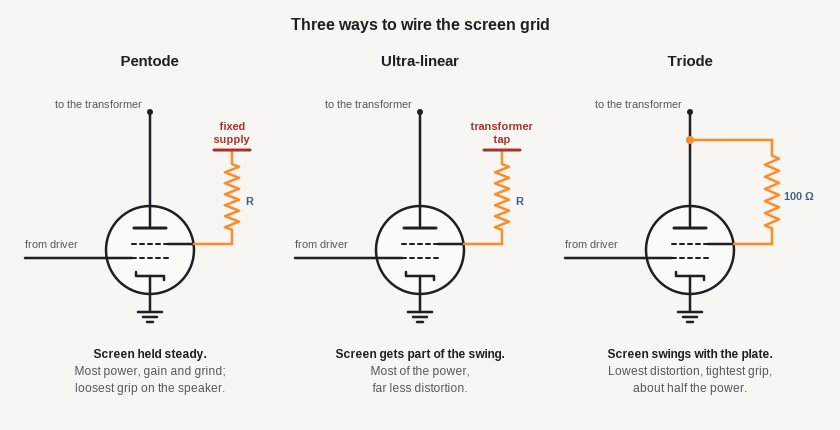
A push-pull power tube with a screen grid can be wired three ways. The plate always goes to the output transformer. What changes is where the screen grid gets its voltage, and that one connection changes the power, the distortion and the feel of the whole amp. Ultra-linear is the connection in the middle, and this series is about why it exists, how it works, and where it earns its place.
Three Ways to Wire the Screen
| Connection | Where the screen goes | What you get |
|---|---|---|
| Pentode (or beam tetrode) | a fixed, steady supply voltage, through a screen resistor | the most power and gain, the most distortion, and a high output impedance that lets the speaker ring and bloom |
| Ultra-linear | a tap partway along the output transformer primary, through a screen resistor | most of the pentode's power with much lower distortion and a tighter grip on the speaker |
| Triode | the tube's own plate, through a small resistor | the lowest distortion and the lowest output impedance, but only about half the power |
Pentode is what most guitar amps use. Triode is what many hi-fi purists prefer. Ultra-linear sits between them, and for big clean amps it often gives the best of both.
Why the Tap Works
In pentode wiring the screen sits at a steady voltage. The plate swings up and down with the music, but the screen doesn't move, so the tube behaves like a current pump: high gain, high power, and not much control over the speaker.
In triode wiring the screen swings exactly with the plate. When the plate voltage falls, so does the screen's, and that pulls the tube's current back. The tube corrects itself on every cycle. That self-correction is a form of local negative feedback inside the tube, and it is why triodes measure so clean.
Ultra-linear gives the screen part of the plate's swing. The output transformer primary is one long winding from one plate, through the center tap (where B+ comes in), to the other plate. A tap partway between the center and each plate carries a fraction of that plate's signal. Feed the screen from there and the tube gets some of the triode's self-correction while keeping most of the pentode's drive.
Both ends of the primary sit at about B+ as far as DC is concerned, so the screen in an ultra-linear stage runs at nearly the full plate voltage. That one fact shapes everything in Level 2: the tube has to be rated for it.
The Classic Taps
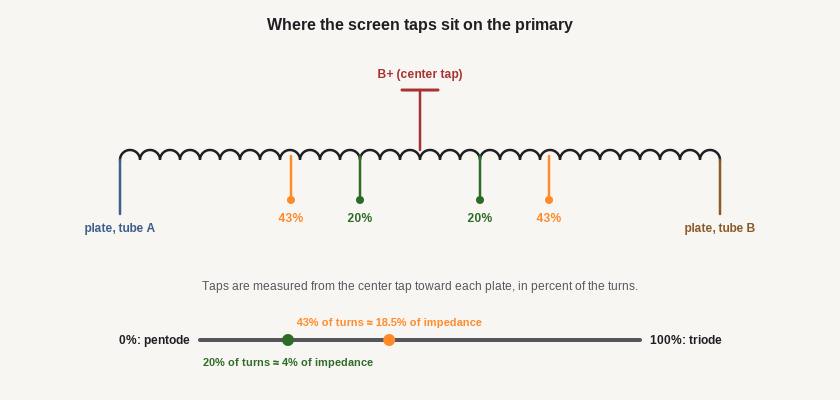
Taps are measured from the center tap toward the plate, as a percentage of the turns.
| Tap | Character | Typical use |
|---|---|---|
| About 43% of the turns | the classic hi-fi tap: low distortion, a good share of the power | 6L6, EL34, KT66, KT88 and 6550 hi-fi amps, and big clean amps |
| About 20% of the turns | lighter: more pentode-like, more power, less correction | smaller tubes, early designs, and guitar amps that want some bite |
The same tap is sometimes quoted as a percentage of impedance instead, which gives a much smaller number. Impedance goes with the square of the turns, so a 43% turns tap is about 18.5% of the impedance, and a 20% turns tap is about 4%. When a transformer maker quotes a screen tap, check which one they mean.
Move the tap toward 0% and the stage becomes a pentode. Move it all the way to 100% and it becomes a triode. Every tap in between is a blend.
How Much Power
As a rough rule for the same tubes at the same plate voltage:
- Pentode: full power.
- Ultra-linear: about 75% to 100% of the pentode's power, depending on the tap and the design.
- Triode: about half.
Ultra-linear's intermodulation distortion is far lower than pentode's and, at a well-chosen tap, close to triode's. That is the kind of distortion that muddies a chord: notes mixing into frequencies that were never played. Getting near-triode cleanliness at near-pentode power is the whole point of the connection.
How It Sounds
Ultra-linear amps are known for clean, firm, controlled power. The low end is tight, because the lower output impedance damps the speaker. The top is smooth. Pushed hard, they stay clean longer and then break up more abruptly than a pentode amp, with less of the rising midrange grind that classic rock players chase from a cranked pentode head.
That is why the connection is so common in hi-fi and bass amps, and so rare in the guitar amps most players know. The best-known guitar example is the 200 W Marshall Major, with four KT88s wired ultra-linear.
Try It
Open the Tube Bias Calculator and set a pair of KT88s at 480 V. In an ultra-linear amp, that 480 V is on the screens too. Then look up the screen voltage rating for an EL34 and a 6L6GC in your tube data: Level 2 shows why some tubes take this connection easily and others don't.
Level 2 covers how ultra-linear works in a real amp: the transformer, the screen voltage limits by tube, what it needs from the rest of the amp, how it sounds pushed hard, and its history.