A 100 W tube amp into 4 ohms pushes 5 A through its speaker cable. The jack at the end of that cable is a 1/4 inch part, and the most common ones are published at 1 A or 5 A. Stages have run on them for decades. This level explains why that works, and exactly where it stops working.
The Numbers That Do Not Add Up
The standard Switchcraft 11 is published at 1 A and 25 V, with a contact resistance of 0.03 ohm. Switchcraft does not rate it for speaker power, and that 1 A figure is a signal rating. The Cliff S2 plastic jack seen on many cabs is published at 5 A maximum, with a nominal contact resistance under 50 milliohm, a nylon body and 10,000 or more operations. Its 2,000 V DC figure is a withstand test, not a working voltage.
Now put real amps against those ratings. Voltage is the square root of power times load, current is the square root of power divided by load, and peaks run about 1.4 times higher.
| Amp power | Load | Voltage (RMS) | Current (RMS) | Peak current |
|---|---|---|---|---|
| 50 W | 8 ohm | 20 V | 2.5 A | 3.5 A |
| 100 W | 4 ohm | 20 V | 5 A | 7.1 A |
| 150 W | 8 ohm | 35 V | 4.3 A | 6.1 A |
| 150 W | 4 ohm | 24 V | 6.1 A | 8.7 A |
| 200 W | 8 ohm | 40 V | 5 A | 7.1 A |
| 200 W | 4 ohm | 28 V | 7.1 A | 10 A |
A 150 W head such as the Dumble Steel String Singer, or a 200 W head such as the Marshall Major, sits in the lower half of this table at 8 ohms and in the upper half at 4 ohms. A 1 A jack is past its rating in every row, and a 5 A jack is at or past its rating in the 4 ohm rows.
Why It Works: Heat Is the Real Limit
A jack does not fail because a number on a data sheet is crossed. It fails when heat builds up at the contact. That heat is current squared times the contact resistance, and for a good jack the resistance is tiny.
| Amp power | Load | Current | Heat at 0.03 ohm (new) | Heat at 0.3 ohm (worn) |
|---|---|---|---|---|
| 50 W | 8 ohm | 2.5 A | 0.2 W | 1.9 W |
| 100 W | 4 ohm | 5 A | 0.75 W | 7.5 W |
| 150 W | 8 ohm | 4.3 A | 0.6 W | 5.6 W |
| 150 W | 4 ohm | 6.1 A | 1.1 W | 11 W |
| 200 W | 8 ohm | 5 A | 0.75 W | 7.5 W |
| 200 W | 4 ohm | 7.1 A | 1.5 W | 15 W |
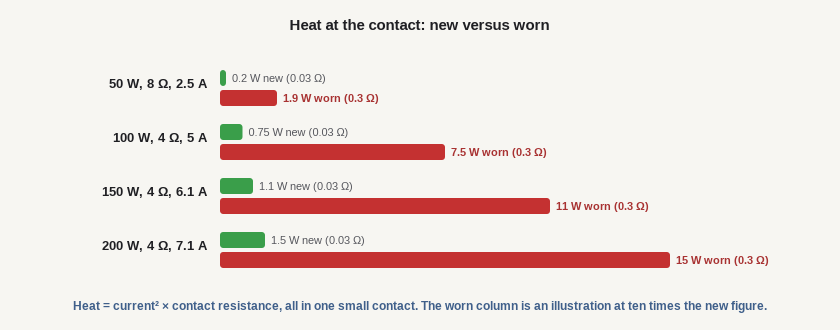
The 0.03 ohm column uses the published figure for a new Switchcraft 11. The 0.3 ohm column is an illustration at ten times that, because no maker publishes a worn-jack figure. The voltage dropped across a new contact at 5 A is 0.15 V, against 20 V at the speaker, so the loss is negligible.
That is the whole paradox. The rating is conservative, and a jack in good condition runs cool at speaker currents. The same jack worn loose runs ten times hotter, and the heat is not spread out, it is concentrated in one small contact. Using these jacks for speaker power is long-standing practice, not a specification.
Why a Plain Jack Helps on a Cab
A cab's input and extension jacks are usually plain open-circuit jacks (see Level 2). A plain jack has no extra switch contact, so there is one point of contact that carries the current, and nothing else that has to open and close under load. A switching jack adds a second contact that can build resistance. That is one more reason the amp's shorting jack is the exception, and why only one jack per output should carry a switch.
Where It Breaks
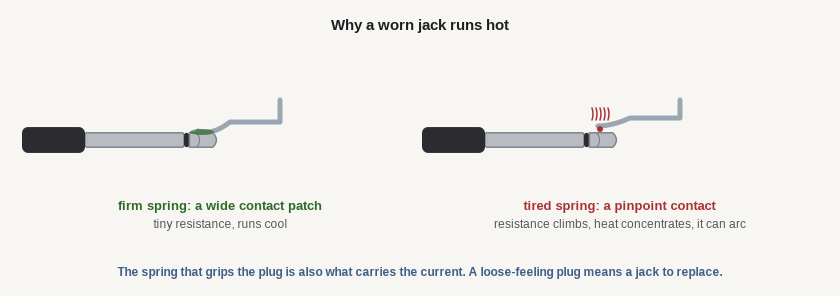
- A worn spring. The spring that grips the plug is also what carries the current. When it loses tension the contact resistance climbs, the heat in the table rises, and the contact can start to arc.
- A loose or half-seated plug. The contact area drops and the connection flickers, which is the "load that flickers" from Level 1.
- A cold solder joint. It behaves like a worn spring, but it sits behind the jack where you cannot see it.
- A thin cable. An instrument cable carries far thinner wire than the jack does, so it heats before the jack does. Use proper speaker cable.
- No load at the amp. If a jack opens completely while a tube amp is playing, the output transformer has no load. This is the failure that matters most.
What to Do About It
- Treat the jack as a wear item. If a plug feels loose, the jack's contact has lost tension, so replace the jack.
- Check the grip, not the rating. A firm click and a plug that resists pulling are better signs than any number.
- Match the part to the load. A 1 A Switchcraft 11 is past its published rating in every row above, and a 5 A Cliff is at or past it at 4 ohms. Step up to a high-current 1/4 inch jack such as the Switchcraft Z15J (15 A) or to Speakon (30 A per contact) for heavy use.
- Keep the amp closed. A Marshall Major puts about 700 V DC on its output tube plates. Swapping a jack on an unplugged cab is a small job. Opening a tube amp is a technician's job.
- Do not assume what was original. Jacks in older amps and cabs have often been replaced over the years, so the part in front of you may not be what the amp shipped with.
Level 3 has the part numbers and the replacement checklist.