This level covers questions 1 and 4 from Level 1: the family and the build. It puts numbers on what each jack can carry and lists the parts by name.
Power Through the Jack
For a speaker output, voltage is the square root of power times impedance, and current is the square root of power divided by impedance. These are continuous RMS values. Peaks run about 1.4 times higher.
| Amp power | Load | Voltage (RMS) | Current (RMS) | Peak voltage |
|---|---|---|---|---|
| 50 W | 8 ohm | 20 V | 2.5 A | 28 V |
| 100 W | 16 ohm | 40 V | 2.5 A | 57 V |
| 100 W | 8 ohm | 28 V | 3.5 A | 40 V |
| 100 W | 4 ohm | 20 V | 5 A | 28 V |
| 200 W | 8 ohm | 40 V | 5 A | 57 V |
Published Ratings
| Connector | Current | Voltage | Notes |
|---|---|---|---|
| Switchcraft 11, standard 1/4 inch jack | 1 A | 25 V | contact resistance 0.03 ohm, 10,000 cycles |
| Speakon NL2MP chassis | 30 A RMS per contact | 250 V AC | contact resistance 3 milliohm or less |
| XLR, Neutrik 3 pin | 16 A per contact | below 50 V | latch lock, over 1,000 matings |
| Cliff S2, 1/4 inch jack, nylon body | 5 A maximum | working voltage not published (2,000 V DC withstand test) | contact resistance under 50 milliohm, 10,000 or more operations |
| Switchcraft Z15J, high-power 1/4 inch speaker jack | 15 A continuous | not published* | 10,000 cycles with a proper plug |
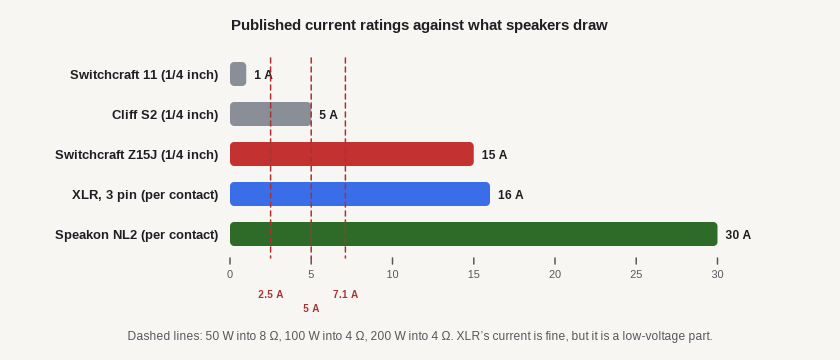
*Note: Switchcraft publishes a current rating for the Z15J but no voltage rating, and we found none from any distributor. The speaker levels in the table above peak at 57 V or less, and this jack is sold for speaker use, but that is not a rated figure. If voltage matters to your build, ask Switchcraft.
The standard 1/4 inch jack's published rating is a signal rating. A 100 W amp pushes more than that through a speaker jack, so the contact's condition and the plug's grip decide how well it holds up. That is why a worn 1/4 inch speaker jack is a replacement item, and why high-power rigs favor Speakon. The XLR's current rating is fine, but its voltage rating is a low-voltage rating, and a 200 W amp into 8 ohms swings about 57 V at the peaks.
High-Current 1/4 Inch Speaker Jacks
Between the standard jack and Speakon there is a middle option: a 1/4 inch jack built for speaker current. The Switchcraft Z15J is the usual example.
- Rating. 15 A continuous, with a 30 degree C heat rise at 15 A. That is three times the 5 A a 200 W amp pushes into 8 ohms. Switchcraft publishes no voltage rating for it.
- Build. A two-conductor jack with a glass-reinforced housing (UL 94V-0), a positive detent that holds the plug, and solder lugs that take wire up to 10 AWG. The housing is red to mark the high rating. Life is 10,000 cycles with a proper plug.
- Plugs. The listing names the Switchcraft 70, 184 and 187 series. The jack's rating depends on the plug, so use a solid plug and good speaker cable with it.
- Switching. The listing does not mention any. Treat it as a plain jack and check the part before you use it where a shorting jack is expected.
- Availability. One distributor lists it as no longer available, so confirm stock before you plan a build around it.
- Where it fits. A cab input or extension jack. It keeps the 1/4 inch cable and plug you already own, and it does not change anything on the amp.
Speakon is still the stronger upgrade for high-power rigs, because it locks, is finger-safe and is rated at 30 A per contact. The Z15J is the smaller step when you want to keep 1/4 inch cables.
Switchcraft Part Numbers
| Model | Conductors | Build | Switching |
|---|---|---|---|
| 11 | mono | open frame | open circuit, no switch |
| 12A | mono | open frame | shunt tip |
| 12B | stereo | open frame | open circuit |
| 13 | mono | open frame | isolated make |
| 13B | stereo | open frame | shunt tip |
| 13E | mono | open frame | isolated break |
| 112AX | mono | enclosed | shunt tip |
| 112BX | stereo | enclosed | see the listing |
| 152B | stereo | long thread | see the listing |
| 157 | stereo | acoustic guitar end pin | see the listing |
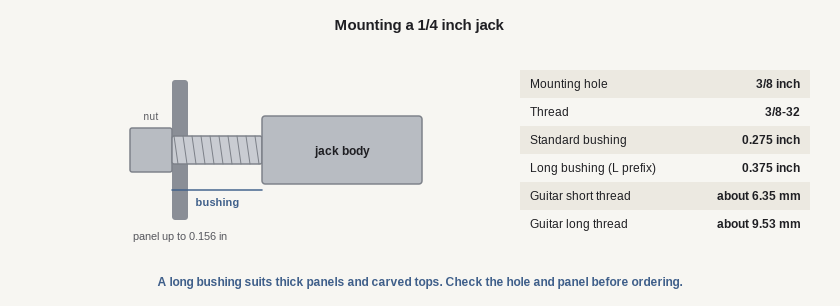
The Switchcraft 11 mounts in a 3/8 inch hole with a 3/8-32 thread. The standard bushing is 0.275 inch and the long version (L11) is 0.375 inch. It suits panels up to 0.156 inch thick. The contacts are copper alloy, nickel-plated with fine silver. Many models have a long-bushing version, written with an L prefix such as L12A.
Cliff Jacks
Cliff makes switched and non-switched 1/4 inch jacks in several bodies. S2 and S4 are series names, so the listing's words (switched, non-switched, metal or plastic nut) are what actually decide the part.
| Cliff listing | Switching | Build |
|---|---|---|
| S2, plastic nut | switched | mono, in gold and white as well |
| S4, metal nut | switched or non-switched | solder lug or PC mount, straight or L-leg |
| Solder lug, non-switched | none | plastic or metal nut |
| Sealed | switched | enclosed |
| For Marshall | switched | metal nut, PC mount or solder lug |
| Stereo | see the listing | PC mount, six pins, L-leg |
Switchcraft and Cliff are not pin-for-pin interchangeable. Check the lug layout and the body size, not only the mono or stereo label.
Speakon in Detail
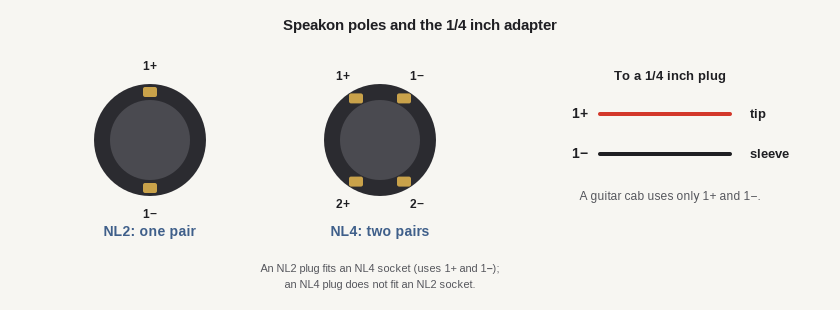
- Poles. NL2 has two (1+ and 1-), NL4 has four (1+, 1-, 2+, 2-) and NL8 has eight. A guitar cab needs only one pair.
- Fit. An NL2 plug fits an NL4 socket and uses 1+ and 1-. An NL4 plug does not fit an NL2 socket.
- Polarity. The plus contact is in phase and the minus contact is return. With a 1/4 inch adapter, 1+ goes to the tip and 1- goes to the sleeve.
- Locking. The plug twists or latches, and contact is made only once it is fully locked.
- Safety. The design is finger-safe (IP2X).
- Cable. Screw terminals take wire from 1.5 to 4 square millimeters (about AWG 12). Thicker wire is soldered.
- Panel. The chassis part uses a D-shaped cutout, which is larger than a 1/4 inch jack hole. A combo jack puts a Speakon and a 1/4 inch jack in one panel opening.
XLR in Detail
A 3 pin XLR has brass contacts plated with gold over nickel, a latch lock, and a rating of 16 A per contact below 50 V. It is excellent for balanced microphone and line signals. It is not a speaker connector, and an amp's XLR output is a DI or line feed.
Replacing a Jack Safely
- Match the mount. Hole size, thread, bushing length and panel thickness.
- Match the switching. A shorting jack replaced with an open-circuit jack changes what the amp sees when no plug is in.
- Copy the wiring. Keep the shunt lug and the switch lug where the original had them.
- Keep one shorting jack per output. See Level 2.
- Check the joint. A cold solder joint on a speaker jack is the same hazard as a loose plug.
- Re-check the match. The tap must match the cab or step up, never step down.