This level answers questions 2 and 3 from Level 1: how many conductors a jack has, and what its switch does. It also covers where each type is used on a guitar, an amp and a cab harness.
Mono (TS) and Stereo (TRS)
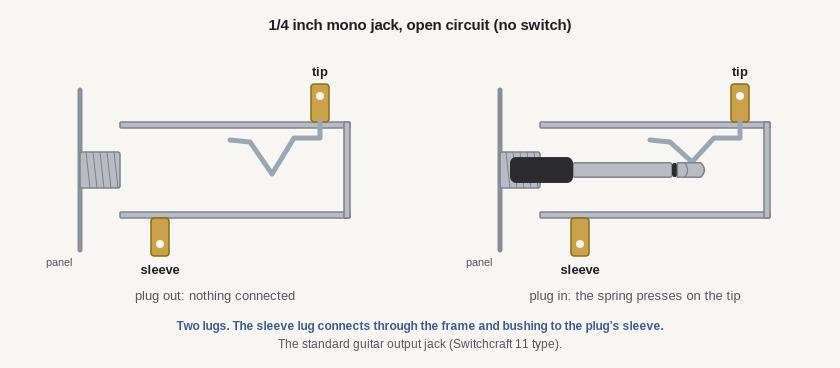
A mono jack has two connections: the tip carries the signal and the sleeve is ground or return. A stereo jack adds a third connection, the ring.
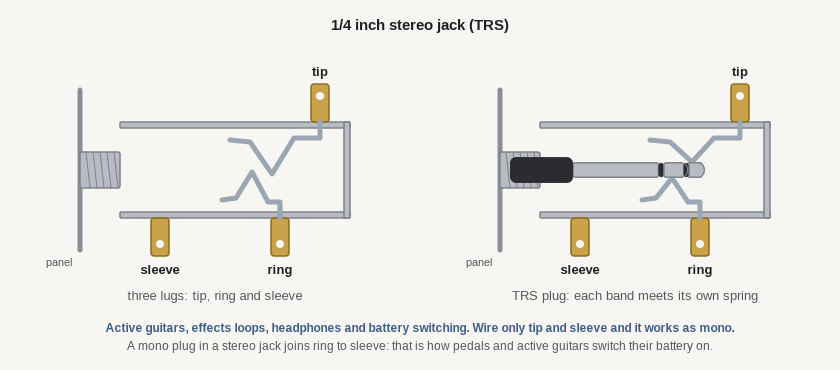
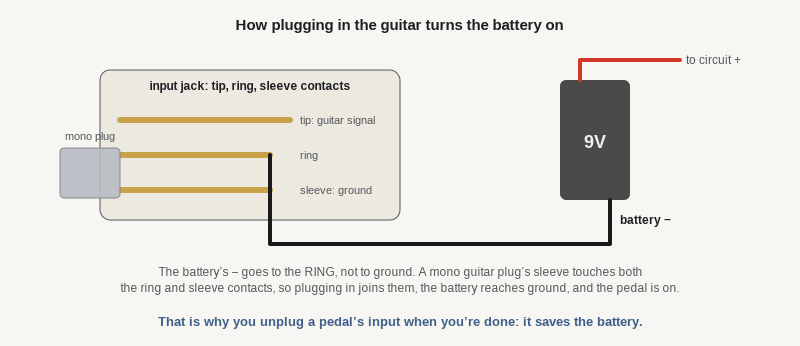
- Active guitars and basses use a stereo jack so the plug can switch the battery. The mono plug's sleeve touches the extra contact and turns the electronics on, and unplugging turns them off.
- Stereo output guitars use the ring for a second signal. The Stereo Output Guitars series covers how those are wired.
- Effects loops and headphone outputs use stereo jacks for send and return or left and right.
- A stereo jack can serve as a mono jack. Wire only the tip and sleeve lugs and ignore the ring.
- Speaker connections are two-conductor. The jack on a speaker output is mono.
The Switching Types
Switching is an extra set of contacts inside the jack that move when a plug goes in. This is where the word "shunt" comes from, and it is the part of a listing most often misread.
| Type | Plug out | Plug in | Typical use | Examples |
|---|---|---|---|---|
| Open circuit (no switch) | nothing is connected through the jack | the plug makes the connection | guitar outputs, simple jacks | Switchcraft 11 (mono), 12B (stereo) |
| Closed circuit (normally closed contact) | the contact passes or shorts the signal | the contact opens | speaker disconnect, shorting outputs | Cliff switched jacks, Fender amp jacks from 1999 |
| Shunt tip | an extra lug touches the tip contact | the extra lug releases | grounding an input when nothing is plugged in | Switchcraft 12A (mono), 13B (stereo), 112AX (mono, enclosed) |
| Isolated make | a separate contact is open | the separate contact closes | turn on a circuit, light an LED | Switchcraft 13 |
| Isolated break | a separate contact is closed | the separate contact opens | mute or switch off something when plugged | Switchcraft 13E |
| Double open (stereo) | both circuits open, no switching | both make | the stereo version of open circuit | Lumberg, Pure Tone |
How the shunt works. A shunt tip jack has an extra lug that touches the tip contact when the jack is empty. Wire that lug to the sleeve (ground) and the input is grounded whenever nothing is plugged in. That keeps an open amp input from picking up hum. When a plug goes in, the contact opens and the signal passes.
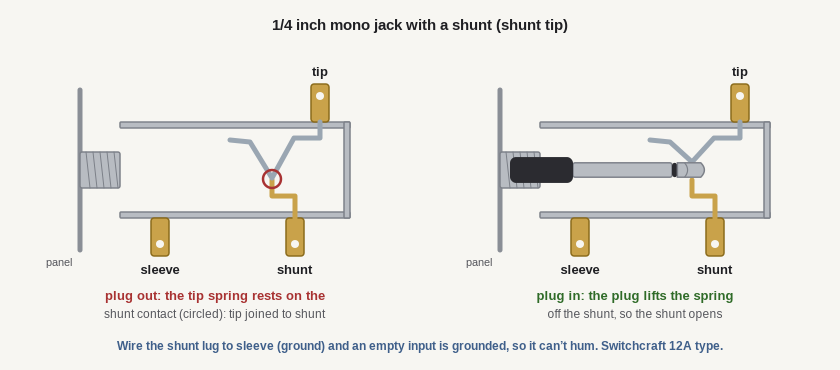
A shunt trap. When two shunt jacks feed one channel, such as the two inputs on a classic Fender, the empty jack still grounds the signal. That is why those circuits use resistors, and why you cannot just add a second shunt jack to a single input.
Reading a Listing
A listing is the four questions from Level 1 in a single line. Two examples:
- 1/4 inch Jack - Switchcraft 12A, Mono, open frame, shunt tip. Family 1/4 inch, maker and model Switchcraft 12A, mono, open frame build, shunt tip switching.
- 1/4 inch Jack - Cliff S2, Gold, switched, plastic nut, Mono. Maker and series Cliff S2, gold plating, switched, plastic nut, mono.
If a listing leaves the switching out, check the picture and the lug count before you order. Three lugs on a mono jack usually mean a switch of some kind.
Amp Speaker Outputs: Shorting Jacks
Many tube amps use a switched 1/4 inch jack on the speaker output so the transformer's secondary is shorted when no plug is in the jack. Plug a speaker cable in and the switch opens, so the speaker is driven.
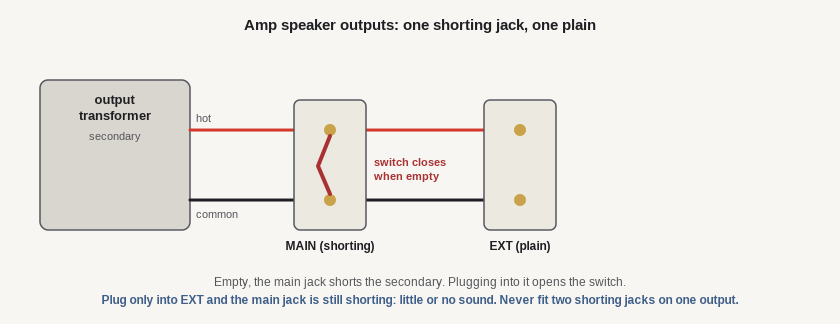
- Only one jack may short. If two output jacks are in parallel and both short, plugging into one still leaves the other shorting the output. One jack carries the switch. The other is plain tip and sleeve.
- Order matters on older Fenders. The main speaker jack shorts when empty, and the extension jack is plain. Plug only the extension jack and the main jack is still shorting, so you get little or no sound.
- This is a tube-amp practice. Most tube amp designers treat a shorted secondary as the lesser risk, because an open secondary lets the primary voltage climb. Neither is something to run while playing. Do not short a solid-state amp's output.
Guitar Output Jacks
The guitar's jack is the same family of part, built for a lower-stress job.
- Mono, open circuit is the standard passive guitar jack, such as the Switchcraft 11.
- Stereo is used for active electronics or stereo output, such as the Switchcraft 12B.
- Thread length matters more than anything else on a guitar. A short thread (6.35 mm) fits thin plates and control cavities, and the common choice for Telecaster and Stratocaster style bodies. A long thread (9.53 mm) is for thick tops and recessed jacks. The mounting hole is 3/8 inch for both.
- Enclosed and open frame versions exist. The enclosed version keeps dust and moisture off the contacts.
Pedal Jacks
Pedals use the same jack families, built for a small enclosure.
- Mono input and output jacks are usually enclosed or PC-mount types. Boss-style enclosed jacks are a common replacement, and Cliff, Neutrik and other PC-mount jacks come in switched and non-switched versions.
- A stereo input jack on a battery pedal works as a power switch. A mono cable's sleeve closes the battery circuit when it goes in, and unplugging it turns the pedal off. This is the same idea as the active guitar jack above.
 - Stereo pedals use TRS jacks for stereo or send and return signals, such as the six-pin PC-mount stereo jacks sold for effects pedals.
- Check the pin layout before swapping. PC-mount jacks come in straight and L-leg versions, and the lug positions are not standard from maker to maker.
Harness and Extension Jacks
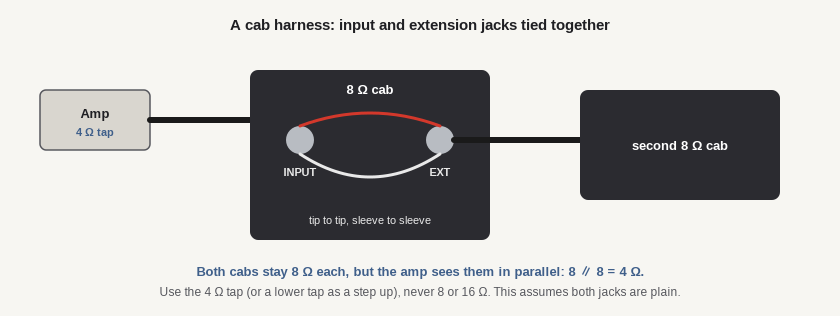
A speaker harness with an input jack and an extension (EXT) jack ties the two jacks together, tip to tip and sleeve to sleeve, so they share one node. Each cab on the harness stays at its own impedance, but the amp sees them in parallel: an 8 ohm cab plus a second 8 ohm cab on the extension jack gives 4 ohms at the amp. Use the 4 ohm tap, or a lower tap as a safe step up, and never an 8 or 16 ohm tap. This assumes both jacks are plain. If a jack is switched, the answer changes, so check the jack type before you rely on it. The Cab Builder in the Tools tab models this directly.