A female jack is the socket built into a chassis: the one on the back of an amp, the side of a cab, the face of a guitar. Every signal in a rig passes through several of them, and the speaker jack matters most. It carries real power, and when it fails it can hurt the output transformer.
Three Families, Many Makers
Switchcraft and Cliff are makers of 1/4 inch jacks, not types of jack. The real sorting starts with the family.
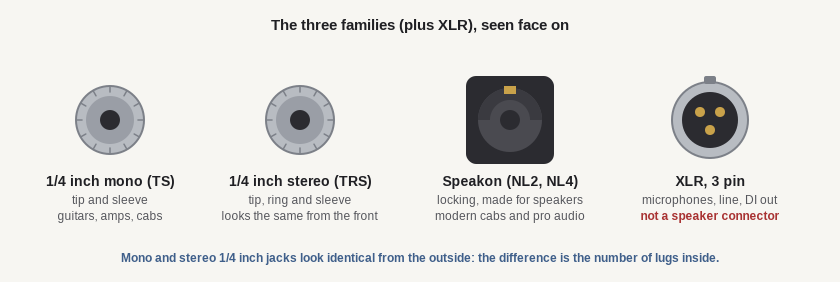
| Family | Contacts | Usual home | Makers you will see |
|---|---|---|---|
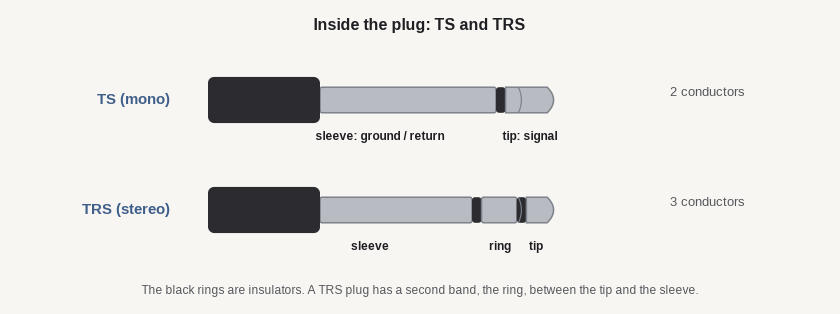
| 1/4 inch phone jack, mono (TS) | tip and sleeve | guitar outputs, amp inputs, amp speaker outputs, cab inputs | Switchcraft, Cliff, Neutrik, Lumberg, plus Fender and Boss style parts |
| 1/4 inch phone jack, stereo (TRS) | tip, ring and sleeve | active guitars, stereo guitars, effects loops, headphones | the same makers |
| Speakon NL2, NL4, NL8 | 2, 4 or 8 poles | pro audio speaker cables and many modern guitar cabs | Neutrik |
| XLR, 3 pin | three pins | microphones, line level, DI outputs | Neutrik and others |
Where Each Jack Lives
| Job | What flows | Usual jack |
|---|---|---|
| Guitar output | a low-level signal from a high-impedance pickup | 1/4 inch mono, or stereo when the guitar is active |
| Pedal input and output | a low-level signal | 1/4 inch mono or stereo, usually enclosed or PC mount |
| Amp input | a low-level signal | 1/4 inch, often with a shunt or switch built in |
| Amp speaker output | real power, from a few watts to a few hundred | 1/4 inch (often a switched or shorting type) or Speakon |
| Cab input and extension jacks | speaker power | 1/4 inch or Speakon |
| Harness and selector jacks | speaker power | 1/4 inch, tied tip to tip and sleeve to sleeve |
| DI or line out | a low-level balanced signal | XLR |
How to Sort Any Jack: Four Questions
Every jack listing answers the same four questions, and sorting them in this order keeps the sub-types from blurring together.
- Which family? 1/4 inch, Speakon or XLR.
- How many conductors? Mono (tip and sleeve) or stereo (tip, ring and sleeve).
- What does its switch do? Nothing (open circuit), closed circuit, shunt tip, isolated make or break, or double open.
- How is it built? Open frame or enclosed, solder lugs or PC pins, nut and thread, bushing length.
Level 2 covers questions 2 and 3 in depth. Level 3 covers questions 1 and 4 with part numbers and ratings.
What Actually Protects the Output Transformer
A tube amp's output transformer wants a load that is present, steady and correctly matched. The connector's job is to keep that connection solid. The risks are:
- A load that disappears. A plug that works loose or gets kicked half out leaves the amp with no load while you are playing.
- A load that flickers. A worn, dirty or loose contact opens and closes the circuit in time with the vibration.
- A load that is wrong. The tap and the cab impedance do not agree. Match the tap or step up (an 8 ohm tap into a 16 ohm cab is fine). Never step down (an 8 ohm tap into a 4 ohm cab is not).
Whatever the connector, use proper speaker cable. An instrument cable is thin, shielded and built for a signal, not for power.
The XLR Question
XLR is the wrong connector for a speaker output, even though it locks.
- Three pins do not add safety. A speaker circuit has two conductors. The third pin has no job, and extra contacts only help when there is more current to share.
- It is built for low-level audio. Microphones and line signals are the job it was designed for. Level 3 has the numbers.
- It is easy to confuse. An XLR on an amp is normally a DI or line output. A speaker output that looks identical invites someone to plug the wrong thing into it, and that can ruin gear.
Why Speakon Is the Upgrade
Speakon is the connector made for speaker power.
- It locks, and contact is made only once the plug is fully locked, so there is no half-in position.
- The contacts are finger-safe and the plug only goes in one way.
- It is rated for tens of amps per contact.
The trade-offs are a larger D-shaped chassis cutout, new cables, and a change to a vintage amp's original look. Level 2 covers the 1/4 inch alternatives, and Level 3 has the Speakon details.
Do I Have to Change the Amp's Jack Too?
No. The jack on the cab and the jack on the amp are separate parts joined by a cable, and each can be a different type.
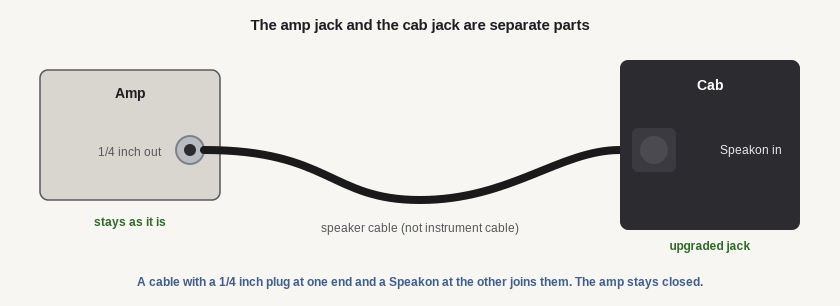
- Cab only. Fit a better jack on the cab, such as a Speakon or a high-current 1/4 inch jack like the Switchcraft Z15J. The amp's output jack stays as it is.
- Speakon on the cab, 1/4 inch on the amp. Use a cable with a 1/4 inch plug at the amp end and a Speakon at the cab end.
- Keep the amp closed. A tube amp holds dangerous voltage inside even when it is unplugged. Changing a jack on a cab that is unplugged from the amp is a much smaller job.
- Do both jacks on the cab. If the cab has an input and an extension jack, change both the same way.
- The amp's jack is still the weak link. If it is worn or loose, the cab's upgrade does not fix that.
Level 3 has the part details for the Z15J.