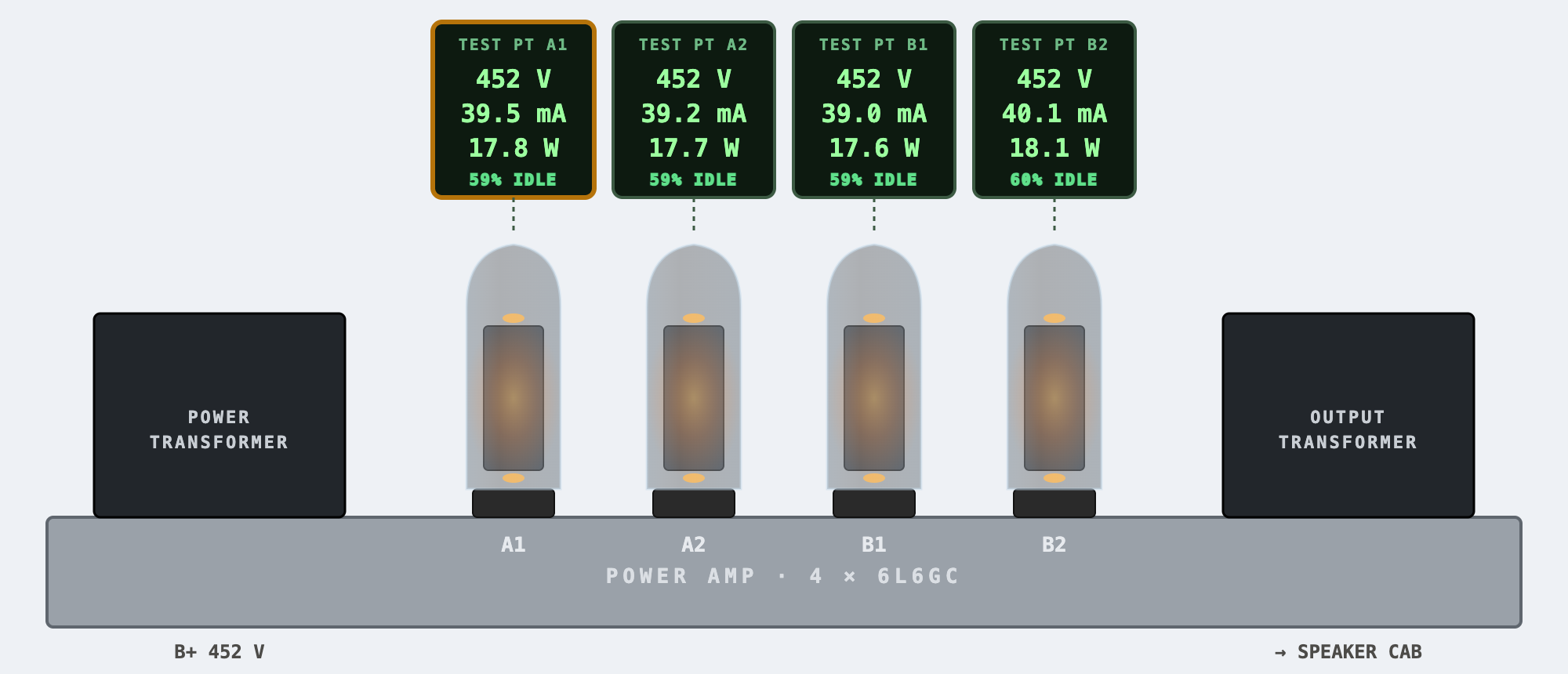
The Tube Bias Calculator answers the question every amp owner asks after buying new power tubes: what should my bias read? Pick your tubes and plate voltage and it gives the target current, in milliamps and in millivolts at a 1 Ω test point. Then turn the bias pots on a simulated amp and watch the tubes, the readouts and a meter respond.
Think of bias as a car's idle
Set it too low and the engine stalls: the tube runs cold, sounds thin and fizzy, with odd distortion on quiet notes (crossover distortion). Set it too high and it is always revving: the tube runs hot, wears out early, and in the worst case the plates glow red (red plating). Set it right and it idles smoothly, ready the moment you step on the gas, which is when you hit the strings.
Different tubes are different engines. A 6L6 and an EL84 idle at very different currents, so the target always starts from the tube's own rating.
How to find your target
Every power tube has a maximum plate dissipation in watts. A good idle for a push-pull class AB amp is about 60% to 70% of that maximum.
Target plate current (mA) = max plate watts × target % ÷ plate voltage × 1000
Example: a 6L6GC (30 W) with 450 V on the plate, aiming for 70%: 30 × 0.70 = 21 W, and 21 ÷ 450 = 0.0467 A, so about 47 mA per tube.
Start cooler (around 60%) and go up only if the amp sounds thin.
Max plate watts by tube
| Tube | Max plate watts | Notes |
|---|---|---|
| EL84 / 6BQ5 | 12 W | Many EL84 amps are cathode biased (no pot) |
| 6V6GT | 14 W | Older data sheets say 12 W |
| 6973 | 12 W | |
| 7591A | 19 W | |
| 5881 / 6L6WGB | 23 W | Fits a 6L6 socket, rated lower |
| EL34 / 6CA7 | 25 W | |
| KT77 | 25 W | |
| KT66 | 25 W | |
| 6L6GC | 30 W | |
| 6550 | 35 W | Some later versions are rated 42 W |
| 7027A | 35 W | |
| KT88 | 35 W | Ratings vary by maker, 35 W to 42 W |
| KT90 | 50 W |
When ratings vary, use the lower figure.
Reading the bias test points
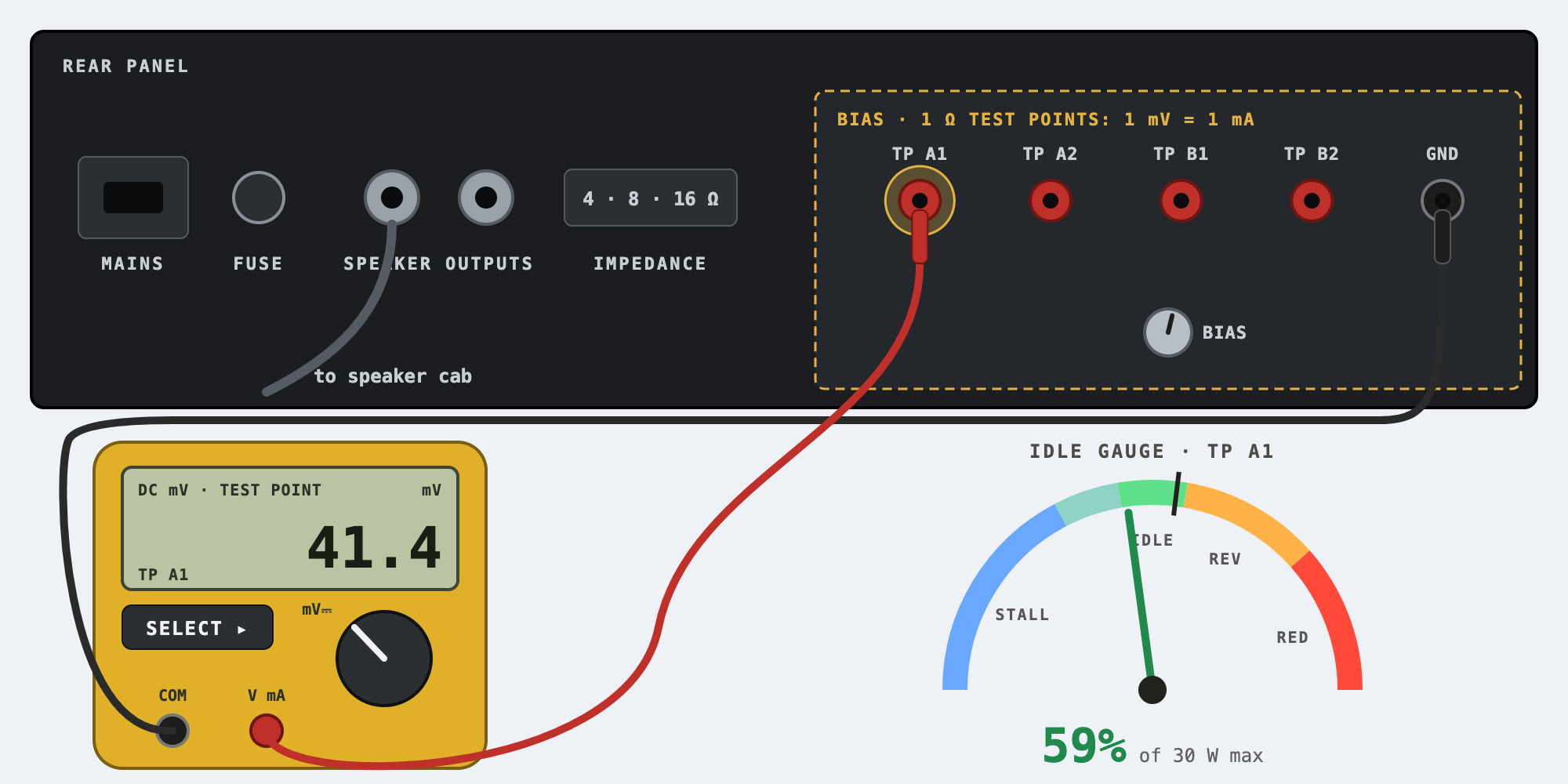
Many amps have bias test points: a small 1 Ω resistor in each tube's cathode. With a meter on DC millivolts, 1 mV across 1 Ω means 1 mA flowing, so the meter reads the current directly.
- The reading includes screen current. A test point (or a socket bias probe) measures cathode current, which is plate current plus screen current. Screen current is roughly 5% at idle, so aim about 5% above the plate target.
- A shared test point reads two or more tubes together. Divide by the number of tubes to get each tube's current.
- One test point for all tubes can hide a hot tube. The average looks fine while one tube runs hotter. Matched tubes avoid this.
Bias pots: how amps lay them out
- One pot for all tubes: the most common. Matched tubes matter most here.
- One pot per side (pair): set side A and side B separately.
- One pot per tube: each tube set on its own.
- One pot plus a balance pot: the balance pot shifts current between the two sides.
Which way is cold differs from amp to amp, so check before you start.
How to bias, step by step
- Connect a speaker or dummy load. Never run a tube amp with nothing on the output.
- Fit the new tubes (a matched set). Turn the bias pot to the cold end first, so the new tubes start cool.
- Power on with standby off, let the tubes warm up for 1 to 2 minutes, then switch to play. Volume at zero, nothing plugged into the input.
- Meter on DC mV: black lead on ground, red on a test point.
- Turn the pot slowly with an insulated tool until the reading reaches the target.
- Let the amp run 10 to 15 minutes, check again and fine-tune. Recheck after a few hours of playing, as new tubes settle.
- In a dark room, a soft blue or purple glow on the glass is normal. Red or orange plates mean too hot: turn it down right away.
Things worth knowing
- Cathode-biased amps have no pot. Many EL84 amps and small amps set their own idle. Just fit a matched set.
- Some fixed-bias amps have no adjustment. They are built for one tube type.
- Wall voltage moves the bias. Higher mains voltage means higher B+ and a hotter idle.
- Plate voltage changes as you bias. B+ sags a little as current rises, so recheck it near the end.
- Power tubes only. Preamp tubes such as the 12AX7 are not biased this way.
The targets use real math. The amp in the tool is a simulation that behaves like a real one, so you can practise; it is not a model of your amp, and your meter has the final word.