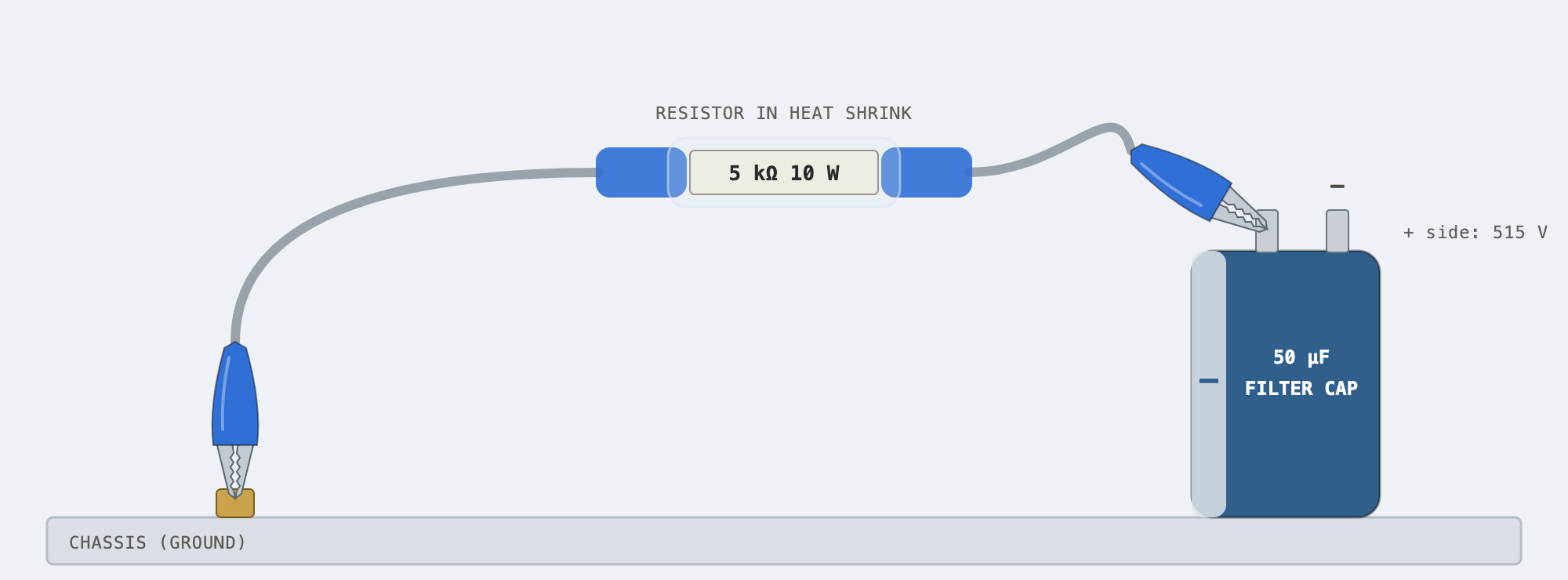
The Cap Drain & Bleeder Calculator answers the first safety question of working inside a tube amp: how do I make sure the filter caps are empty, and how long does it take? Enter the amp's B+ voltage and the filter cap's size, then size a permanent bleeder resistor, see how fast a clip-on drain lead empties the cap, and compare the two on one chart.
Why filter caps are dangerous
A tube amp's filter capacitors store the B+ supply, often 400 to 500 volts DC. They can hold that charge long after the amp is switched off and unplugged. Treat every cap as live until you have drained it and checked it with a meter.
Two ways to drain a cap
A permanent bleeder resistor is soldered across the filter cap. It draws a small current the whole time the amp is on, and slowly drains the cap after the amp is switched off. It is a safety net, not a guarantee: bleeders can fail.
A clip-on drain lead is an alligator clip, a resistor and another alligator clip. Clip one end to the chassis (ground) first, then the other end to the + side of the cap. It empties the cap in a second or two.
The bleeder math (Ohm's law)
Start from whichever you know: the current you want it to draw, the resistor, or the watts.
- Resistor (Ω) = volts ÷ current (A)
- Steady watts = volts × current (A), or volts² ÷ ohms
- Buy a resistor rated about 2× the steady watts, because it runs all the time.
Example: 515 V at 10 mA → 51.5 kΩ, dissipating 5.15 W steady → buy a 15 W part (10 W is just under the 2× margin).
Check the voltage rating too. Many small 1/2 W resistors are only rated for 250 to 350 V. Above that, use two in series (each takes half the voltage) or a part rated for the full voltage.
How long it takes to drain
The voltage on a cap falls away exponentially through a resistor. The time to reach a safe 5 V is:
t = R × C × ln(V ÷ 5)
| B+ and cap | Through | Time to 5 V |
|---|---|---|
| 515 V, 50 µF | 51.5 kΩ bleeder | about 12 s |
| 515 V, 50 µF | 5 kΩ drain lead | about 1.2 s |
The drain lead's resistor only carries current for a moment, so it does not need the steady wattage from the bleeder math. What matters is the energy stored in the cap, ½ × C × V²: about 6.6 joules for 50 µF at 515 V, one quick burst that a 5 W or 10 W cement resistor handles easily.
Using a drain lead, step by step
- Turn the amp off and unplug it from the wall. The standby switch alone is not enough.
- Clip one end of the lead to the chassis (ground) first.
- Clip the other end to the + side of the filter cap. Leave it there for 10 to 20 seconds.
- Do this for every filter cap.
- Caps hard to reach? Clip to the plate of V1, the first preamp tube (pin 1 or pin 6 on a 12AX7). The caps are linked through resistors ending at the preamp, so this drains the whole chain from the far end, but more slowly: leave it for at least a minute.
- Check with a meter on DC volts: black probe on the chassis, red on each cap's + and on the V1 plate. You want under about 5 V everywhere.
- Caps can creep back up a little after draining. Recheck if you leave the amp, or leave a lead clipped on while you work.
Things worth knowing
- Never use a screwdriver to short a cap. The spark can damage the cap and the circuit.
- Under 1 kΩ is close to a dead short on a drain lead: a big current and a spark at the clip. Most drain leads use 2 kΩ to 100 kΩ.
- Times are worked out from the values you enter. Real caps and parts vary, so the meter has the final word.