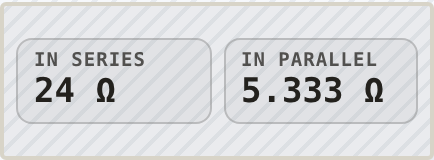
The Resistance (Ω) Calculator answers two everyday questions: what is the total of these parts, and what part do I need to hit a target? Enter two or more values (Ω, kΩ or MΩ) and it shows the series and parallel totals side by side. Or give it a target total and one part you already have, and it works out the missing part.
It works the same for resistors, speaker loads and dummy loads, because they all follow the same rule.
The math
Series: the values add. Total = R1 + R2 + … Two 8 Ω parts in series = 16 Ω.
Parallel: use the reciprocal. Total = 1 ÷ (1/R1 + 1/R2 + …). With equal parts, that is simply R ÷ the number of parts. Two 8 Ω parts in parallel = 4 Ω. An 8 Ω and a 16 Ω in parallel = 5.33 Ω.
The missing part: - In series: missing = total − the part you have. The total must be larger than that part. - In parallel: missing = 1 ÷ (1/total − 1/the part you have). The total must be smaller than that part.
Example: you need 5.33 Ω and have an 8 Ω part. In parallel, the missing part is 16 Ω.
The opposite rule
| Resistance (Ω) | Capacitance (µF) | |
|---|---|---|
| In series | adds | reciprocal |
| In parallel | reciprocal | adds |
Capacitors do the reverse. The Capacitance (µF) Calculator shows the flip.
How to use it
- Enter the parts, with their units. Add rows for more parts.
- Read the series total and the parallel total.
- For a target, use the missing-part box: the total you want, the part you have, and how they are wired.
Things worth knowing
- Speakers follow this rule. For a speaker cab, match the amp's tap or step up; never step down. The Cab Builder checks a whole cab against the amp.
- Mind the wattage too. In series, the larger resistor takes more of the power; in parallel, the smaller one does. The Power (W) Calculator sizes each part.
- Tolerance adds up. Five percent parts in series or parallel give a total that is also about five percent out.