This level is the reference: why resistors come in the values they do, how to read every kind of marking, how to work out the power and voltage a resistor has to handle, and how to test, buy and substitute one.
Standard Values: the E Series
Resistors are not made in every value. They come in series spaced so that, within the tolerance, every value in between is covered.
| Series | Tolerance | Values in each decade |
|---|---|---|
| E12 | ±10% | 10, 12, 15, 18, 22, 27, 33, 39, 47, 56, 68, 82 |
| E24 | ±5% | the E12 values plus 11, 13, 16, 20, 24, 30, 36, 43, 51, 62, 75, 91 |
| E96 | ±1% | 96 values per decade, for metal film parts |
Each decade repeats: 4.7, 47, 470, 4.7k, 47k, 470k, 4.7M. That is why the same numbers keep turning up in every schematic. When a calculation lands between two values, pick the nearest one that keeps you safe: for an LED resistor, the next value up.
Tolerance
The tolerance band says how far the real value may sit from the marked one. A 4.7k ±5% part can measure anywhere from 4,465 to 4,935 Ω and still be in spec. For most pedal and amp work 5% is fine. Use 1% metal film where two values have to match, such as the two halves of a phase inverter or a stereo pair.
Reading Every Kind of Marking
4 bands and 5 bands
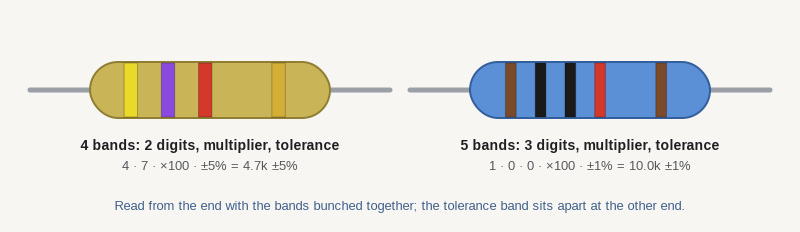
A 5-band resistor adds a third digit for precision values: brown, black, black, red, brown is 1, 0, 0, then two zeros, ±1%, which is 10.0k. A sixth band, when there is one, is the temperature coefficient.
Surface-mount codes
Tiny surface-mount resistors on modern pedal boards are printed with numbers instead of bands:
| Printed | Means | Value |
|---|---|---|
| 472 | 4, 7, then two zeros | 4.7k |
| 103 | 1, 0, then three zeros | 10k |
| 4701 | 4, 7, 0, then one zero | 4.7k (a 1% part) |
| 4R7 | R marks the decimal point | 4.7 Ω |
| 01C | an EIA-96 code: look it up in a table | 10k (1%) |
Larger parts
Power resistors are big enough to print the value in words: 10W 8Ω J is a 10 W, 8 Ω part, and the letter is the tolerance (F = 1%, G = 2%, J = 5%, K = 10%).
Power: How Big Does It Need to Be?
Every resistor turns some energy into heat, and its body size sets how much heat it can shed.
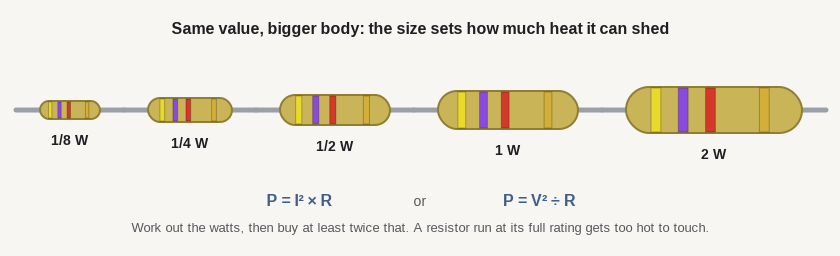
Use whichever pair you know:
- P = I² × R when you know the current.
- P = V² ÷ R when you know the voltage across it.
Then buy at least twice the result. A resistor at its full rating runs hot enough to drift and scorch the board around it.
| Job | The numbers | Watts | Buy |
|---|---|---|---|
| LED resistor in a pedal | 680 Ω at 10 mA: 0.01² × 680 | 0.07 W | 1/4 W |
| Preamp tube cathode resistor | 1.5k at 1 mA: 0.001² × 1,500 | 0.0015 W | 1/4 W (1/2 W in an amp is common) |
| Bleeder across a 450 V filter cap | 450² ÷ 220,000 | 0.92 W | 2 W, rated for the voltage |
| Two power tubes sharing a cathode resistor | 130 Ω at 80 mA: 0.08² × 130 | 0.83 W | 3 W or 5 W |
| Dummy load for a 50 W amp | 50 W of heat, all of it | 50 W | 100 W or more, on a heatsink if it needs one |
The Power (W) Calculator does this math and its Rating Check picks the part to buy.
Voltage Rating
Power is not the only limit. Each resistor also has a maximum working voltage, and small parts have low ones: a typical 1/4 W carbon or metal film resistor is good for about 200 to 250 V. Tube plates and filter caps can run at 300 to 500 V, so plate loads, screen resistors and bleeders in an amp need parts rated for the voltage, usually 1/2 W to 2 W metal oxide or metal film. Check the datasheet.
Temperature Coefficient and Noise
- Temperature coefficient (tempco) is how far the value moves as the part warms, in parts per million per °C. Metal film is commonly 50 to 100 ppm/°C; carbon composition can be over ten times worse.
- Noise. Every resistor makes a little hiss, more as the value rises. Carbon composition adds extra noise on top when current flows through it, which is why metal film is the choice in the first stage of a high-gain amp or pedal, where any hiss gets amplified.
Testing a Resistor
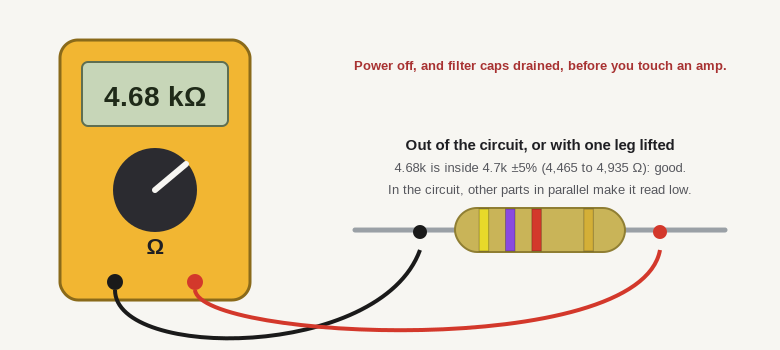
- Set the meter to ohms (Ω), on a range above the marked value if it isn't auto-ranging.
- Touch the probes together first: most meters read a few tenths of an ohm from the leads. Subtract that from small readings.
- Measure the resistor out of the circuit, or with one leg unsoldered. In the circuit, anything wired in parallel makes it read low.
- Compare with the tolerance. Outside it, or drifting as you hold it, means replace it.
Burnt resistors: a scorched or cracked body means too much current flowed. Replacing it fixes the symptom; find out what failed upstream, such as a shorted tube or cap, before powering up again.
DANGER: LETHAL VOLTAGE. A tube amp's filter caps can hold a deadly charge long after it is unplugged. Before you measure or replace anything inside, unplug it, drain the caps and check them with a meter. The Cap Drain & Bleeder Calculator shows how.
Buying and Substituting
| You need | Choose |
|---|---|
| General pedal work | 1/4 W metal film, 1%: quiet, cheap, and the 1% costs almost nothing extra now |
| Amp signal path | 1/2 W metal film, or metal oxide film where there is real power |
| Amp plate, screen and bleeder positions | metal oxide film, 1 W to 5 W, rated for the voltage |
| Dummy load or attenuator | wirewound or thick-film power resistors on a heatsink |
| A vintage restoration | carbon composition if originality matters; otherwise metal film or metal oxide |
Safe substitutions:
- A higher power rating is always fine, if it fits.
- A tighter tolerance is always fine.
- A quieter type (metal film in place of carbon) is fine in the signal path, apart from the small sound difference some players hear from carbon composition in a plate load.
- Not fine: a lower power or voltage rating, or a wirewound part in the audio signal path.
Try It
Build a Circuit's Resistor Sub Box dials through real standard values, the same E-series numbers in the table at the top. Wire it to an LED and a battery, open Circuit Math, and watch the current change as you turn the dial.