Level 1 covered reading a resistor. This level is about what it does once it is soldered in: the one rule behind every resistor, how resistors combine, the jobs they do in pedals and amps, and which type to use for each job.
The One Rule: Ohm's Law
Voltage, current and resistance are tied together:
V = I × R
- V is voltage, in volts: the pressure.
- I is current, in amps: how much flows.
- R is resistance, in ohms: how hard it is to flow.
Know any two and you have the third. Put 9 V across a 1k resistor and 9 mA flows (9 ÷ 1,000 = 0.009 A). Double the resistance to 2k and the current halves to 4.5 mA. Every resistor job below is this rule put to work.
Series and Parallel
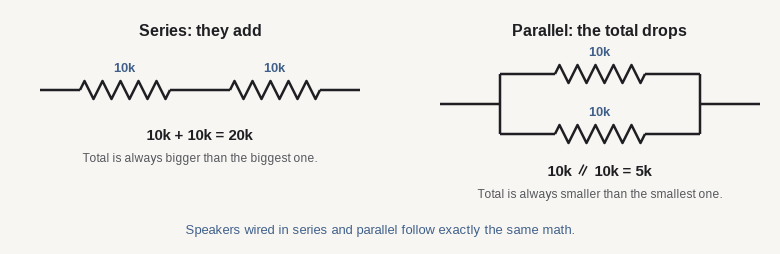
- Series, end to end: the values add. Two 10k make 20k.
- Parallel, side by side: the total falls below the smallest one. Two equal resistors make half of one; for unequal ones, total = (R1 × R2) ÷ (R1 + R2).
This is the same math as wiring speakers. Two 8 Ω speakers in series are 16 Ω; in parallel they are 4 Ω. The Resistance (Ω) Calculator does both, and finds the resistor you need to add to reach a target. When the value you want isn't made, two standard parts in series or parallel will usually get there.
The Jobs Resistors Do
Limiting current
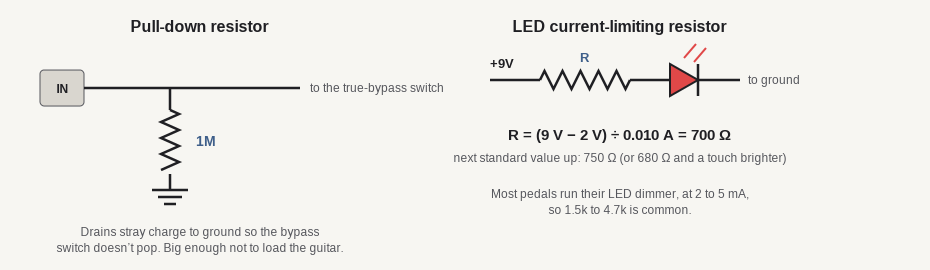
An LED, or a transistor's base, will take as much current as it can get and burn out. A resistor in line sets a safe amount.
Pulling down
A true-bypass pedal's input cap can hold a small charge. When the switch connects it, that charge jumps out as a pop. A large resistor to ground, usually 1M to 2.2M, drains it quietly. It is big enough that the guitar barely notices it is there.
Setting a voltage: the divider
Two resistors in series across a supply split the voltage between them in proportion to their values. Two equal resistors across 9 V give 4.5 V in the middle, which is how many pedals make the half-supply point their op-amps and transistors sit at. A volume pot is a voltage divider with a moving middle.
Biasing tubes and transistors
- Cathode resistor (tube amps): current through it raises the cathode above ground, which sets how hard the tube idles. A 12AX7 preamp stage commonly uses about 1.5k, often with a capacitor across it for more gain.
- Plate load (tube amps): the resistor from B+ to the plate, commonly 100k on a 12AX7. The signal appears across it; a bigger load gives more gain, up to a point.
- Bias resistors (pedals): pairs of resistors that set a transistor's resting voltage, so it can swing both ways without clipping too early.
Stopping trouble: grid stoppers
A resistor right at a tube's grid, from about 1k to 68k, forms a small filter that blocks radio-frequency noise and stops a stage from oscillating. Many Fender amps put 68k resistors at the input jacks for this, and power tubes often get 1k to 5.6k.
Protecting the tube: screen resistors
A power tube's screen grid gets its own resistor, commonly 470 Ω to 1k at 1 W or more, to limit screen current when the amp is pushed hard.
Draining filter caps: bleeders
A tube amp's filter caps can hold a lethal charge long after the amp is unplugged. A bleeder resistor across them, often around 220k at 2 W, drains them over a minute or two. The Cap Drain & Bleeder Calculator sizes one and shows how fast it works.
Soaking up power: dummy loads
A dummy load is a big power resistor, for example 8 Ω at 150 W, standing in for a speaker so an amp can be run, tested or recorded silently. Never run a tube amp with no load at all.
The Types, and Where Each Belongs
| Type | Strengths | Weaknesses | Best for |
|---|---|---|---|
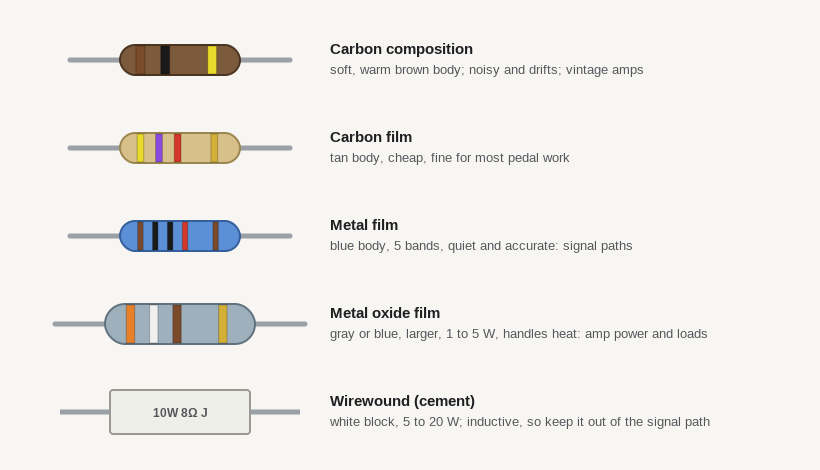
| Carbon composition | survives short surges; the vintage original | the noisiest type; drifts with heat, humidity and age, usually upward | restoring vintage amps where originality matters |
| Carbon film | cheap, fine in most places | some noise; 5% tolerance | general pedal work |
| Metal film | quiet, accurate (1%), stable with temperature | low power in small sizes | signal paths, gain stages, anywhere noise matters |
| Metal oxide film | handles heat, high power for its size, non-inductive | larger | amp plate and screen resistors, bleeders, load resistors in the signal path |
| Wirewound | very high power, very stable | inductive: the wire is a coil | dummy loads and power duty, never the audio signal path |
Some players hear carbon composition resistors in a plate load position as warmer when the amp is pushed. The effect is small and hard to pin down; noise and drift are the parts that are certain.
Common Mistakes
- Reading the bands backwards. Start from the end where the bands bunch together. A gold or silver band is never first.
- Too small a power rating. A resistor at its limit runs hot and drifts. Work out the watts and buy at least double (Level 3).
- A wirewound in the signal path. Its inductance colors the sound. Use metal oxide film for loads in the signal path.
- Measuring it in the circuit. Other parts in parallel make the meter read low. Lift one leg first.
- Forgetting the voltage rating. A small 1/4 W resistor can be fine for the power but not the voltage at a tube's plate.
Try It
In Build a Circuit, wire a battery, a resistor and an LED, then open Circuit Math: it works out the LED current and the resistor needed for 5, 10 or 20 mA. Swap the resistor for a Resistor Sub Box and dial through the values to watch the current change.
Level 3 covers the numbers: standard values, tolerance, power and voltage ratings, the 5-band code, surface-mount codes, and how to test and substitute a resistor.