A resistor is the simplest part in electronics, and the most common. It makes it harder for current to flow. That one job, done in the right place, sets how loud a stage is, how bright an LED glows, how a tube is biased and whether a pedal pops when you step on it. Every pedal, every amp and many guitars are full of them.
Think of current as water and a resistor as a narrow section of pipe. The narrower the pipe, the less water gets through for the same pressure. The energy it holds back turns into a little heat, which is why resistors come in different sizes.
How to Spot One
A through-hole resistor is a small cylinder with a wire lead out of each end and colored bands painted around the body. It has no polarity: it works the same either way round.
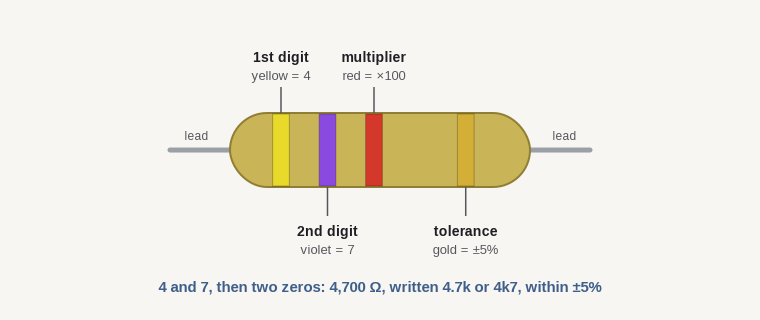
The bands are the value, in code. The value is measured in ohms, written Ω.
Reading the Color Code
Hold the resistor so the bands bunched closest to one end are on the left. The lone band at the other end, usually gold or silver, is the tolerance. Then read left to right:
- First band: the first digit.
- Second band: the second digit.
- Third band: the multiplier, or how many zeros to add.
- Fourth band: the tolerance, how close to the marked value the real part is guaranteed to be.
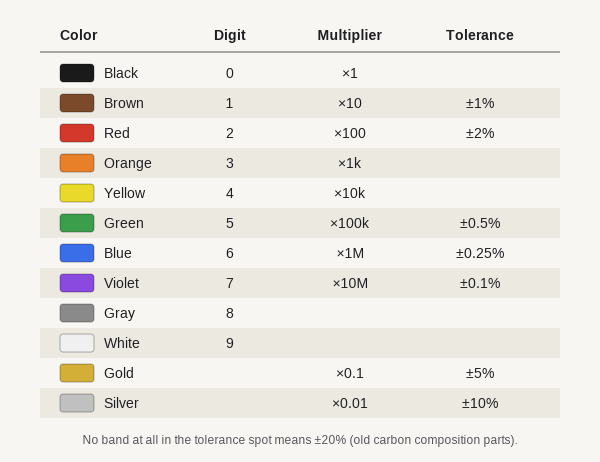
A few you will see again and again:
| Bands | Reads | Value | Where it turns up |
|---|---|---|---|
| Yellow, violet, brown | 4, 7, one zero | 470 Ω | LED resistors, small currents |
| Brown, green, red | 1, 5, two zeros | 1.5k | the classic preamp tube cathode resistor |
| Yellow, violet, red | 4, 7, two zeros | 4.7k | LED resistors, transistor stages |
| Brown, black, orange | 1, 0, three zeros | 10k | everywhere in pedals |
| Brown, black, yellow | 1, 0, four zeros | 100k | tube plate loads, transistor bias |
| Brown, black, green | 1, 0, five zeros | 1M | pedal input pull-downs, tube grid resistors |
A way to remember the digit order, black through white: Black, Brown, Red, Orange, Yellow, Green, Blue, Violet, Gray, White, 0 to 9.
Writing the Value
Values get large fast, so they are shortened:
- k means thousand: 4,700 Ω is 4.7k.
- M means million: 1,000,000 Ω is 1M.
- On schematics the letter often replaces the decimal point, because a printed dot can disappear: 4k7 is 4.7k, 2M2 is 2.2M, and 4R7 is 4.7 Ω.
On a Schematic
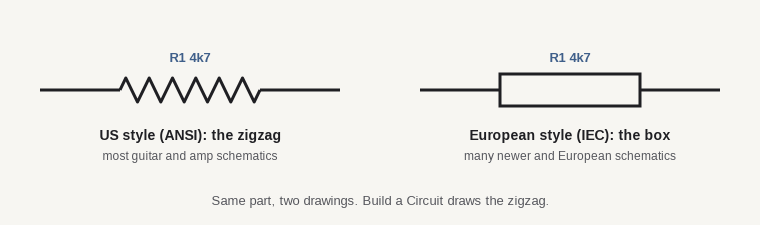
Each resistor gets a name, R1, R2 and so on, and its value beside it. The zigzag and the box mean exactly the same thing.
Where You Find Them
| In a... | What the resistors are doing |
|---|---|
| Pedal | setting the gain of each stage, biasing transistors, limiting the LED's current, the 1M pull-down on the input that stops the switch from popping |
| Tube amp | plate loads that set each preamp stage's gain, cathode resistors that bias the tubes, grid stoppers, screen resistors, and bleeders that drain the filter caps after power-off |
| Guitar | mostly hidden inside the pots, which are adjustable resistors, and in a treble bleed network on the volume pot |
| Speaker cab | usually none. Resistors appear in dummy loads and attenuators, where big power resistors stand in for a speaker |
Try It
Drop a resistor into Build a Circuit and type a value in the Inspector: 330, 4k7, 1M. The bands change to match, and the Inspector shows the code with the digits printed on each band. It is the quickest way to make the color code stick.
Level 2 covers what a resistor actually does in a circuit: Ohm's law, series and parallel, and the jobs above, one by one.