Levels 1 and 2 covered the common rectifier tubes and how they behave. This level is about applications: which rectifier suits which kind of amp and player, swapping them, and buying them.
Which Rectifier for Which Job
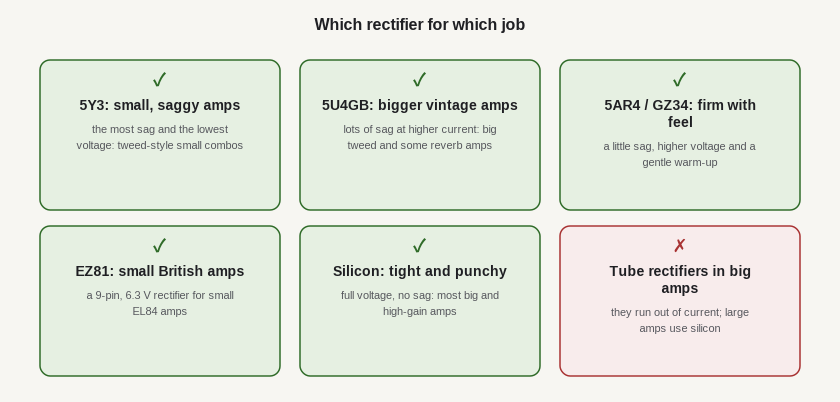
5Y3: Small, Saggy Amps
The job: a small amp that compresses and blooms under the fingers.
Why it suits: the biggest voltage drop of the common types means the most sag and the lowest voltage. It is the rectifier of small tweed-style combos, where its limited current rating is enough.
5U4GB: Bigger Vintage Amps
The job: sag in an amp that draws more current.
Why it suits: a large voltage drop, like the 5Y3, but with a current rating high enough for a pair of 6L6s. It is found in some larger vintage American amps, and some players fit it in 5AR4 amps to soften them.
5AR4 / GZ34: Firm With Feel
The job: a little sag, good power and a gentle warm-up.
Why it suits: a small voltage drop keeps the amp's voltage and headroom close to silicon, while still giving a touch of compression under hard playing. Its slow, indirectly heated warm-up is kind to the rest of the amp. It is the most common rectifier tube in current amps.
EZ81: Small British Amps
The job: rectification in small EL84 amps.
Why it suits: a small 9-pin tube running from 6.3 V, sized for 15 W to 18 W amps. It is part of the original AC15 sound and of the small British amps modeled on it.
Silicon Diodes: Tight and Punchy
The job: full voltage and a firm supply, with no sag.
Why it suits: big amps need more current than a rectifier tube can supply, and high-gain amps want a tight, immediate response. Silicon gives both, and it never wears out.
Where Tube Rectifiers Don't Suit
Large amps with four or more power tubes, and tight high-gain amps, are better served by silicon. A tube rectifier there either runs out of current or softens a response that should be tight.
Swapping Rectifier Tubes
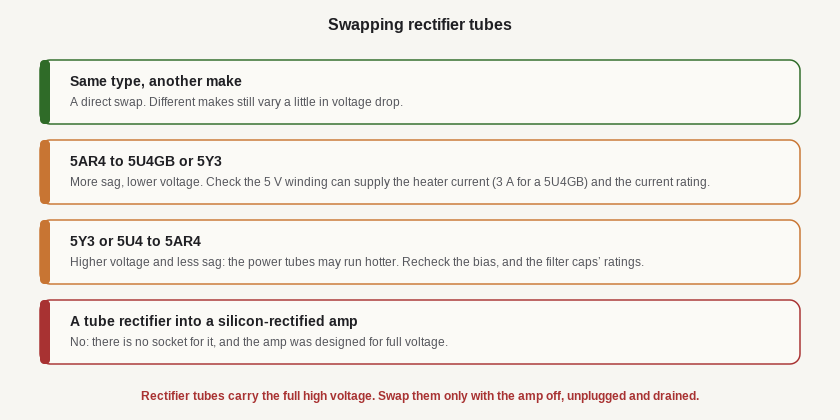
Rectifiers share the octal socket and, in most amps, the same wiring, so they can often be swapped to change the feel. Check these first:
| Change | Effect | Check |
|---|---|---|
| 5AR4 to 5U4GB | more sag, lower voltage, softer feel | the 5 V winding must supply 3 A instead of 1.9 A |
| 5AR4 to 5Y3 | the most sag | the 5Y3's low current rating must suit the amp: fine in small amps, not in bigger ones |
| 5Y3 or 5U4 to 5AR4 | higher voltage, less sag | the power tubes run hotter: recheck the bias, and the filter caps' voltage ratings |
| Any change | the bias shifts | a fixed-bias amp should be rechecked after any rectifier change |
Some amps offer a switch between tube and silicon rectification, or between rectifier types, so you can hear the difference without swapping.
DANGER: LETHAL VOLTAGE. Swap rectifiers only with the amp off, unplugged and drained. If you are unsure whether the power transformer's 5 V winding can supply a different rectifier's heater, have a technician check.
Buying Rectifier Tubes
- Current production: the 5AR4/GZ34, 5U4GB, 5Y3 and EZ81 are all made today, in Russia, Slovakia and China, under several names.
- Ratings vary by maker: voltage drop and current rating differ a little between makes of the same type, so a new rectifier can change an amp's voltage slightly.
- Vintage: original British and American rectifiers are prized; the usual caution about fakes and worn tubes applies.
- Signs of a failing rectifier: loss of volume, more hum, a blown fuse, or visible arcing inside the tube. A rectifier that arcs should be replaced at once, and the filter caps and fuse checked.
- Spares: keep a spare rectifier with any tube-rectified amp; when one fails, the amp stops completely.
Try It
If your amp has a 5AR4 and its power transformer can supply the heater current, try a 5U4GB for an evening, after checking the bias. Play the same songs and listen for the extra softness and bloom on hard chords, and for the slightly lower volume. Then decide which feel suits the way you play.