Level 1 covered the common rectifier tubes and what sag is. This level is about how they behave: sag over time, warm-up, the heater windings they need, their current limits, and how they interact with the filter capacitors.
DANGER: LETHAL VOLTAGE. Everything in this article sits at the full high-voltage supply. Never measure or work on it unless you are trained to, and always drain the filter caps first. The Cap Drain & Bleeder Calculator shows how.
Sag Over Time
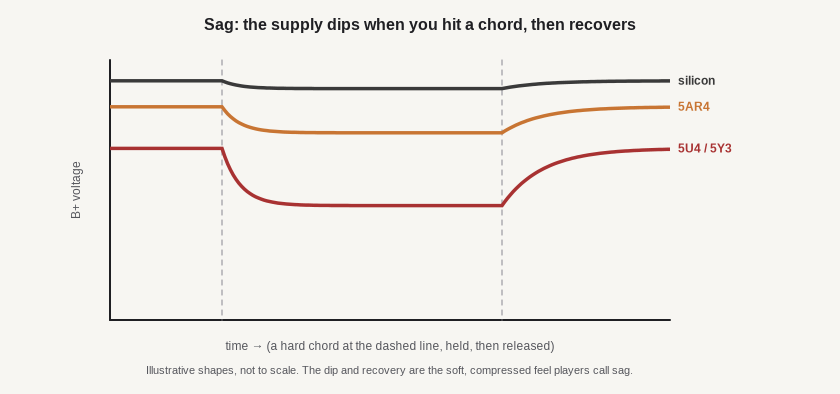
When you strike a hard chord, the power tubes suddenly draw more current. The filter capacitors supply the first burst; then the rectifier has to recharge them. A silicon rectifier recharges them almost at once. A tube rectifier, with its internal resistance, can't keep up, so the supply voltage dips and stays lower while the chord rings, then recovers when it fades. The bigger the rectifier's voltage drop, the deeper the dip and the slower the recovery.
That dip slightly reduces the amp's power and compresses its peaks, which is why a tube-rectified amp feels softer under the fingers. Small filter capacitors, as in many vintage amps, deepen the effect.
Warm-Up
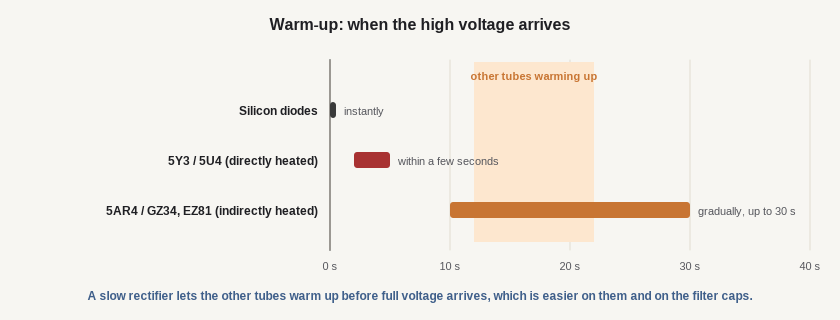
- Directly heated rectifiers (5Y3, 5U4) have a filament that is itself the cathode. They start conducting within a few seconds, before the other tubes in the amp have warmed up, so the supply rises above its working voltage for a moment.
- Indirectly heated rectifiers (5AR4/GZ34, EZ81) have a separate cathode, like an amplifying tube. They warm up gradually, over up to about 30 seconds, so the high voltage arrives as the other tubes become ready. That is easier on the tubes and the filter caps.
- Silicon diodes conduct at once, which is one reason many silicon-rectified amps have a standby switch.
The Heater Winding
Most rectifier tubes have a 5 V heater fed by its own winding on the power transformer. In a directly heated rectifier, that winding sits at the full high voltage, so it can't be shared with the other tubes' heaters. Each type draws a different current:
| Rectifier | Heater current |
|---|---|
| 5AR4 / GZ34 | 1.9 A at 5 V |
| 5Y3 | 2 A at 5 V |
| 5U4GB | 3 A at 5 V |
| EZ81 | 1 A at 6.3 V |
The EZ81 is unusual: it runs from 6.3 V, and some small amps run it from the same winding as the other tubes. That works, but a fault between its heater and cathode can then put high voltage on every heater in the amp. The Power Transformers series covers heater windings.
Current Limits
Every rectifier has a maximum current. The 5Y3 is only good for about 125 mA, enough for a small amp. The 5AR4 and 5U4 can handle around 250 mA to 275 mA, enough for two power tubes in a medium amp. Large amps with four or six power tubes draw more than a single rectifier tube can supply, which is why they use silicon diodes, or occasionally two rectifier tubes in parallel.
Filter Capacitor Limits
Rectifier tube data sheets list a maximum value for the first filter capacitor. A larger one draws a bigger charging current through the tube each cycle, which can make it arc or wear out early. When restoring a tube-rectified amp, keep the first filter cap within the rectifier's rating.
Try It
On a tube-rectified amp, turn up until it just breaks up, then play a hard chord and let it ring. Listen to the note settle and swell slightly as it decays: that swell is the supply recovering.
Level 3 covers which rectifier suits which job, swapping them, and buying them.