Every tube amp needs high-voltage DC, and the power transformer only supplies AC. A rectifier turns that AC into DC. Many amps use silicon diodes for the job, but many classic amps, and many built in their image, use a rectifier tube: a diode in a bottle. A tube rectifier does the job less efficiently than silicon, and that inefficiency is part of the sound. As you play harder it lets the supply voltage dip and recover, giving the soft, compressed feel called sag.
This series covers the common rectifier tubes. The Vacuum Tubes series, Level 3B, introduces them, and the Power Transformers series covers the windings that feed them.
DANGER: LETHAL VOLTAGE. A rectifier tube carries the full high-voltage supply, often 300 V to 500 V or more, and its socket is live whenever the amp is on. The filter capacitors it charges hold a lethal charge long after unplugging. Never reach inside an amp unless you know how to drain it safely. The Cap Drain & Bleeder Calculator explains how long the charge lasts.
The Common Rectifier Tubes
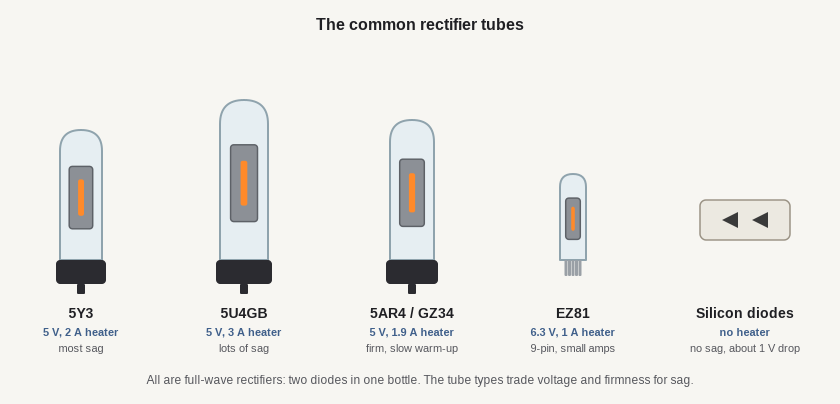
| Rectifier | Heater | Voltage drop | Current rating | Character |
|---|---|---|---|---|
| 5Y3 | 5 V, 2 A | large, about 50 V to 60 V | small (about 125 mA) | the most sag; small amps |
| 5U4GB | 5 V, 3 A | large, about 50 V | high (about 275 mA) | lots of sag in bigger amps |
| 5AR4 / GZ34 | 5 V, 1.9 A | small, about 10 V to 17 V | high (about 250 mA) | firm with a little sag; slow warm-up |
| EZ81 | 6.3 V, 1 A | moderate | small | a 9-pin rectifier for small British amps |
| Silicon diodes | none | about 1 V | very high | no sag; full voltage |
All are full-wave rectifiers: two diodes in one bottle, one for each half of the AC wave. Figures are typical and vary with the current drawn and with the maker.
What a Rectifier Does to the Sound
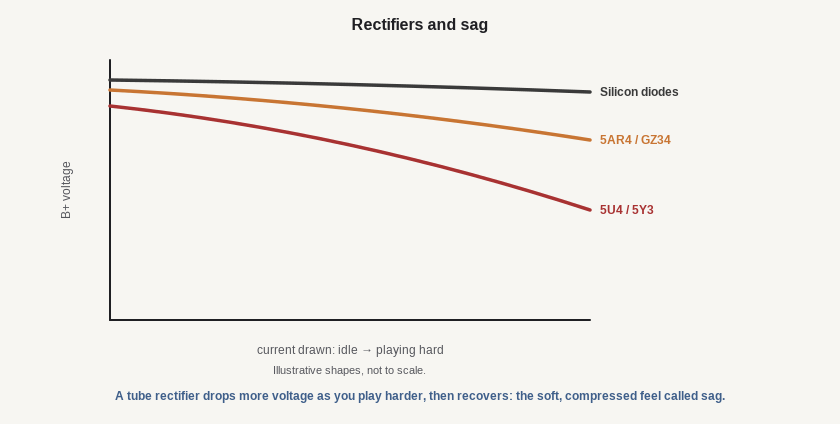
A tube rectifier has internal resistance, so the more current the amp draws, the more voltage it loses. At idle the supply sits near its full value; hit a hard chord and the power tubes draw more current, the voltage dips, and the amp compresses a little; let the chord ring and it recovers. Players describe it as a bloom, a softness, or the amp "breathing" with the playing.
The more voltage a rectifier drops, the more it sags and the lower the amp's power and headroom. A 5Y3 sags the most, a 5U4 a lot, a 5AR4 a little, and silicon diodes hardly at all.
Where You've Heard Them
- 5Y3: small tweed-era combos such as the 1950s Deluxe.
- 5U4: larger vintage American amps.
- 5AR4 / GZ34: many classic and current amps that want a little sag with good power, from the late tweed Bassman to many reverb combos and the AC30.
- EZ81: the original Vox AC15 and small British 18 W amps of the 1960s.
- Silicon: most large amps, and nearly all high-gain amps.
Try It
In the Power (W) Calculator, work out the watts a power tube makes at 420 V and 100 mA, then at 370 V and the same current. That 50 V difference is roughly what a 5U4 drops compared with silicon, and the power difference is part of why tube-rectified amps feel softer.
Level 2 covers how rectifiers behave: sag over time, warm-up, heater windings, and why big amps don't use them.