This level is the reference: how transformer ratings work, heater current budgets, the standard lead colors, why vintage amps run hot on modern mains, resistance checks on an unplugged transformer, and what to match when choosing a replacement.
DANGER: LETHAL VOLTAGE. The only measurements in this article are made with the amp unplugged and its filter caps drained and checked with a meter. Never measure a power transformer with the amp plugged in: the primary carries mains voltage and the secondaries carry lethal high voltage. Replacing a power transformer is a job for a qualified technician. The Cap Drain & Bleeder Calculator explains how filter caps are drained.
Power Ratings
A transformer's capacity is given in VA (volt-amps): roughly the power it can handle. Each winding's share is its voltage times its current, and they add up:
| Winding | Rating | VA |
|---|---|---|
| High voltage | 650 V end to end at 150 mA DC | about 100 VA, more in practice (see below) |
| Heater | 6.3 V at 4 A | about 25 VA |
| Rectifier | 5 V at 2 A | 10 VA |
DC and AC current ratings differ. A high-voltage winding feeding a rectifier and filter caps doesn't supply current smoothly: it delivers it in short, heavy pulses near the peak of each wave. The RMS current in the winding, which is what heats it, is noticeably higher than the DC current the amp draws. Manufacturers usually rate the high-voltage winding in DC milliamps for a stated rectifier arrangement. When comparing transformers, check whether the rating is AC or DC and for which rectifier.
Voltage Under Load
A transformer's rated voltages are what it gives at its rated load. With no load, its outputs read higher, often 5 to 10% higher. That is why measuring an unloaded transformer on the bench (a job for a trained tech with a current-limited supply) shows more than the label says.
Today's Mains Voltage
Many vintage amps were designed for mains of 110 to 117 V. Today's North American mains is nominally 120 V and often measures 120 to 125 V. Every secondary rises in proportion: the heaters run high, and so does B+. For most amps that is harmless, but some vintage amps run noticeably hotter and harder on their tubes and filter caps. Techs sometimes fit a small bucking transformer to lower the mains feeding an old amp. Whether an amp needs one is a judgment for a tech who has measured it.
Heater Current Budgets
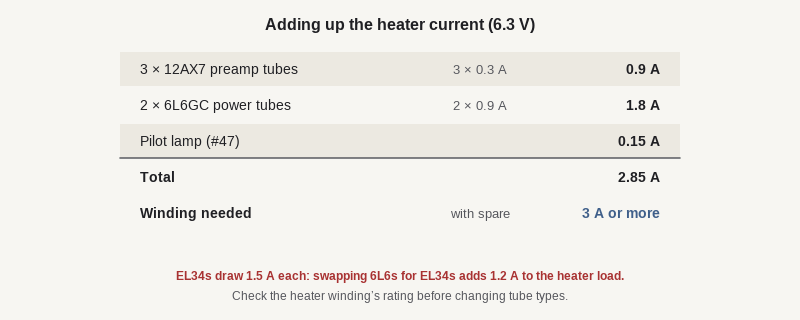
The heater winding must supply every tube's heater, plus any pilot lamp:
| Tube | Heater current at 6.3 V |
|---|---|
| 12AX7, 12AT7, 12AU7 | 0.3 A |
| EL84 | 0.76 A |
| 6V6 | 0.45 A |
| 6L6GC | 0.9 A |
| EL34 | 1.5 A |
| KT88, 6550 | 1.6 A |
| #47 pilot lamp | 0.15 A |
Rectifier tubes have their own 5 V winding: a 5AR4 (GZ34) draws 1.9 A, a 5Y3 about 2 A.
Tube swaps: two EL34s draw 3 A of heater current where two 6L6GCs draw 1.8 A. Swapping one for the other, even where the circuit allows it, can push the heater winding past its rating. Four EL34s in a 100 W amp draw 6 A on their own. Check the winding's rating before changing power tube types; the bias also needs resetting, as the Tube Bias Calculator explains.
The Lead Color Code
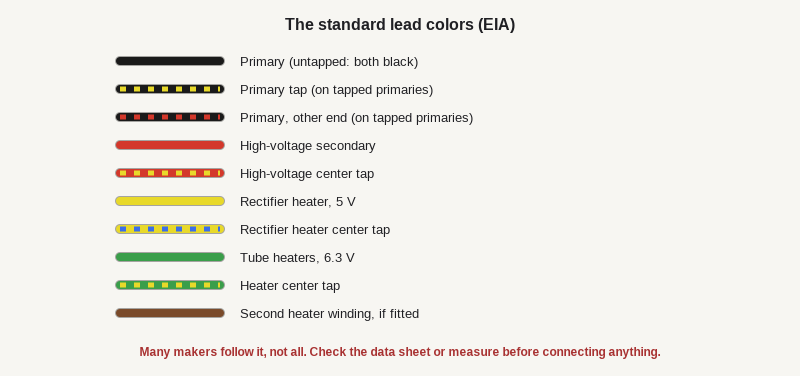
| Color | Winding |
|---|---|
| Black (both leads) | untapped primary |
| Black, black and yellow, black and red | tapped primary: common, tap, finish |
| Red | high-voltage secondary |
| Red and yellow | high-voltage center tap |
| Yellow | rectifier heater (5 V) |
| Yellow and blue | rectifier heater center tap |
| Green | tube heaters (6.3 V) |
| Green and yellow | heater center tap |
| Brown | a second heater winding |
Many manufacturers follow this code, but not all, and some use extra colors for bias taps or multiple primaries. Always check the data sheet for the exact transformer; never identify windings by color alone.
Winding Resistance Checks
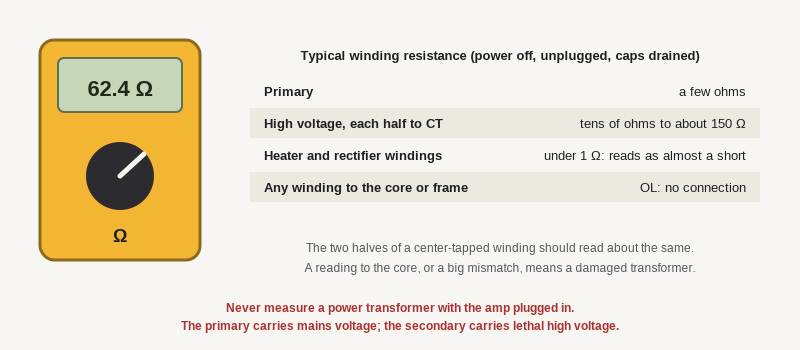
With the amp unplugged and the filter caps drained, a meter on ohms can check a transformer's windings for open circuits and shorts to the core:
| Between | Typical reading |
|---|---|
| The two primary leads | a few ohms |
| Each half of the high-voltage winding to its center tap | tens of ohms up to about 150 Ω, and the two halves about equal |
| The heater or rectifier winding's leads | under 1 Ω |
| Any winding to the core or frame | OL: no connection at all |
| One winding to another | OL |
What the readings tell you:
- OL across a winding means it is open: a broken wire inside. The transformer needs replacing.
- A reading between a winding and the core, or between two windings, means the insulation has broken down. The transformer is unsafe and must be replaced.
- Halves that don't match on a center-tapped winding suggest damage.
Resistance checks can't find shorted turns, a fault where a few turns inside a winding have melted together. A transformer with shorted turns runs very hot, hums loudly and pulls down its voltages, even though its resistances look normal. That needs a tech's tests under power, with a current-limited supply.
Choosing a Replacement
| Match | Why |
|---|---|
| Primary voltage | 120 V, 230 V or dual; must match the mains it will run on |
| High-voltage secondary | the same AC voltage, to keep B+ where the amp was designed |
| High-voltage current rating | equal or higher |
| Rectifier arrangement | a center-tapped winding for a two-diode or rectifier-tube circuit; no center tap needed for a bridge |
| Heater current | equal or higher, for the tubes the amp actually uses |
| 5 V winding | needed only if the amp uses a rectifier tube |
| Bias tap | if the amp's bias supply uses one |
| Mounting and size | the same footprint and bolt pattern, and room for the bells |
Replacement transformers made for specific classic amps exist for most well-known models, and are the easy choice. A transformer with slightly higher current ratings than the original runs cooler and is a reasonable upgrade; one with a different high-voltage rating changes the amp's B+, its bias and its sound, and should be chosen deliberately.
DANGER: LETHAL VOLTAGE. A power transformer swap involves the amp's mains wiring, its grounding and its high-voltage supply. Mistakes can kill, or start a fire. Have it done by a qualified technician, and have the bias checked afterwards.
Try It
Using the table above, add up the heater current for your own amp's tubes, including any pilot lamp, and compare it with the heater rating in its schematic or service information. Then look up the tube bias range for its power tubes in the Tube Bias Calculator.