The power transformer is the heavy iron block near the back of a tube amp. It takes the mains and turns it into every voltage the amp needs: a high voltage for the tubes' plates, a low voltage to light their heaters, and often a few more. It also keeps the amp's circuit electrically separate from the mains. Every tube amp has one, and its size goes a long way toward explaining why tube amps are so heavy.
DANGER: LETHAL VOLTAGE. A power transformer connects to the mains on one side and produces several hundred volts on the other, and the filter caps it charges can hold a deadly charge long after the amp is unplugged. This series explains what the transformer does so you understand your amp. It is not a guide to working on a live amp. Leave anything inside a tube amp to someone trained to work on high voltage, and never open an amp that is plugged in. The Cap Drain & Bleeder Calculator explains how filter caps are made safe.
What It Looks Like
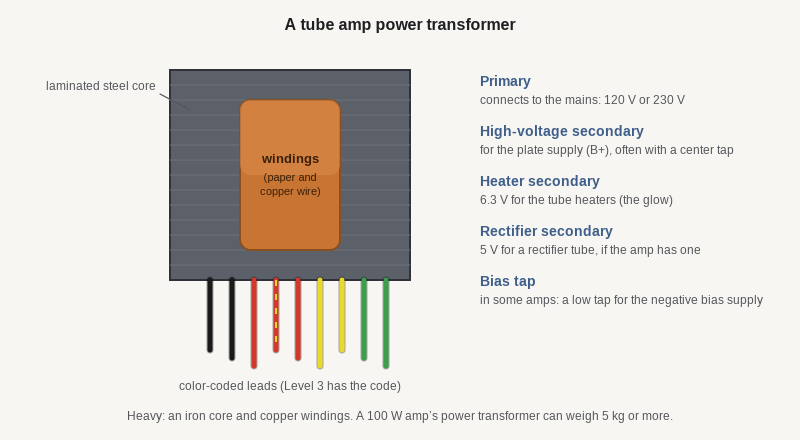
A power transformer is a stack of thin steel sheets, the core, with coils of copper wire, the windings, wound around its center. Some are open, with the windings and core visible; others are enclosed in metal end caps called bells. Color-coded wires come out of it and disappear into the chassis.
It is usually the biggest and heaviest part in the amp. In amps with a separate output transformer, the power transformer is typically the larger of the two, and a choke, a smaller block with only two wires, may sit nearby.
What's Inside
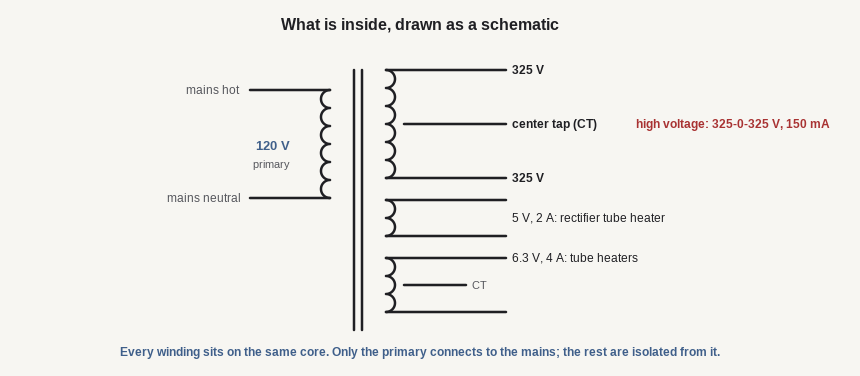
A transformer has one primary winding and one or more secondary windings, all on the same core:
- Primary: connects to the mains through the power switch and fuse. 120 V in North America, 230 V in much of the rest of the world.
- High-voltage secondary: a few hundred volts AC, turned into the DC B+ supply for the tubes' plates. Often it has a center tap, a connection halfway along, written like 325-0-325 V.
- Heater secondary: 6.3 V AC to heat the tubes' filaments, the orange glow you see inside them. It carries several amps.
- Rectifier secondary: 5 V for the heater of a rectifier tube, in amps that use one.
- Bias tap: in many amps, a low-voltage tap used to make the negative bias supply for the power tubes.
The only connection between the windings is the magnetic field in the core. That is why the amp's circuit is isolated from the mains, an important safety feature.
How It Works, Simply
A transformer only works on AC. The mains' alternating current in the primary makes a changing magnetic field in the core, and that field makes a voltage in every other winding on the same core. The voltage each winding produces depends on how many turns of wire it has compared with the primary: more turns, more volts. Level 2 explains the turns ratio.
Reading a Transformer's Label
Replacement and custom transformers come with a label or data sheet listing:
| Rating | Example | Means |
|---|---|---|
| Primary | 120 V, 60 Hz | the mains it is built for |
| High voltage | 325-0-325 V, 150 mA DC | voltage each side of the center tap, and the current it can supply |
| Heater | 6.3 V CT, 4 A | heater voltage, center tapped, and the most current it can supply |
| Rectifier | 5 V, 2 A | for a rectifier tube's heater |
The current ratings matter as much as the voltages. A transformer asked for more current than it is built for runs hot and eventually fails.
Where You Find Them
| In a... | The power transformer |
|---|---|
| Tube amp | always: the big iron block that makes the B+, heater and bias voltages |
| Solid-state amp | usually one, making the lower voltages for transistors |
| Pedal adapter | a small transformer, or a light switching supply that uses a tiny high-frequency transformer |
| Guitar, cab, pedal | none inside, though a pedal's adapter has one |
Output transformers, which match the power tubes to the speaker, are a different part with a different job. Amp and speaker impedance matching is covered in the Speakers section, and the rule is always to match the amp's output tap or step up, never down.
Try It
Look at the label on the back of your amp or in its manual: it states the mains voltage and the power the amp draws from the wall. Compare it with the rating of the fuse holder on the back panel. Never replace a fuse with a larger one: the fuse protects the transformer.
Level 2 covers how a power transformer works in an amp: the turns ratio, turning the high voltage into B+, heater wiring and hum, dual mains voltages, fuses, and why transformers get hot or buzz.