Level 1 covered what a power transformer is and what its windings do. This level is about how it works in a tube amp: the turns ratio, how the high-voltage winding becomes B+, heater wiring and hum, amps built for two mains voltages, fuses, and what it means when a transformer runs hot or buzzes.
DANGER: LETHAL VOLTAGE. Everything in this article happens inside a powered tube amp, at mains voltage and several hundred volts DC. It explains how the amp works. It is not a guide to measuring or modifying a live amp. Filter caps can stay charged for minutes or days after unplugging; the Cap Drain & Bleeder Calculator explains how they are made safe.
The Turns Ratio
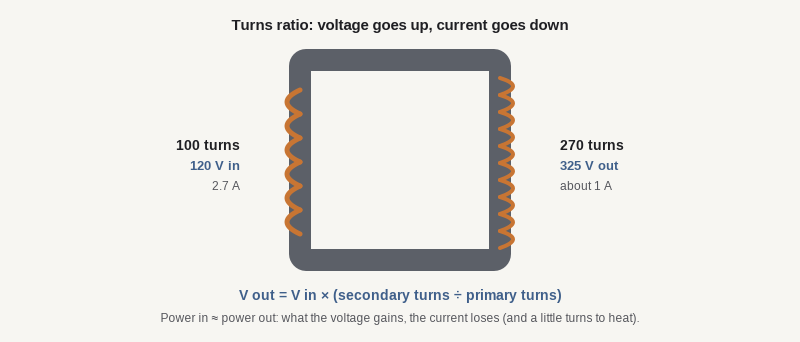
Each winding's voltage is set by its number of turns compared with the primary's:
V out = V in × (secondary turns ÷ primary turns)
A secondary with 2.7 times the primary's turns turns 120 V into about 325 V. A heater winding with about one nineteenth of the turns gives 6.3 V.
A transformer doesn't create power. Apart from a little loss as heat, the power out equals the power in. So a winding that steps the voltage up delivers proportionally less current, and one that steps it down can deliver more. That is why the 6.3 V heater winding can supply several amps while the high-voltage winding supplies a fraction of an amp, and why the heater wires are thick.
From the High-Voltage Winding to B+
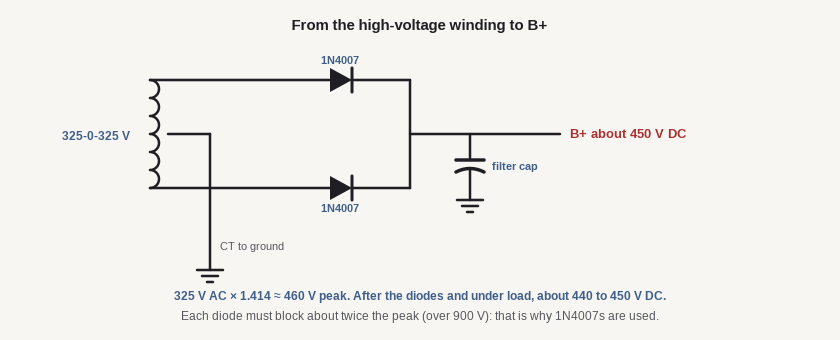
The high-voltage winding produces AC. The tubes need DC. Getting from one to the other takes two steps:
- Rectifying: diodes, or a rectifier tube, let through only one direction of current. With a center-tapped winding, two diodes each handle half of the wave, and the center tap goes to ground. Without a center tap, four diodes in a bridge do the same job. The Diodes and LEDs series covers both.
- Filtering: big filter capacitors smooth the result into steady DC, the B+ supply. A choke or resistor and more caps follow to cut the ripple further for the preamp (see the Capacitors series).
The DC that comes out is higher than the AC reading, because the filter caps charge to the peak of the wave: about 1.41 times the AC voltage, minus what the diodes or rectifier tube drop and what sags under load. A 325 V winding gives roughly 440 to 450 V of B+ with silicon diodes.
Rectifier tube or diodes? A rectifier tube drops more voltage than diodes and lets the supply sag when the amp is played hard, which softens the attack and compresses the sound. Diodes give a stiffer, slightly higher supply. The power transformer's 5 V winding exists only to heat a rectifier tube.
Heaters and Hum
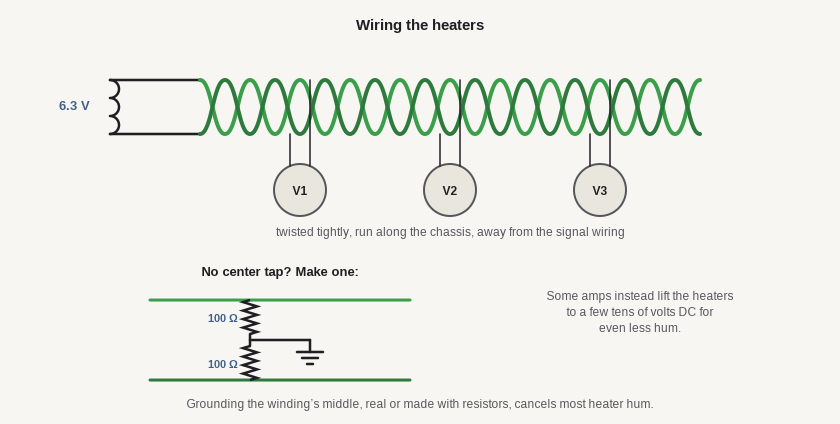
The 6.3 V heater supply is AC, carrying several amps, and it runs to every tube in the amp. Wired carelessly, it puts 60 Hz hum straight into the signal. The standard practices:
- Twisted pair: the two heater wires are twisted tightly together, so their magnetic fields largely cancel, and run along the chassis, away from signal wiring.
- A grounded center: the winding's center tap goes to ground. If there is no center tap, two 100 Ω resistors across the winding, with their junction to ground, make an artificial center tap. Either way, the two heater wires swing equally above and below ground, and their hum mostly cancels.
- Elevated heaters: some amps lift the heater winding to a few tens of volts DC, which reduces hum from the tubes further.
- DC heaters: a few amps, mostly for the preamp tubes of high-gain designs, rectify and filter the heater supply into DC.
Mounting and Magnetic Hum
A transformer's core spills a little magnetic field around it. An output transformer or choke mounted close by can pick it up as hum. Amp builders mount the power transformer and the output transformer with their cores at right angles to each other to minimize it.
Two Mains Voltages: Dual Primaries
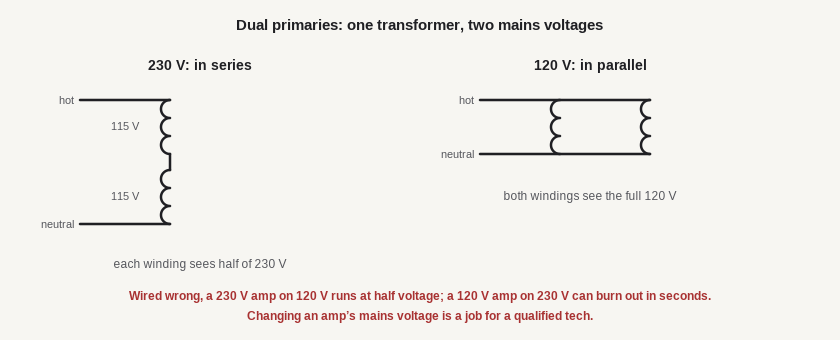
Amps sold worldwide often have a transformer with two primary windings, or a primary with several taps:
- In series, the two windings share 230 V between them.
- In parallel, each sees the full 120 V.
Either way, every secondary produces its normal voltages. Changing which way they are connected changes the mains voltage the amp expects. Getting it wrong is serious: an amp set for 120 V and plugged into 230 V can destroy its transformer, tubes and caps in seconds. Some amps have a voltage selector switch; others are wired internally. Changing an amp's mains voltage is a job for a qualified technician, along with the matching fuse change.
Fuses and Standby
- The mains fuse protects the transformer and the house wiring if something inside fails. It is usually a slow-blow type, because the transformer and the empty filter caps draw a surge at switch-on. A fuse that blows means something is wrong. Never fit a larger fuse, and never bridge one: a transformer with no working fuse can overheat and start a fire.
- The standby switch, where fitted, keeps the heaters on while cutting the high voltage, so the amp can warm up and be muted between songs.
Hot or Buzzing
- Warm is normal. A power transformer under load runs warm, sometimes too warm to keep a hand on for long in a big amp.
- Very hot, or smelling hot, means trouble: the amp drawing too much current (a failing tube, a shorted filter cap), the wrong mains voltage, or a tube swap the heater winding can't support. Switch off and have it checked.
- A mechanical buzz from the transformer itself is usually loose laminations, or DC on the mains. It's annoying more than dangerous, but worth a tech's look if it's new.
- Tar or wax oozing from an old transformer means it has been overheated, often for years.
Common Mistakes
- A bigger fuse to stop it blowing. The fuse is doing its job; find the fault.
- An amp moved between countries without changing the primary wiring. Check the voltage label first.
- Tube swaps that overload the heater winding. EL34s draw much more heater current than 6L6s (Level 3).
- Opening a chassis before it's drained. The transformer is off when unplugged; the filter caps it charged are not.
Try It
Read the voltage and fuse rating on your amp's back panel and compare them with what the manual says. If your amp has a voltage selector, note which setting it is on, and never change it with the amp plugged in.
Level 3 covers the numbers: VA ratings, current ratings and what they mean, heater current budgets, the standard lead color code, today's higher mains voltage, winding resistance checks, and choosing a replacement transformer.