This level is the reference: taper percentages, tolerance, the loading math behind 250k and 500k, faking a taper with a resistor, power ratings, and how to test, buy and substitute a pot.
Taper in Numbers
A taper is described by where the resistance sits with the shaft turned halfway, measured from lug 1 to the wiper:
| Taper | At halfway | Notes |
|---|---|---|
| Linear (B) | 50% | the same change for every degree of turn |
| Audio (A) | about 10% to 20% | the figure varies by maker; 10%, 15% and 20% audio tapers are all sold |
| Reverse audio (C) | about 80% to 90% | an audio taper turned round |
A real audio taper is not a smooth curve. It is usually made from two or three straight sections of track with different resistances, so turning it can feel slightly uneven, and two pots of the same value from different makers can feel quite different. Guitar pots marketed as "custom" or "smooth" tapers are tuned to spread the change more evenly across the knob.
Tolerance
Most pots are ±20%. A 500k pot may measure anywhere from 400k to 600k, and some measure outside even that. Some makers sell ±10% pots, and many guitar parts suppliers sell pots measured and sorted by value.
Since a pot's value changes a guitar's treble, two guitars with "500k" pots can sound noticeably different. If you want brighter, pick the highest-measuring pots from a batch; for darker, the lowest.
The Loading Math
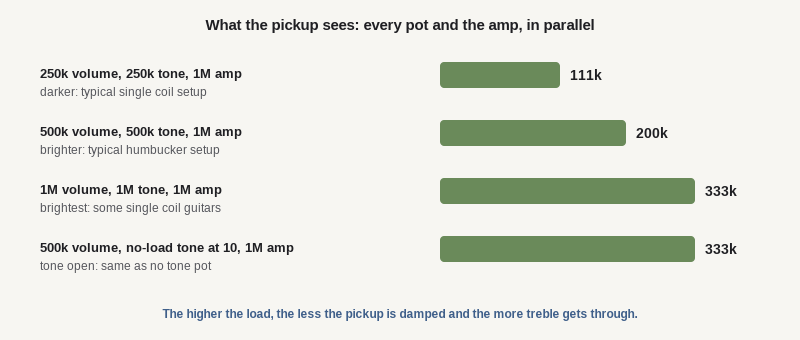
With the volume on 10 and the tone on 10, the pickup sees the volume pot, the tone pot and the amp's input all in parallel. Resistors in parallel combine as:
1 ÷ R = 1 ÷ R1 + 1 ÷ R2 + 1 ÷ R3
| Volume | Tone | Amp input | Total load |
|---|---|---|---|
| 250k | 250k | 1M | 111k |
| 500k | 500k | 1M | 200k |
| 1M | 1M | 1M | 333k |
| 500k | no-load at 10 | 1M | 333k |
| 500k | none (volume only) | 1M | 333k |
Going from 250k to 500k pots nearly doubles the load resistance, which is why the change is easy to hear. The cable adds capacitance on top of this: the Instrument Cable (pF) Calculator shows how much.
Turning the volume down puts resistance in series with the signal, and with the cable's capacitance that forms a low-pass filter. The pot's output resistance is highest where the resistance above and below the wiper are equal: halfway round on a linear pot, but well up the knob on an audio pot. That is where the treble loss is worst, and where a treble bleed helps most.
Faking a Taper
A resistor from the wiper to lug 1 bends a linear pot's curve toward an audio taper. A value around 10% to 20% of the pot's value works well: about 47k to 100k across a 500k linear pot, or 1k to 2.2k across a 10k. It is handy when the right pot isn't in the drawer, and it is how some circuits get an in-between taper. The resistor also lowers the pot's effective value slightly, which is worth remembering in a guitar.
The same trick in reverse, a resistor from the wiper to lug 3, pushes the curve the other way.
Power and Current
Ordinary carbon pots are rated somewhere around 0.05 W to 0.5 W, depending on size. The rating assumes the power is spread over the whole track. Used as a variable resistor, all the current flows through only part of the track, so near the zero end a small section can overheat even when the total power looks safe. Two rules follow:
- Put a fixed resistor in series to set a minimum resistance whenever the circuit could otherwise put a lot of current through the wiper.
- Never use an ordinary pot to control speaker level. A guitar amp's speaker output can be tens of watts. Speaker attenuators and level controls use an L-pad or a wirewound rheostat rated for the power, matched to the speaker's impedance, so the amp still sees the load it expects.
DANGER: LETHAL VOLTAGE. Pots in a tube amp can sit at high DC voltages, and their cases may not be grounded the way a guitar's are. Before replacing one, unplug the amp, drain the filter caps through a resistor and check each with a meter. The Cap Drain & Bleeder Calculator shows how.
Testing
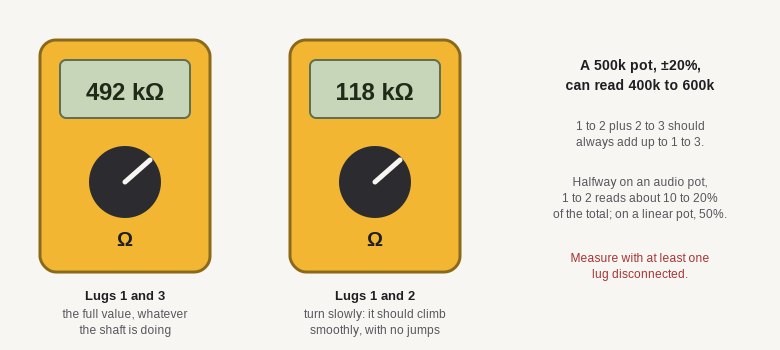
Set the meter to ohms, with at least one of the pot's lugs disconnected from the circuit.
- Lugs 1 and 3: the total value, whatever position the shaft is in. It should be within tolerance.
- Lugs 1 and 2: turn the shaft slowly from one end to the other. The reading should climb smoothly from near zero to the full value, with no jumps or drop-outs.
- Check the sum: at any position, 1 to 2 plus 2 to 3 should equal 1 to 3.
- Check the taper: set the shaft halfway. On an audio pot, 1 to 2 should read about 10% to 20% of the total; on a linear pot, about 50%.
- Check a push-pull switch with the meter on continuity, pulling and pushing the shaft.
A reading that flickers as you turn is a dirty or worn track. A reading of OL from the wiper at some positions means the wiper has lost contact.
Buying and Substituting
The value and taper decide how a pot sounds. Everything else decides whether it fits.
| Check | Options | Notes |
|---|---|---|
| Value and taper | for example A500K | ±20% unless stated |
| Body size | 24 mm, 16 mm, 9 mm | 24 mm for most guitars and amps, 16 mm for most pedals |
| Bushing | 3/8" (guitar and amp standard) or M7 / 7 mm (common on 16 mm pots) | check the hole first; a 3/8" bushing needs a larger hole than many import guitars use |
| Bushing length | short or long | long for carved tops and thick panels |
| Shaft | solid, or split (knurled) | knurled shafts take push-on knobs |
| Knurl count | fine (24 splines) or coarse (18 splines) | a knob made for one doesn't fit the other well; fine is common on American guitar parts, coarse on many imports |
| Mounting | solder lugs, PCB legs, right-angle PCB | match the circuit board when replacing a pedal pot |
Substituting:
- Replace a pot with the same value and taper whenever you can.
- A value 20% or so away usually works, with a small change in brightness or range.
- In a guitar, moving from 250k to 500k brightens it; from 500k to 250k darkens it. That is a valid mod, not a mistake.
- A linear pot can stand in for an audio one in a pinch, with a resistor from the wiper to lug 1 to fake the taper.
- For a dual gang, both sections should match each other closely, especially in stereo or filter circuits.
Try It
Use the Resistance (Ω) Calculator to check the loading table above: put 500k, 500k and 1M in parallel and you should get 200k. Then in Build a Circuit, place a Potentiometer and set its value from the Inspector to match the pots in your own guitar.