Level 1 covered what a pot is and how to read one. This level is about how pots behave once they are wired in: the two ways to use one, how a guitar's volume and tone controls work, why taper matters, why guitars use 250k or 500k, and the special types you will run into.
Two Ways to Use a Pot
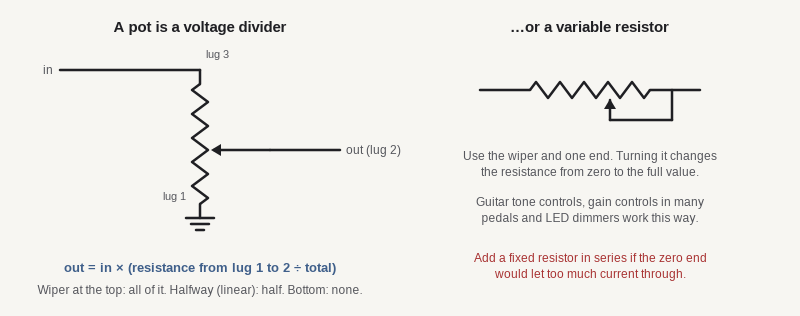
As a voltage divider, all three lugs are used. The signal goes in at lug 3, lug 1 goes to ground, and the wiper picks off part of the signal:
out = in × (resistance from lug 1 to lug 2 ÷ total resistance)
With the wiper at the top you get the whole signal; at the bottom, none. Every volume control works this way, in guitars, pedals and amps.
As a variable resistor, only the wiper and one end are used, often with the unused end joined to the wiper. Turning it changes the resistance from zero to the full value. Guitar tone controls, many pedal gain controls and LED dimmers work this way. If zero ohms would let too much current through, as with an LED, add a fixed resistor in series to set the minimum.
How a Guitar's Controls Work
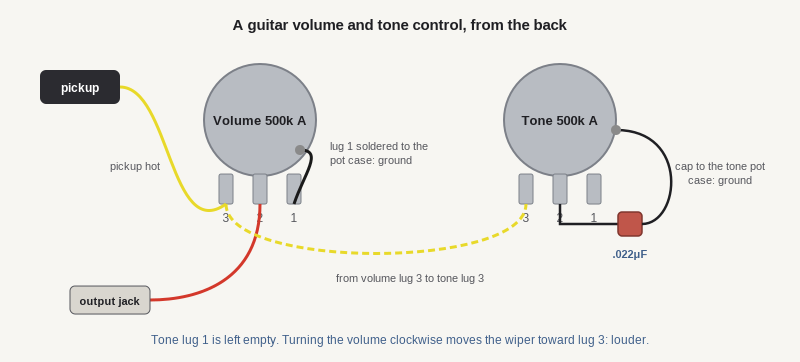
Volume: the pickup goes to lug 3, the wiper (lug 2) goes to the output jack, and lug 1 goes to ground, usually soldered straight to the back of the pot's case. Turning clockwise moves the wiper toward the pickup: louder. If a volume control works backwards, lugs 1 and 3 are swapped.
Tone: the tone pot is wired as a variable resistor in series with a capacitor to ground. At 10, its full resistance sits in front of the cap, so very little treble leaks away. Turning it down lowers the resistance and sends more treble through the cap to ground. The Capacitors series covers how the cap's value changes the sound.
Where the tone control connects makes a difference you can hear:
- Modern wiring: the tone circuit connects to the volume pot's lug 3, where the pickup comes in. The two controls work independently, but turning the volume down loses some treble.
- Fifties wiring: the tone circuit connects to the volume pot's wiper instead. The tone control then interacts with the volume, and the guitar keeps more of its treble as you turn the volume down. Many players prefer it for that reason.
Turning the volume down also loses treble for another reason: the pot's resistance and the cable's capacitance form a filter. That is what a treble bleed network fixes, and it gets its own series.
Why Taper Matters
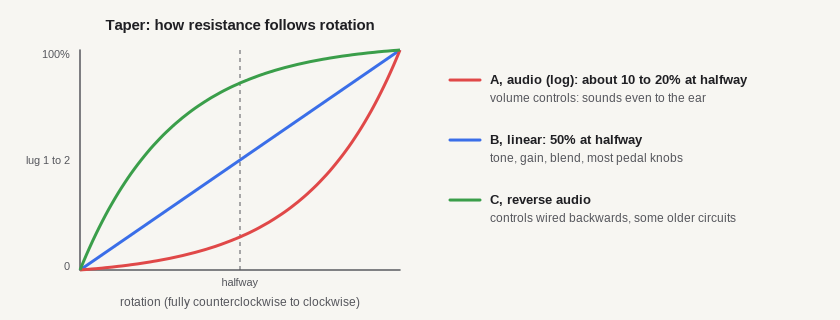
Your ears hear loudness on a logarithmic scale: to sound twice as loud, a signal needs roughly ten times the power. A linear pot used for volume does almost nothing for most of its turn and then all of the change comes in the last part, so the guitar seems to go from loud to off in the bottom quarter of the knob. An audio taper changes slowly at first and quickly near the top, so each step of the knob sounds like an even step in volume.
As a rule:
- Audio taper (A): volume, level and master controls. Most guitar tone controls too, because the effect sounds more even.
- Linear taper (B): gain, tone and EQ in most pedals, blend controls, rate and depth.
- Reverse audio (C): a control that has to work backwards, for example when the layout forces the lugs the other way round.
250k or 500k?
A guitar pickup is loaded by everything connected to it: the volume pot, the tone pot and the amp's input, all in parallel. The bigger those resistances, the less the pickup's natural treble peak is damped, so the brighter the guitar sounds.
- 250k pots load the pickup more and soften the treble. They are the usual choice with single coils, which are bright to begin with.
- 500k pots load it less and keep more treble. They are the usual choice with humbuckers, which are warmer.
- 1M pots are sometimes used with single coils for an extra-bright sound.
Changing pot values is one of the cheapest ways to brighten or darken a guitar. Level 3 shows the numbers.
Pots in Pedals and Amps
- Gain controls are often a variable resistor in a transistor's or op-amp's feedback path. Turning it up changes how much the stage amplifies.
- Level controls are voltage dividers at the output, almost always audio taper.
- Tone controls in pedals vary, but many are a pot sweeping between a treble-cut and a bass-cut filter, usually linear.
- Amp tone stacks use three pots and several caps that interact with each other, so turning one control changes the others a little. Treble and bass pots are usually a few hundred k to 1M; middle pots are often 10k to 25k.
- Bias trim pots in tube amps set the power tubes' idle current. They are adjusted with the amp on and must be set while measuring, following the Tube Bias Calculator.
DANGER: LETHAL VOLTAGE. An amp's bias pot, tone controls and the circuits around them sit inside a chassis with voltages that can kill, and the filter caps can stay charged after the amp is unplugged. Only adjust a bias pot if you know how to work on a live amp safely; otherwise leave it to a tech. Before replacing any pot inside an amp, unplug it, drain the caps and check them with a meter. The Cap Drain & Bleeder Calculator shows how.
Special Types
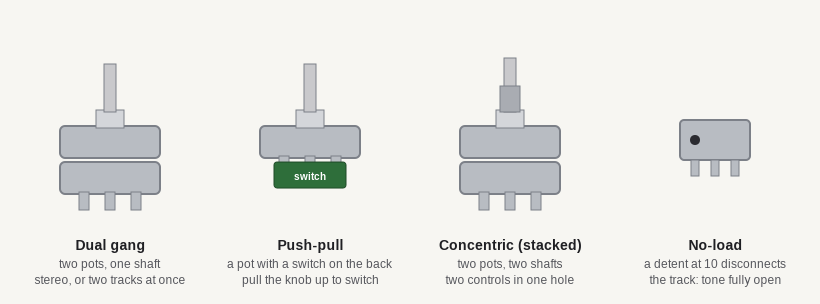
| Type | What it is | Used for |
|---|---|---|
| Dual gang | two pots on one shaft, turning together | stereo controls, filters that need two tracks to move at once |
| Push-pull | a pot with a small switch on the back, worked by pulling the knob | coil splits, series and parallel pickup wiring, phase switches |
| Push-push | same idea, pressed instead of pulled | the same jobs with a cleaner look |
| Concentric (stacked) | two pots with two shafts, one inside the other | two controls in one hole, as in some basses |
| No-load | a pot whose track disconnects at the top of its turn, with a click | tone controls: at 10, the tone circuit is out of the signal completely |
| Blend | a pot with a center detent, sometimes with a special taper | mixing two pickups, or a clean and an effected signal |
Scratchy Pots
A pot that crackles when you turn it has dust or wear on its track. A shot of contact cleaner made for pots, sprayed into the opening near the lugs and then worked by turning the shaft back and forth, usually fixes it. If it doesn't, or if the sound cuts in and out at one spot, the track is worn and the pot needs replacing.
A pot that crackles in a pedal or amp even when you aren't turning it can mean DC is reaching it, often from a leaky coupling cap. Fix the cap, and the pot goes quiet.
Common Mistakes
- Lugs 1 and 3 swapped: the control works backwards. Swap the two outer wires.
- A linear pot for volume: all the change is at one end of the knob.
- Too much heat on the case when soldering a ground wire: it can damage the pot inside. Use a hot iron, scuff the case first, and be quick.
- The wrong bushing or shaft: check the hole size and the knob's fit before buying (Level 3).
- A pot with zero resistance at one end driving an LED or transistor directly: add a series resistor to set a safe minimum.
Try It
In Build a Circuit, load the Potentiometer-Controlled LED template and trace which two of the pot's legs it uses, and why the series resistor is there. Then work out a guitar's pickup load with the Resistance (Ω) Calculator: put a volume pot, a tone pot and a 1M amp input in parallel.
Level 3 covers the numbers: taper percentages, tolerance, the loading math, faking a taper with a resistor, power ratings, and how to test, buy and substitute a pot.