A potentiometer, or pot, is a resistor you can adjust by turning a shaft. Every knob on a guitar, almost every knob on a pedal and most of the knobs on an amp is a pot. Volume, tone, gain, treble and bass are all the same part, wired and chosen a little differently.
What's Inside
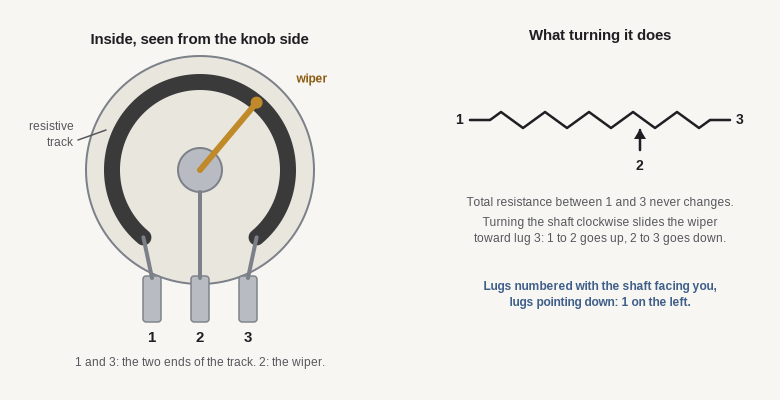
A pot has three lugs (terminals):
- Lugs 1 and 3 are the two ends of a curved resistive track. The resistance between them is the pot's value, and it never changes.
- Lug 2, the middle one, is the wiper: a contact that slides along the track as you turn the shaft.
Turning the shaft moves the wiper closer to one end and farther from the other. So the resistance from lug 1 to lug 2 goes up while the resistance from lug 2 to lug 3 goes down, and the two always add up to the full value.
Numbering: hold the pot with the shaft pointing at you and the lugs pointing down. Lug 1 is on the left, 2 in the middle, 3 on the right. Turning clockwise moves the wiper toward lug 3. Seen from the back, the way you see it when you solder, the order flips: lug 3 is on the left.
Reading the Markings
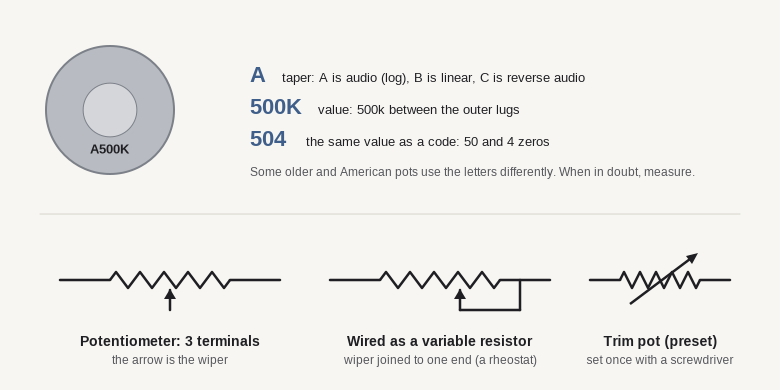
Most pots print two things: a letter for the taper and the value.
| Marking | Taper | Value |
|---|---|---|
| A500K | audio (log) | 500k |
| B10K | linear | 10k |
| A250K | audio (log) | 250k |
| B100K | linear | 100k |
| C25K | reverse audio | 25k |
Taper is how the resistance changes as you turn the shaft. An audio taper (A) changes slowly at first and quickly at the end, which matches how your ears hear loudness, so it is the choice for volume. A linear taper (B) changes evenly, and suits tone, gain and blend. Level 2 explains why.
Some pots, especially small ones, print the value as a three-digit code instead, the same code used on capacitors: two digits and then the number of zeros. 103 is 10k, 254 is 250k, 504 is 500k and 105 is 1M.
The letters above are the standard on most pots made today, but some older and American pots use the letters differently. If a pot's taper matters and you're not sure, measure it (Level 3 shows how).
Sizes
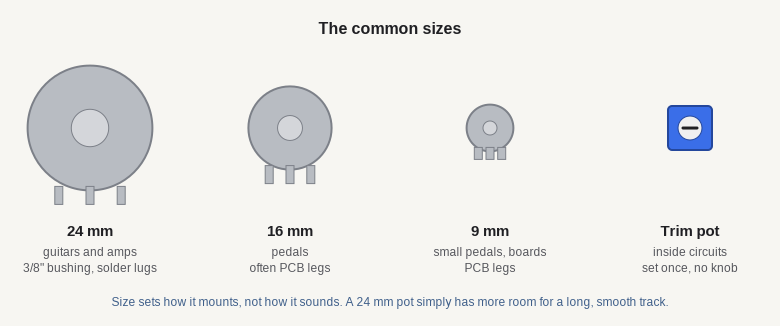
- 24 mm (full size): the standard in guitars and most amps, with solder lugs and a 3/8" threaded bushing.
- 16 mm: the usual size in pedals, often with legs that solder straight into a circuit board.
- 9 mm: compact pedals and boards with tight spacing.
- Trim pots: tiny pots inside a circuit, set once with a small screwdriver and left alone. A bias adjustment in an amp or a pedal's internal bias control is usually a trim pot.
Size sets how a pot mounts and how long its track is, not how it sounds.
On a Schematic
A pot is drawn as a resistor with an arrow pointing at it: the arrow is the wiper. If the wiper is joined to one end, the pot is being used as a simple variable resistor (sometimes called a rheostat). A resistor with a diagonal arrow through it is an adjustable resistor, often used for trim pots; the label beside it, such as BIAS or TRIM, tells you what it sets.
Where You Find Them
| In a... | What the pots are doing |
|---|---|
| Guitar | volume and tone. 250k is the usual value with single coil pickups, 500k with humbuckers. Audio taper for volume, and usually for tone too |
| Pedal | level, gain, tone, blend, rate and depth. Values from 10k to 500k, mostly linear, with audio taper for level and volume |
| Tube amp | volume, treble, middle and bass, presence, reverb and master. Values from about 10k for a middle control to 1M for volume and bass. Trim pots for the bias and sometimes a hum balance control |
| Speaker cab | rarely. A speaker attenuator uses a heavy-duty control, not an ordinary pot (Level 3 explains why) |
Try It
In Build a Circuit, drag in the Potentiometer-Controlled LED template: a pot wired as a variable resistor, its wiper feeding an LED. It shows the wiring pattern for dimming an LED with a knob. Then place your own Potentiometer and look at how its three legs sit on the breadboard.
Level 2 covers how a pot works in a circuit: voltage dividers, guitar wiring, why tapers matter, 250k versus 500k, and the special types like push-pull and no-load pots.