This level is the reference: the impedance and turns ratio math, typical primary impedances for common tube types, power, voltage and current at the speaker, lead colors, resistance checks with the amp unplugged, and what to match when replacing an output transformer.
DANGER: LETHAL VOLTAGE. The only measurements here are made with the amp unplugged, its filter caps drained and checked with a meter, and the speaker disconnected. The primary sits at B+ in a running amp, and an unloaded output transformer can produce spikes of thousands of volts. Replacing an output transformer is a job for a qualified technician. The Cap Drain & Bleeder Calculator explains how filter caps are drained.
The Ratio Math
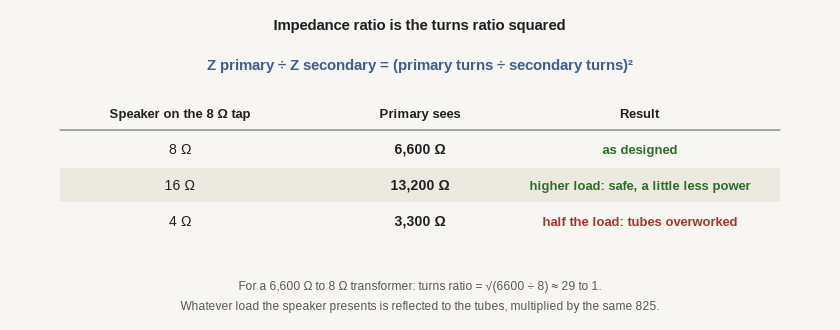
The impedance ratio is the turns ratio squared:
Z primary ÷ Z secondary = (N primary ÷ N secondary)²
so the turns ratio is the square root of the impedance ratio:
N primary ÷ N secondary = √(Z primary ÷ Z secondary)
A 6,600 Ω to 8 Ω transformer has an impedance ratio of 825 and a turns ratio of about 29 to 1. Any load on that tap is multiplied by 825: 16 Ω becomes 13,200 Ω, and 4 Ω becomes 3,300 Ω.
A multi-tap secondary is one winding with taps at the right points. Because impedance goes with turns squared, the taps are not evenly spaced: the 4 Ω tap sits at about 71% of the 8 Ω tap's turns, and the 16 Ω end at about 141%.
Typical Primary Impedances
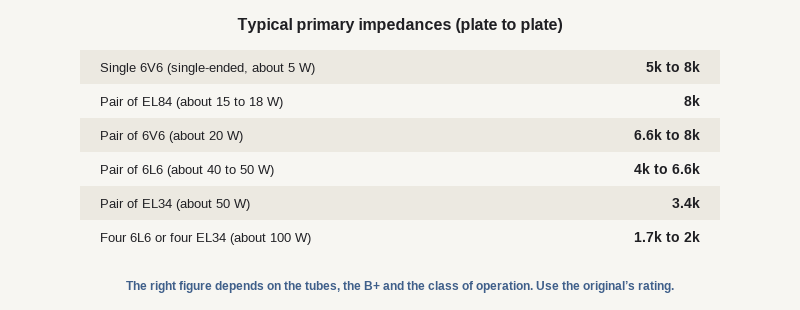
| Power tubes | Approximate power | Primary impedance (plate to plate) |
|---|---|---|
| Single 6V6, single-ended | about 5 W | 5k to 8k |
| Pair of EL84 | 15 to 18 W | 8k |
| Pair of 6V6 | about 20 W | 6.6k to 8k |
| Pair of 6L6 | 40 to 50 W | 4k to 6.6k |
| Pair of EL34 | about 50 W | 3.4k |
| Four 6L6 or four EL34 | about 100 W | 1.7k to 2k |
Doubling the number of tubes in parallel halves the primary impedance they want. The exact figure depends on the B+, the class of operation and the designer's choices, so a replacement should match the original's rating rather than a table.
Power, Voltage and Current at the Speaker
The speaker side follows Ohm's law and the power formulas:
V = √(P × R) and I = √(P ÷ R)
| Amp power | Load | Voltage at the speaker | Current |
|---|---|---|---|
| 15 W | 8 Ω | 11 V | 1.4 A |
| 50 W | 8 Ω | 20 V | 2.5 A |
| 50 W | 16 Ω | 28 V | 1.8 A |
| 100 W | 8 Ω | 28 V | 3.5 A |
| 100 W | 4 Ω | 20 V | 5.0 A |
Those are average figures at full power; a cranked amp's peaks go higher. Speaker cables, jacks and switches must be rated for the current, which is why a guitar cable is no substitute for a speaker cable. The Power (W) Calculator works these out, and the Speaker Wire (AWG) Calculator picks the cable gauge.
Power Rating and Frequency
A transformer's power rating is usually given at a stated low frequency, because bass is what pushes a core toward saturation. A transformer rated "50 W at 40 Hz" carries much more than 50 W at 1 kHz. Guitar amp transformers are often rated at higher frequencies than hi-fi ones, which is one reason the same tube power can come with very different transformer sizes.
Ultralinear taps: some output transformers have extra taps on the primary for the power tubes' screen grids, a hi-fi-derived arrangement that sits between pentode and triode behavior. Amps that use them need a transformer with matching taps.
Lead Colors
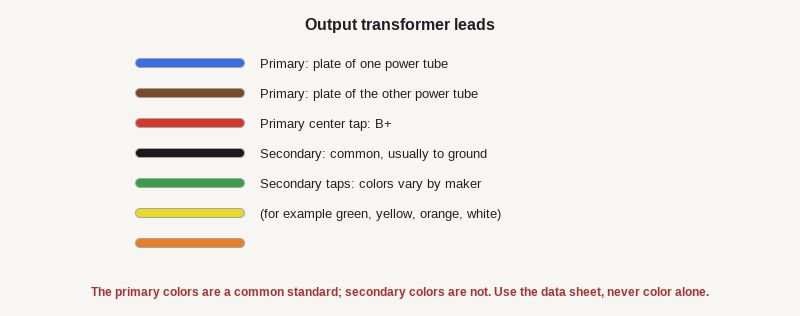
| Color | Usual meaning |
|---|---|
| Blue | primary: one power tube's plate |
| Brown | primary: the other power tube's plate |
| Red | primary center tap: B+ |
| Black | secondary common |
| Green, yellow, orange, white and others | secondary taps, varying by maker |
Swapping the blue and brown leads reverses the transformer's phase. In an amp with negative feedback, that turns the feedback positive and the amp can howl or oscillate, which is why a replacement must be wired exactly as the original, and why techs check the feedback phase after a transformer change.
Resistance Checks
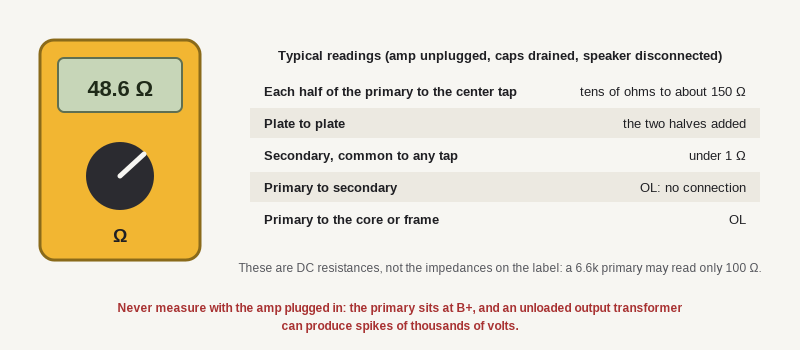
With the amp unplugged, the filter caps drained and the speaker disconnected, a meter on ohms checks the windings:
| Between | Typical reading |
|---|---|
| Each half of the primary to the center tap | tens of ohms to about 150 Ω, the halves roughly equal |
| Plate lead to plate lead | the two halves added |
| Secondary common to any tap | under 1 Ω |
| Primary to secondary | OL: no connection |
| Primary to the core or frame | OL |
These are DC resistances, not the impedances on the label. A 6,600 Ω primary may measure only about 100 Ω on a meter: impedance is an AC property set by the turns ratio and the load.
What the readings tell you:
- OL across half the primary: an open winding, often from an arc or overheating. The transformer needs replacing.
- Any reading between primary and secondary, or primary and core: broken insulation. The transformer is dangerous and must be replaced, because B+ could reach the speaker circuit.
- Normal readings don't prove the transformer is healthy: shorted turns and weak insulation only show up in tests under power, which are a tech's job.
Choosing a Replacement
| Match | Why |
|---|---|
| Push-pull or single-ended | they are built differently and are not interchangeable |
| Primary impedance | sets the load the tubes see |
| Secondary taps | the speaker loads you will use |
| Power rating | at least the amp's output, with margin |
| Ultralinear taps | only if the amp uses them |
| Size and mounting | the footprint, bolt pattern and lead length |
| Tone | for a well-known amp, a replacement made for that model keeps its character |
Upgrading to a larger transformer of the same impedance usually gives more bass and headroom, and changes the sound: sometimes wanted, sometimes not.
DANGER: LETHAL VOLTAGE. An output transformer replacement involves the amp's B+ wiring, the power tube plates and the feedback loop. A mistake can kill, destroy the new transformer, or make the amp oscillate. Have it done by a qualified technician.
Try It
Work out the voltage and current your own amp puts on its speaker cable with the Power (W) Calculator, then check that your speaker cable is up to it with the Speaker Wire (AWG) Calculator.