Level 1 covered what an output transformer does and the rule for connecting speakers. This level explains why the rule exists: how the transformer reflects the speaker's load back to the tubes, what happens when the load is too low or missing, how to wire cabinets for the right tap, and how the transformer shapes an amp's sound.
DANGER: LETHAL VOLTAGE. The output transformer's primary sits at B+, and with no speaker connected it can produce spikes of thousands of volts. Connect speakers with the amp off or on standby, and never work inside a powered amp. The Cap Drain & Bleeder Calculator explains how filter caps are made safe.
The Speaker's Load Is Reflected to the Tubes
A transformer changes impedance by the square of its turns ratio. An output transformer with about 29 times as many turns on its primary as on its 8 Ω tap multiplies the load by about 29², roughly 825. So an 8 Ω speaker on that tap looks to the tubes like 6,600 Ω, the load they were designed to drive.
The key point: the transformer doesn't fix the impedance; it multiplies whatever the speaker presents. Change the speaker load and the load the tubes see changes in proportion:
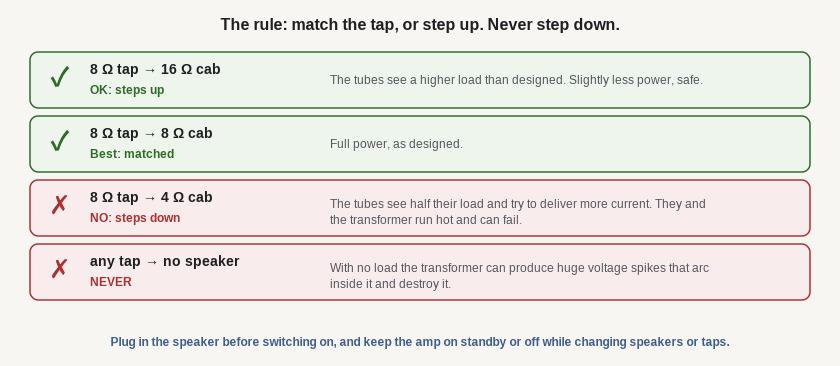
- Speaker load higher than the tap (16 Ω on the 8 Ω tap): the tubes see double their design load. They deliver a little less power and run a little easier. Safe.
- Speaker load lower than the tap (4 Ω on the 8 Ω tap): the tubes see half their design load. They try to deliver more current than they were designed for. They run hot, wear out faster, and the extra current through the transformer heats it too. Done hard and long enough, tubes, screen resistors or the transformer can fail. Never.
Why No Load Is the Worst Case
With no speaker connected, the load the tubes see is effectively infinite. The transformer's primary has nothing to transfer its energy to, and every time the signal swings, the collapsing magnetic field produces a voltage spike. These spikes can reach thousands of volts, enough to arc between the windings inside the transformer, puncture its insulation, and take out the power tubes and their sockets. One loud chord into an open output can do it.
Common ways it happens:
- Turning the amp on with no speaker plugged in.
- A broken speaker cable, or a jack whose contacts don't touch.
- Plugging the speaker into the wrong jack, such as an effects loop or a line out.
- Pulling the speaker plug with the amp on and playing.
The habits that prevent it: plug in the speaker before switching on, change speakers with the amp off or on standby, and keep a spare speaker cable. If you need to run a tube amp without a speaker, for recording for example, use a dummy load or a load box rated for the amp's power and impedance, as the Resistors series describes.
Some amps short the output when no plug is in the jack, to protect against exactly this. Others have nothing. Don't count on it.
Wiring Cabinets for the Right Tap
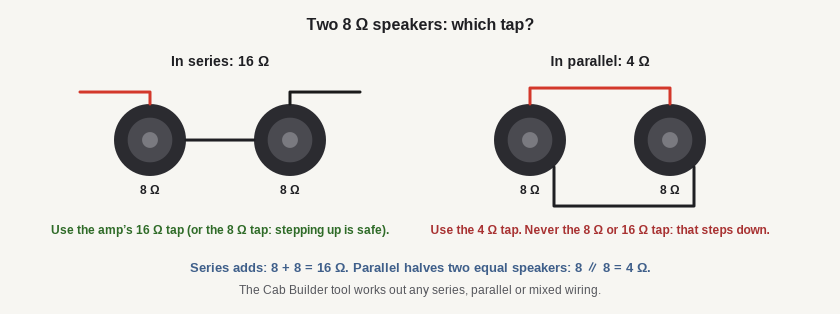
- Series: the impedances add. Two 8 Ω speakers make 16 Ω.
- Parallel: for equal speakers, the impedance divides by the number of speakers. Two 8 Ω speakers make 4 Ω; four 16 Ω speakers make 4 Ω.
- Series-parallel: four 8 Ω speakers wired as two series pairs in parallel make 8 Ω.
Then set the amp to the matching tap, or to a lower tap (step up), never a higher one. A 4 Ω cabinet goes only on the 4 Ω tap. A 16 Ω cabinet is matched on the 16 Ω tap and safe on the 8 Ω tap, with a little less power. A bigger step up, onto the 4 Ω tap, is still on the safe side of the rule but gives up more power and changes the feel, so one step is the usual limit in practice.
Two cabinets plugged into two jacks on the same tap are in parallel. Two 16 Ω cabinets on an amp set to 8 Ω is matched; two 8 Ω cabinets need the 4 Ω setting. The Cab Builder works out any wiring, and the Resistance (Ω) Calculator handles series and parallel totals. The Speakers section covers impedance, and how it varies with frequency, in depth.
How the Transformer Shapes the Tone
The output transformer is one of the most important parts of a tube amp's sound, not just a converter:
- Bass response: a bigger core carries low frequencies with less loss. Small transformers lose deep bass, which is part of the sound of many small amps.
- Saturation: pushed hard, the core approaches its magnetic limit and compresses the low end, adding a thick, softly clipped quality.
- High frequencies: the way the windings are interleaved sets how high the response reaches.
- Negative feedback: most amps take a signal from the transformer's secondary back to an earlier stage, which tightens and cleans up the sound. A presence control usually adjusts this feedback for high frequencies. Amps with no feedback sound looser and rawer.
That is why replacement transformers for well-known amps are sold by model, and why swapping an output transformer can change an amp's character noticeably.
Impedance Mismatch and Tone
A one-step mismatch upward (a 16 Ω cab on an 8 Ω tap) is safe and often used on purpose: it changes the feel slightly, usually a little tighter and less powerful. Some players try a downward mismatch for a different sound; it may work for a while, but it overworks the tubes and transformer, and this library's rule stands: match or step up, never step down.
Common Mistakes
- Two 8 Ω cabs on an amp left at 8 Ω. That is 4 Ω on the 8 Ω tap: stepped down.
- Switching on with no speaker. The single most common way to kill an output transformer.
- A guitar cable used as a speaker cable. Its thin center conductor can't carry speaker current, and it can fail, opening the output. Use a proper speaker cable.
- Changing the impedance selector while playing. Some selectors open the output for an instant between positions.
- Replacing a push-pull transformer with a single-ended one, or the other way round.
Try It
Use the Cab Builder to work out the load of your own cabinet, or of two cabinets together, and check which of your amp's taps is safe for it.
Level 3 covers the numbers: impedance and turns ratios, typical primary impedances for common tube types, power and voltage at the speaker, lead colors, resistance checks with the amp unplugged, and choosing a replacement.