The output transformer sits between a tube amp's power tubes and its speaker. Power tubes work at high voltage and small current and want to drive a load of thousands of ohms. A speaker is 4, 8 or 16 Ω and needs low voltage and large current. Connected directly, the two would hardly work together at all, and the tubes' high DC voltage would sit across the speaker. The output transformer translates between them, and keeps the DC off the speaker.
It is also the part behind the rule this library repeats whenever amps and speakers meet: match the amp's output tap to the speaker load, or step up. Never step down, and never run a tube amp with no speaker.
DANGER: LETHAL VOLTAGE. An output transformer's primary sits at the amp's full B+, often 400 to 500 V, and an output transformer with no load can produce spikes of thousands of volts. This series explains how it works so you can connect speakers safely and understand your amp. It is not a guide to working inside a live amp. The Cap Drain & Bleeder Calculator explains how filter caps are made safe.
The Job
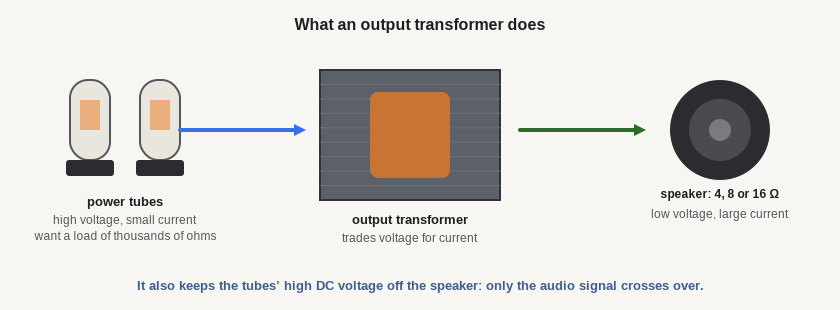
An output transformer trades voltage for current. On the tube side, its primary winding sees a few hundred volts and a fraction of an amp. On the speaker side, its secondary delivers tens of volts and several amps. In doing so it changes the impedance the tubes "see": a speaker of 8 Ω looks to the tubes like several thousand ohms, the load they are designed for.
Because the only link between primary and secondary is the magnetic field in the core, the tubes' DC voltage never reaches the speaker. Only the audio signal crosses over.
What's Inside
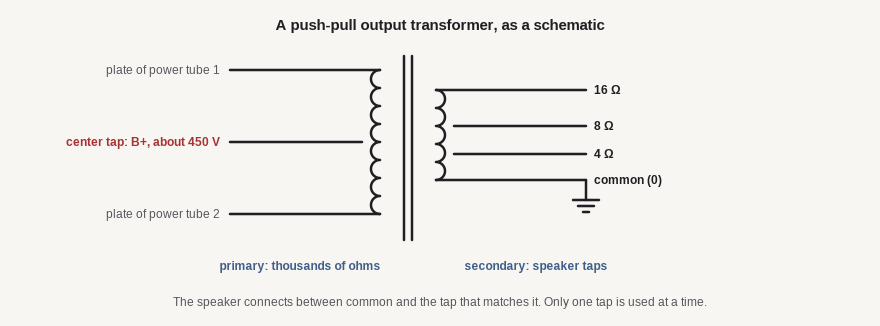
- Primary: connects to the power tubes' plates. In most amps it has a center tap fed with B+, with one end going to each power tube's plate.
- Secondary: connects to the speaker jacks. Many amps have taps for several speaker loads: a common connection plus 4, 8 and 16 Ω taps. Only one tap is used at a time, chosen to match the speaker.
Push-Pull and Single-Ended
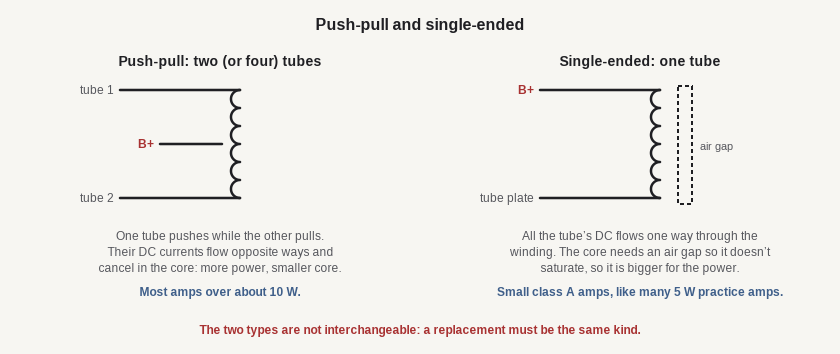
- Push-pull: two or four power tubes take turns, one pushing while the other pulls. Most amps over about 10 W work this way.
- Single-ended: one power tube does all the work. Small class A amps, like many 5 W practice and studio amps, use it. Its transformer has to handle steady DC through the winding, so it is built differently, with a gap in its core.
The two kinds are not interchangeable.
Impedance Selectors and Speaker Jacks
Amps handle the taps in different ways:
- An impedance selector (a switch or rotary marked 4, 8, 16 Ω) chooses the tap. Set it to match the speaker load.
- Several jacks marked with different impedances, each wired to a tap.
- A single jack wired to one tap, with the speaker load printed beside it.
When an amp has two speaker jacks on the same tap, plugging in two cabinets puts them in parallel, which halves the load: two 8 Ω cabs make 4 Ω. Many amp manuals spell out which jacks and settings to use for one or two cabinets. The Speakers section and the Cab Builder cover working out a cabinet's load.
Where You Find Them
| In a... | The output transformer |
|---|---|
| Tube amp | always, between the power tubes and the speaker jack. Usually smaller than the power transformer, but large in high-power amps |
| Solid-state amp | almost never: transistor power stages drive the speaker directly |
| Speaker cab | none |
| Line or re-amp boxes | small audio transformers do related jobs at signal level |
The Rule, Again
| Amp tap | Speaker load | Verdict |
|---|---|---|
| 8 Ω | 8 Ω | matched: best |
| 8 Ω | 16 Ω | steps up: safe, slightly less power |
| 8 Ω | 4 Ω | steps down: never |
| any | no speaker connected | never |
Level 2 explains why.
Try It
Find your amp's speaker jack and any impedance selector, and check them against the impedance printed on your speaker cabinet. Then use the Cab Builder to work out what load two cabinets make together.
Level 2 covers how the output transformer works: how it reflects the speaker's impedance back to the tubes, why stepping down and running with no load are dangerous, wiring cabinets for the right tap, and how the transformer shapes the amp's tone.