A tube amp is the most dangerous thing most guitarists will ever open up. The voltages inside are many times higher than the wall outlet's, and parts of the amp keep them for hours or days after it is unplugged. None of that should stop anyone working on their own amp. It does mean learning where the danger is and a few rules that never get skipped. This level covers both. Level 2 covers draining the filter caps, and Level 3 powering an amp up safely.
DANGER: LETHAL VOLTAGE. A tube amp's filter capacitors can hold a lethal charge long after it is switched off and unplugged, and the mains side is live whenever it is plugged in. Unplug the amp, drain every filter cap, and check with a meter before you touch anything inside. The Cap Drain & Bleeder Calculator shows how.
Where the Voltage Lives
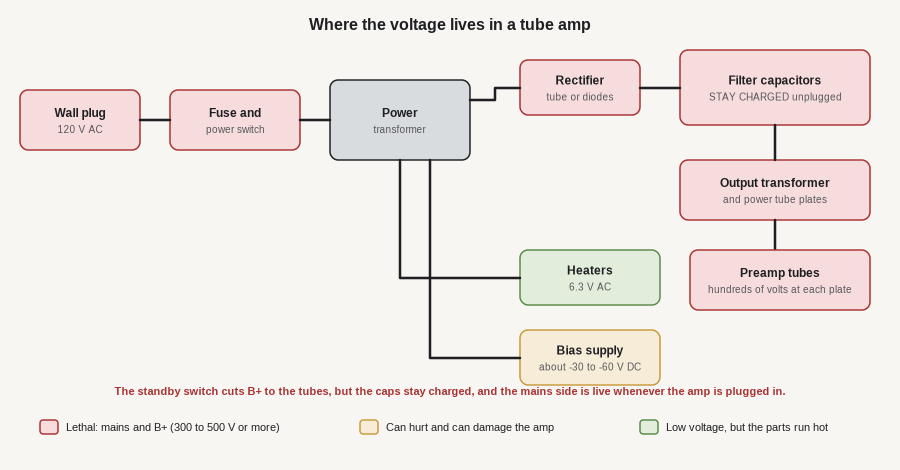
| Where | What's there | Why it matters |
|---|---|---|
| The mains side | 120 V AC from the wall (230 V in much of the world): the power cord, fuse, power switch and the transformer's primary | live whenever the amp is plugged in, even switched off |
| B+, the high-voltage DC | 300 to 500 V in most guitar amps, and more in some big ones | runs from the rectifier through the filter caps to every tube's plate and the output transformer |
| The filter capacitors | store the B+ | hold their charge after the amp is unplugged, sometimes for days |
| The bias supply | a negative voltage, about -30 to -60 V on most fixed-bias amps | enough to hurt; a bias fault can also destroy the power tubes |
| The heaters | 6.3 V AC on most tubes | harmless to touch, but the tubes and the resistors nearby run hot enough to burn |
The standby switch is not a safety switch. It cuts B+ to the tubes so they warm up before they work, but the filter caps stay charged behind it, and the mains side is still live.
Why It's Dangerous
It is current, not voltage, that hurts, but voltage is what pushes the current through you. Dry skin resists a wall outlet's 120 V reasonably well. At several hundred volts, skin resistance breaks down and far more current flows.
- About 10 mA through the arms makes the muscles clamp, and you can't let go of what you're holding.
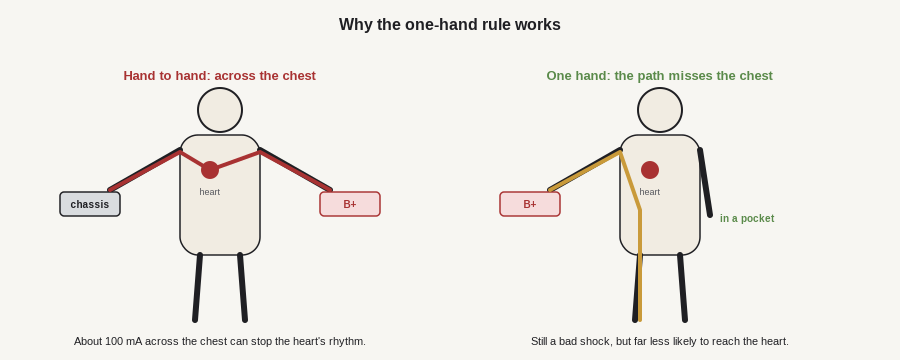
- About 100 mA across the chest can throw the heart out of rhythm. That is fatal without a defibrillator.
The path matters as much as the amount. Current from one hand to the other goes straight across the chest and the heart.
The Bench Rules
- Unplug it. Pull the plug from the wall, not just the power switch. Keep the plug where you can see it.
- Drain the filter caps and measure them. Every time, even if the amp has bleeder resistors and has sat for a week. Level 2 covers how.
- Treat every point as live until a meter says otherwise. Including caps you drained ten minutes ago: they can creep back up.
- One hand. Whenever the amp is or might be live, keep one hand off the chassis, in a pocket or behind your back. Clip the meter's black lead to the chassis so only one hand holds a probe.
- No rings, watches or bracelets. Metal on your hands can bridge two points and burn.
- Dry hands, dry bench, a rubber mat underfoot. Never work barefoot on a concrete floor.
- Insulated tools and good probes. Meter leads with shrouded tips and no cracked insulation, rated for the voltage you're measuring.
- Know how to kill the power. Run the bench from a power strip with a switch within easy reach, so you can cut it without reaching past the amp.
- Don't work tired, rushed or alone. Someone else in the house who knows what you're doing is real protection.
- Always connect a load. Never power a tube amp without a speaker or a dummy load on the output. The output transformer can arc over and fail with nothing connected.
Other Things That Can Hurt You
- Old two-prong amps. Many vintage amps have a two-prong plug and a "ground switch" with a capacitor from the mains to the chassis. If that capacitor fails, the chassis can become live. Have the amp converted to a three-prong grounded cord, and never cut or lift the ground pin on a modern amp.
- A GFCI outlet helps, but only on the mains side. It trips on a few milliamps leaking from the mains to ground. The high-voltage side inside the amp is isolated by the power transformer, so a shock across B+ doesn't trip it.
- Bursting capacitors. An electrolytic cap fitted backwards, or a very old one, can vent or burst at power-up. Wear safety glasses when powering up an amp that has been repaired or sat for years.
- Heat. Power tubes, rectifier tubes and power resistors are hot enough to burn within seconds. Let them cool before pulling a tube.
- Solder and flux. Most vintage amps are built with lead solder. Ventilate the bench, keep food and drink off it, and wash your hands after.
- Weight. A big amp's transformers are heavy. Support the chassis properly when it is out of the cabinet; a chassis sliding off the bench is how fingers get pinched and parts get cracked.
When to Hand It Over
There is no shame in taking an amp to a tech. Hand it over if you don't own a meter or aren't sure how to use one on DC volts, if you can't find or reach the filter caps, or if anything about the job makes you hesitate. A hesitation at the bench is worth listening to.
Try It
Before you next open an amp, find its schematic or layout and mark the filter caps, the rectifier and the standby switch on it. Then open the Cap Drain & Bleeder Calculator, enter your amp's B+ and its first filter cap, and see how long it takes to drain through a bleeder and through a drain lead.
Level 2 covers draining the filter caps: making a drain lead, using it, and checking with a meter.