Ian Anderson is the flute player standing on one leg, but the songs of Jethro Tull were written on an acoustic guitar, and for most of the 1970s that guitar was a small Martin. His playing is the best argument there is for the small bodies of Levels 1 and 2: quick, bright and clear enough to carry a song on its own, then sit under a loud band without turning to mud.
The Road to Martin
Anderson's first guitar was a Spanish guitar bought at about eleven for £5. It was later fitted with steel strings, the very thing Level 2 warns against, and used for three-chord strumming. After that came cheap electrics and the guitars of the early band years:
- a Harmony electric, failing and missing a pickup, on which he wrote the first songs for Stand Up (1969);
- the first Tull acoustic, a Yamaha, the cheapest in its range;
- a bowl-back mandolin bought in Denmark, on which he wrote "Fat Man" for Stand Up;
- a Japanese Aria acoustic, played for a time while recording Aqualung (1971).
The 00-21: 1971 to 1973
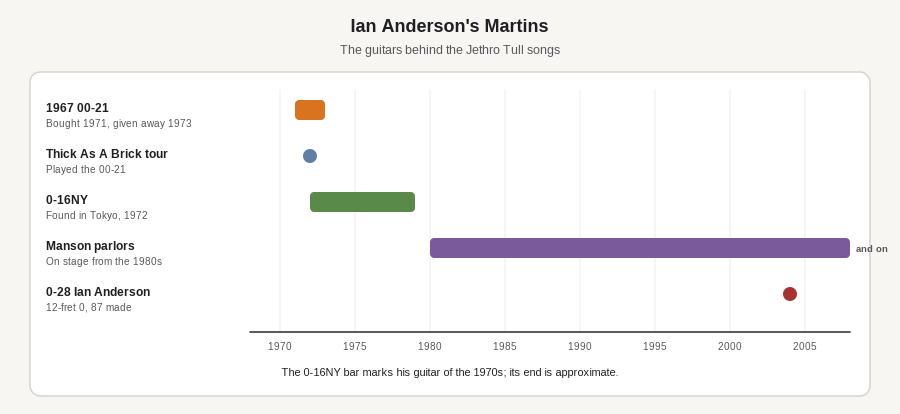
In 1971 Anderson bought a 1967 Martin 00-21, Brazilian rosewood, a grand concert. He played it on the 1972 American tour for Thick As A Brick, then gave it away in 1973, to the singer Gary Pickford-Hopkins. A 00 has a little more bass than a 0, which suits a guitar that had to fill a theater with a band behind it.
The 0-16NY: His Guitar of the 1970s
On the 1972 visit to Tokyo, Anderson found a Martin 0-16NY, the 12-fret reissue from Level 2, built light for nylon or light steel. It became his main guitar of the decade, A Passion Play era included. He went on to own three of them, each reworked with a slimmer neck and a new bridge.
The 0-16NY is a plain guitar: mahogany back and sides, a spruce top, no pickguard, no position markers. What it has is the small-body voice, even from top to bottom, with the notes separate and quick to speak, which is exactly what a fast fingerpicked or flatpicked part needs to stay clear over drums.
The Collection
Anderson went on to collect about twenty classic Martins, from 1834 to the late 1930s: gut-era and early steel guitars, most of them kept rather than played. Two that did see work were a 0-42 and a 0-45, the fanciest styles in the smallest size. They were used on Too Old to Rock 'n' Roll: Too Young to Die! (1976) and other songs of that period.
From the 1980s his acoustics on stage were handmade parlor guitars by Andrew Manson in England, one of them a 3/4-size guitar based on a French design about 150 years old, fitted with Fishman pickups from the late 1980s. He also owns a Martin acoustic bass guitar.
The 0-28 Ian Anderson (2004)
Martin returned the favor in 2004 with the 0-28 Ian Anderson: a 12-fret 0 that takes steel or nylon through its triangular saddle slot, 87 made. It is the 0-16NY idea taken all the way, a small body that is honestly built for either string. Level 2 shows how the two saddles work.
Capo on the Third Fret
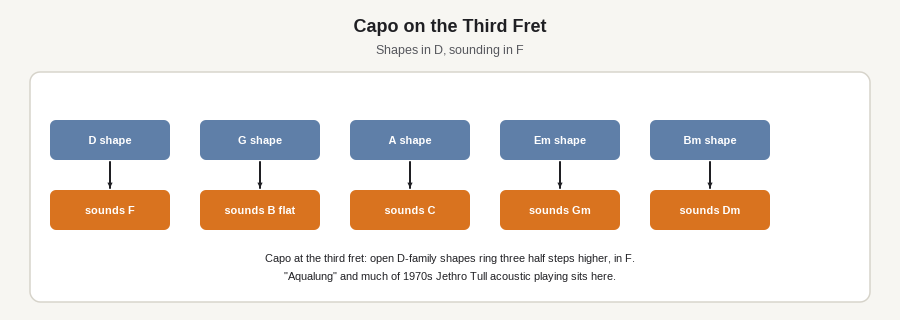
Much of Anderson's acoustic playing sits under a capo at the third fret. The shapes are the open shapes of D: D, G, A, Em, Bm, with open strings ringing against them. With the capo at 3, they sound three half steps higher, in F.
- "Aqualung" (1971): the acoustic part is played with a capo at the third fret, shaped as if in D and sounding in F.
- "Skating Away on the Thin Ice of the New Day" (War Child, 1974), "Only Solitaire" (War Child), "Dun Ringill" (Stormwatch, 1979) and "Jack-A-Lynn" are all usually played with the capo at 3 as well.
Why it works on a small Martin:
- Open strings ring. D shapes keep the open D, G, B and E strings in play. Moving the capo moves the whole ringing sound into a key that suits the voice and the flute.
- A shorter string. With the capo at 3, the vibrating length is shorter, so the strings feel lighter and sound brighter and tighter, which a small body already leans toward.
- The same fingering everywhere. One set of shapes, moved by the capo, gives every song its own key.
Not every song uses a capo. Thick As A Brick opens on D and G shapes and then the same D shape moved up to the 5th fret. On Aqualung, "Wond'ring Aloud", "Cheap Day Return" and "Mother Goose" are the acoustic songs to hear: short, fingerpicked or flatpicked, with nothing but voice and guitar at the start.
What to Take From It
- A small body with light strings and a capo can carry a whole song and still cut through a band.
- The guitar's build decides the strings: Anderson's 0-16NYs were built for nylon or light steel, and his signature 0-28 was built for either.
- Necks and bridges get reworked on old small bodies. Slimmer necks and new bridges, as on Anderson's 0-16NYs, are normal on guitars that work for a living.
Try It
Put a capo at the third fret, play a D chord, then G, then A, and let the open strings ring. That's the sound of a lot of 1970s Jethro Tull. Then play the same three shapes with no capo, and hear how much darker and looser they sound. On a small body, the difference is bigger still.