Before the dreadnought, every Martin was a small guitar. The 0, 00 and 000 are the body sizes Martin built through the nineteenth century and into the twentieth, and they were built for gut strings, played with the fingers in parlors and recital rooms. Steel came later. This series follows those small bodies from gut to steel and back to nylon, and ends with the player who made a 12-fret 0 sound like a rock band's second engine: Ian Anderson of Jethro Tull.
Reading a Martin Model Name
A Martin model name is two parts joined by a hyphen, like 00-21 or 0-28:
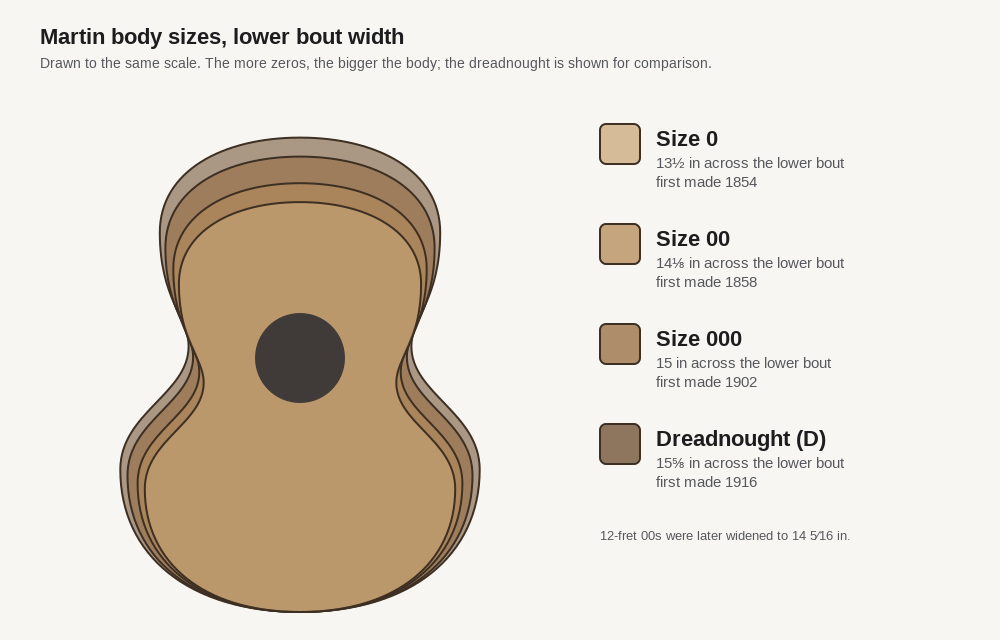
- Before the hyphen: the body size. In Martin's oldest system the numbers ran 5, 4, 3, 2½, 2, 1, from smallest to largest. When bigger bodies came, Martin kept going with zeros: 0, then 00, then 000. The more zeros, the bigger the body.
- After the hyphen: the style. The style sets the woods and the trim, the same on any size. Style 18 is mahogany, Style 21 and 28 are rosewood with more binding and purfling as the number climbs, and Style 42 and 45 carry the pearl.
So a 0-28 and a 000-28 are dressed the same, in different sizes.
The Three Sizes
| Size | Lower bout | First made | Sound |
|---|---|---|---|
| 0 (concert) | 13½ in | 1854 | close, quick, balanced; nothing booms |
| 00 (grand concert) | 14⅛ in (12-fret), later 14 5⁄16 in | 1858 | a little more bass and volume, still even |
| 000 (auditorium) | 15 in | 1902 | the biggest of the three, louder with a fuller low end |
For most of the 1800s the 0 was the big Martin, and C. F. Martin Sr. favored it over the 00 for its balance. The 000 arrived in 1902, a full 7/8 in wider than the 00, because players wanted to be heard over the mandolins that were everywhere at the time.
Built for Gut
Every one of these sizes was designed for gut strings. That matters for everything that follows:
- Light bracing. Martin used X-bracing on its gut-string guitars decades before steel, but the braces were light, because gut doesn't pull hard.
- No truss rod. Gut-era necks have no adjustable rod. The neck is stiff enough for gut and nothing more.
- 12 frets clear of the body. The neck joins the body at the 12th fret, which puts the bridge lower on the top, in the middle of the lower bout, where the top moves most freely. That's a big part of the small-body sound.
- Slotted headstock and a wide neck, like a classical guitar, for fingerpicking.
The Move to Steel
Steel strings came to Martin gradually:
- 1902: the first steel-strung Martin, a special-order 00-21.
- The 1910s: Hawaiian music was the craze, and Martin built steel-string Hawaiian guitars, played flat on the lap.
- 1922: the 2-17 ships with steel strings as standard, the first regular model to do so.
- 1923: Style 18 ships with steel. By 1926: Style 28.
- By the late 1920s, steel was standard across the line, and gut became a special order.
The bracing was made heavier a little at a time, year by year, after steel arrived. Then in 1929 Martin lengthened the neck to 14 frets clear of the body on the 000 for banjo players switching to guitar, and called it the Orchestra Model (OM). The 14-fret neck, the solid headstock and the steel string became the modern Martin, and the 16-inch dreadnought took over the 1930s.
Why the Small Bodies Came Back
The small Martins never went away for fingerpickers. A 0 or a 00 puts every note in front of you, with the bass, middle and treble at the same volume, so a picked pattern comes through clear instead of being buried under a big low end. In the folk boom of the early 1960s, Martin brought the 12-fret small body back as a reissue, built light enough for nylon or light steel. Level 2 is about that choice: the same small body, with either string. Level 3 is about the man who made it famous.
Try It
Look at the label inside any Martin (through the soundhole, on the neck block) and find the model stamp. The digits before the hyphen tell you the size, and the number after it tells you the style. Then count the frets clear of the body: 12 or 14. A 12-fret 0 or 00 is a gut-era design, even if it was built yesterday.