Level 1 showed that the small Martins were born for gut and grew up on steel. That leaves a question every owner of an old or reissue small body asks: which strings does it want? The answer depends on how the guitar was built, not on its size. This level covers what changes between nylon and steel, which small Martins take either, and the one guitar built to switch on purpose.
What Changes Between Nylon and Steel
| Nylon (or gut) | Steel | |
|---|---|---|
| Tension, whole set | roughly 75 to 95 lb | about 130 lb for extra lights, about 160 lb for lights, more for mediums |
| Top and bracing | light, so the low pull can move it | heavier, to stop the pull lifting the bridge |
| Neck | wide, flat, usually no truss rod | narrower, with an adjustable truss rod |
| Saddle | straight, square to the strings | slanted, longer on the bass side |
| Bridge | a tie block on a classical; pins on a guitar built for either | bridge pins and a bridge plate under the top |
| Action | higher: nylon swings wider | lower |
The rule from On the Bench: Strings and Restringing, Level 3A still stands: never put steel strings on a classical. A guitar built for nylon has neither the bracing nor the neck for steel's pull, and the bridge can lift or the neck can bow. Going the other way is safe: nylon on a steel-string guitar won't hurt it. It just sounds thin and loose, because the top is too stiff for nylon to move, and the ball-end nylon may sit poorly in a pin bridge.
The Guitars Built for Either: The NY Series
In 1961 Martin did something new: it reissued its own past. The 0-16NY and the 00-21NY ("NY" for New Yorker, after the stamp on Martin's earliest guitars) were small 12-fret guitars with a slotted headstock, a wide neck, no pickguard, no fret markers on the face of the board and a small rectangular bridge. They were built lighter than the steel-string Martins of the day, much like the late 1920s guitars, and sold for nylon strings or light steel, often shipped with silk and steel strings.
They sold. Martin made 775 of the 0-16NY by 1964, and the model stayed in the catalog until 1995. The 00-21NY ran until 1965.
What "light steel" means on one of these is the important part:
- Extra light or silk and steel only. Around 10 to 46 gauge, or a silk-and-steel set, with lower tension than a standard light set. Standard lights (12 to 54) are what most owners put on them anyway, and that's how these guitars end up with bellied tops, lifted bridges and early neck resets.
- Nylon works too, with ball-end folk nylon on the pin bridge.
Martin's True Classicals
Martin also built real classicals in the small sizes: the gut-string G series from 1936, then the 000-28C from 1962 to 1969 and the 00-28C from 1966 to 1995. These are nylon-only guitars, with tie-block bridges and classical bracing. A 00-28C looks like a 00, but it must never be strung with steel.
The Guitar Built to Switch: the 0-28 Ian Anderson
In 2004 Martin made one small body that takes either string by design: the 0-28 Ian Anderson, a 12-fret 0 with an Adirondack spruce top and East Indian rosewood back and sides. Only 87 were made, each signed inside by Anderson and C. F. Martin IV.
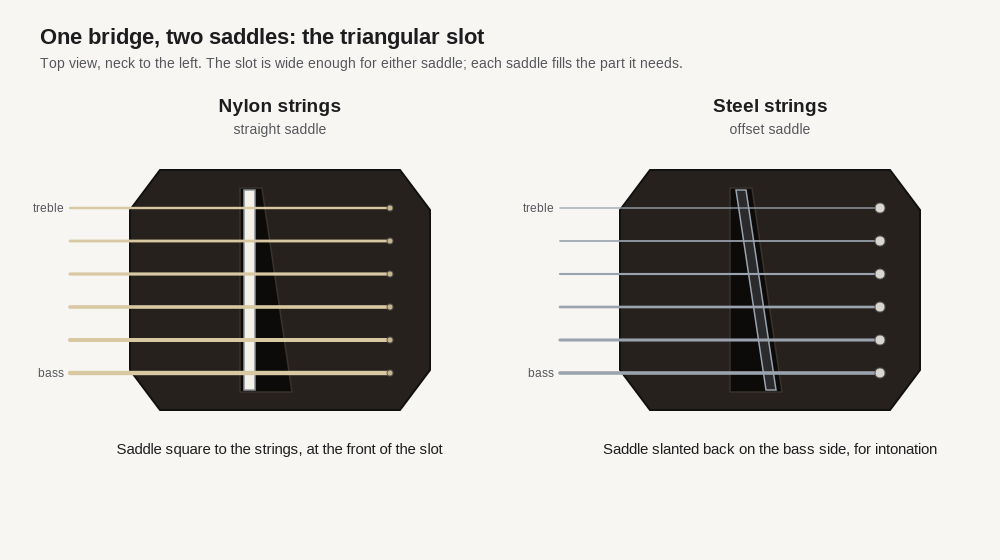
The trick is in the bridge. An ebony pyramid bridge has a triangular saddle slot, wide at the bass end and narrow at the treble. It takes either of two saddles:
- A straight saddle for nylon, square to the strings, with nylon's own compensation.
- An offset saddle for steel, slanted back on the bass side, because steel strings need more length added on the bass side to play in tune.
The slot is wide enough for either, so changing over is a swap of the saddle and a new set of strings, with no change to the bridge or the pickup under the saddle.
Switching Strings on a Guitar That Allows It
On a 0-28 Ian Anderson, or any small body rated for either string:
- Loosen and remove the old set, and lift out the saddle.
- Fit the saddle for the new strings: straight for nylon, offset for steel. Check it sits flat on the bottom of the slot.
- String up with ball-end nylon or extra-light steel.
- Recheck the setup. Nylon wants more action than steel; see On the Bench: Guitar Setup, Level 2B. If a rod is present, steel may need a small relief adjustment once the neck settles.
- Check the intonation at the 12th fret on every string. If it's far out, the wrong saddle is in.
Try It
If you own a small-body acoustic, find out what it was built for before your next string change. Look for "NY", "C" or "G" in the model name, a tie-block bridge, or no truss rod at the soundhole. Anything gut-era, NY or classical gets nylon or extra-light steel at most, never standard lights.