Levels 1 and 2 covered what the KT88 and 6550 are and how they behave. This level is about applications: the jobs they do better than any other common power tube, the reasons why, the jobs they are wrong for, swapping them into amps built for other tubes, and buying them.
Where They Shine
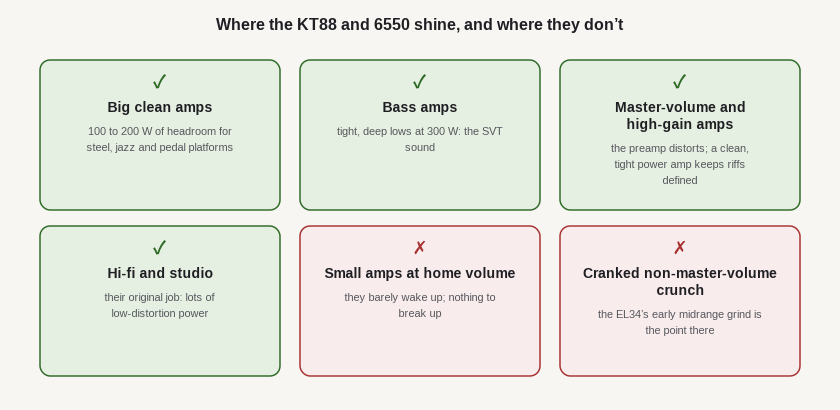
The Big Clean Amp
The job: 100 W to 200 W of clean headroom. Steel guitar and pedal steel, clean jazz, country, and players who want the amp to stay clean and loud while pedals do the dirt.
Why they shine: clean headroom comes from plate dissipation and plate voltage, and these tubes have the most of both among the common types. A steel guitar's sustained low notes and sharp attack ask a lot of a power amp; a pair or quad of KT88s holds them without compressing. Their firm low end keeps a big clean chord from turning to mush.
What to look for: a high-powered head or combo built for them, with an output transformer big enough to match. Steel players have long fitted 6550s or KT88s to big 6L6 amps for extra clean power, but only after the amp is modified for them (see swapping, below).
Bass Amps
The job: big, clean, solid low end at stage volume.
Why they shine: bass notes demand the most current from a power stage, and a tube that runs out of room under them sags and goes woolly. The 6550's headroom and tight lows are why the Ampeg SVT has used six of them since around 1970, and why so many tube bass amps since have followed.
Master-Volume and High-Gain Amps
The job: a preamp that makes all the distortion, and a power amp that has to stay tight and defined under it.
Why they shine: in a high-gain amp, a loose, saggy power amp blurs fast riffs and low palm mutes. A KT88 or 6550 power stage stays clean and tight, so the preamp's distortion comes through with its attack intact. Many players who disliked 6550s in non-master-volume Marshalls liked them in the later master-volume models for exactly this reason.
Hi-Fi and Studio
The job: a lot of power with very low distortion, for loudspeakers rather than guitar speakers.
Why they shine: it is what they were designed for. A push-pull pair in a hi-fi design gives about 50 W at low distortion, and their linearity makes them a favorite in tube power amplifiers. Studio power amps and some keyboard amplifiers use them for the same reason.
Where They Don't
- Small amps at home volume. The headroom that makes them great on stage means they barely start working at low volume. If you want an amp that breaks up at home, a 6V6 or EL84 amp is the better tool.
- Cranked non-master-volume crunch. In an amp where the power tubes are meant to make the distortion, such as a classic British non-master-volume head, the EL34's early midrange grind is the point. A 6550 there delays the breakup and changes the voice. Many players hear the 1970s US-export 6550 Marshalls this way.
- Where weight and heat matter. A quad of KT88s needs a big power transformer and output transformer, and that means a heavy amp that runs hot.
Swapping Them Into Other Amps
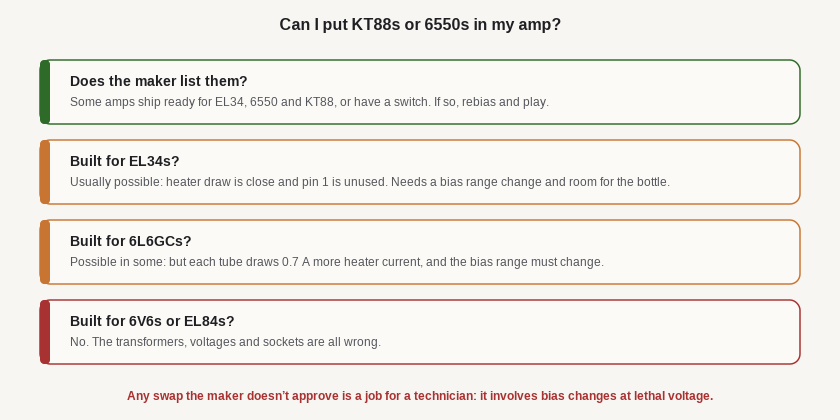
| Amp built for | Can it take KT88s or 6550s? | What has to be checked |
|---|---|---|
| KT88 or 6550, or a multi-tube design | yes | rebias for the tubes fitted |
| EL34 | often | bias range (usually needs resistor changes), room for the bigger bottle, retainers. Heater draw is close; pin 1 is unused on a KT88, so a pin 1 tie to the cathode does no harm. The output transformer was chosen for EL34s, so expect more headroom rather than more power. |
| 6L6GC | sometimes | heater current goes from 0.9 A to 1.6 A per tube: 2.8 A more for a quad, which the power transformer must be able to supply. Bias range, and room for the bottle. |
| 6V6 or EL84 | no | the transformers, voltages and sockets are all wrong for it |
DANGER: LETHAL VOLTAGE. Changing an amp's bias range or rewiring sockets is work at lethal voltage. If the amp's maker doesn't say a swap is supported, have a technician check and modify the amp.
The Bigger Cousins
| Tube | Plate rating | Notes |
|---|---|---|
| KT90 | about 50 W | a larger, higher-power development of the same idea |
| KT120 | about 60 W | about 150 W from a pair at high voltage; fits many KT88 amps after a bias check, but draws more heater current |
| KT150 | about 70 W | an even larger bottle; check the heater current and the space in the amp |
Each needs more heater current and room than a KT88. Treat them as a swap in their own right, not a drop-in.
Buying KT88s and 6550s
- Current production: both are made in Russia, Slovakia and China and sold under many names, including revived historic brands. Each maker's version sounds and behaves a little differently.
- Matched sets: always buy pairs, quads or sextets matched for current. Many sellers grade sets by how hard they draw (soft, medium, hard): stay with the same grade when replacing a set.
- Vintage: original British KT88s and US-made 6550s are collector's items, expensive, and often faked or sold used. A test report from a trusted seller is the minimum.
- Ratings: check whether a set is rated 35 W or 42 W, and bias for the actual rating.
- Spares: keep the old set when you replace one. A worn but working set will get you through a gig.
Try It
Think of an amp you know well and place it on the applications diagram: is its power stage meant to stay clean (a KT88 candidate) or to make the distortion (where an EL34 or 6L6 is part of the voice)? Then, in the Tube Bias Calculator, compare the 70% targets for four 6550s and four KT90s at the same voltage: the bigger plate rating allows more idle current.