Level 1 covered what the KT88 and 6550 are and how they sound. This level is about living with them: how much power each tube count makes, why they stay clean so long, what they ask of the amp around them, and how their numbers compare with the tubes they are usually measured against.
DANGER: LETHAL VOLTAGE. These tubes are run at high plate voltages, often 500 V to well over 600 V in big amps. Bias is measured with the amp on, at those voltages. If you are not trained for it, have a technician do it. Never run a tube amp without a speaker or dummy load: it can destroy the output transformer (see the Output Transformers series).
Power by Tube Count
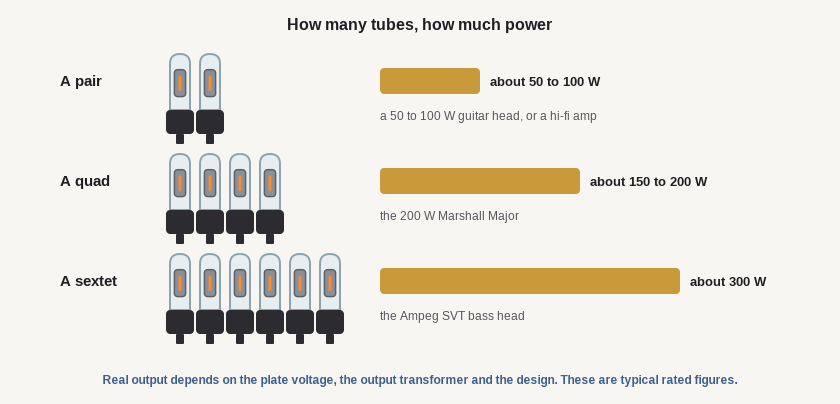
| Tubes | Typical rated power | Where |
|---|---|---|
| A pair | about 50 W to 100 W | guitar heads and combos; hi-fi amps. A pair can make about 100 W at high plate voltage, or about 50 W in a low-distortion hi-fi design. |
| A quad | about 150 W to 200 W | very big guitar heads, like the 200 W Marshall Major; bass heads |
| A sextet | about 300 W | the Ampeg SVT and other big bass heads |
How much a given amp makes depends on its plate voltage, output transformer and design. Many guitar amps run KT88s or 6550s well below their limits: an amp built for EL34s and refitted with 6550s makes about the same rated power, just with more headroom.
Why They Stay Clean
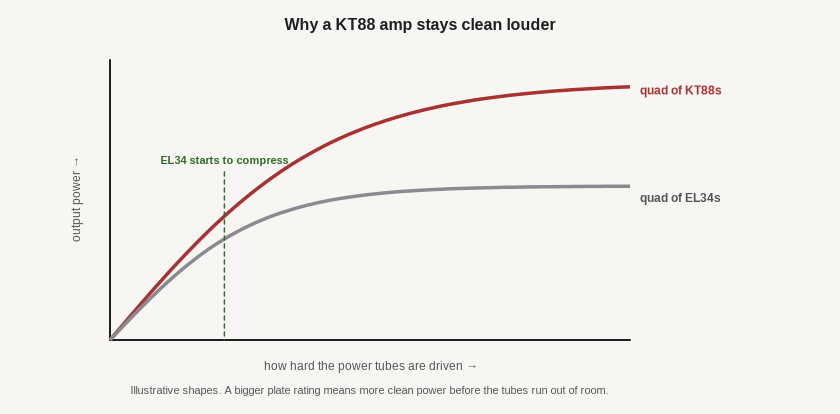
A power tube stays clean until it runs out of room to swing: out of current at one end, out of voltage at the other. A tube with a bigger plate rating, run at a high plate voltage, has more room before it compresses and clips. That is the whole secret of the KT88's headroom. It also explains the tight low end: low notes ask the most of a power stage, and a tube with room to spare doesn't sag or blur under them.
The same headroom is why these tubes do little at low volume. In a small amp at home level, they never get near the point where they start to color the sound.
The Numbers Against Their Neighbors
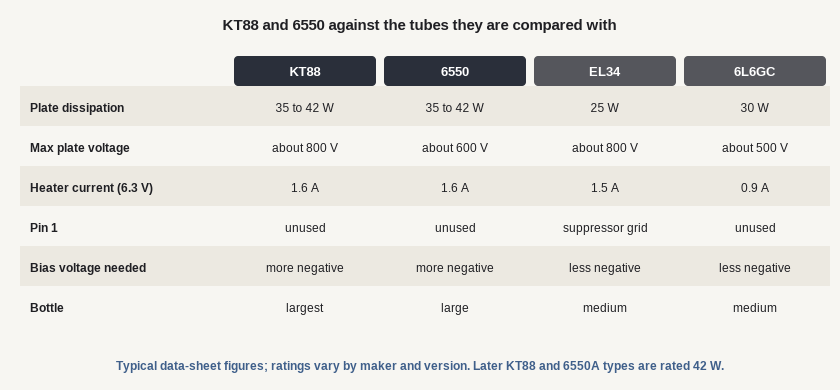
The key differences from an EL34 or 6L6GC:
- More plate dissipation: 35 W to 42 W against 25 W or 30 W.
- Higher voltage ratings: the KT88 especially was built for very high plate voltages.
- More heater current than a 6L6GC: 1.6 A against 0.9 A. Close to an EL34's 1.5 A.
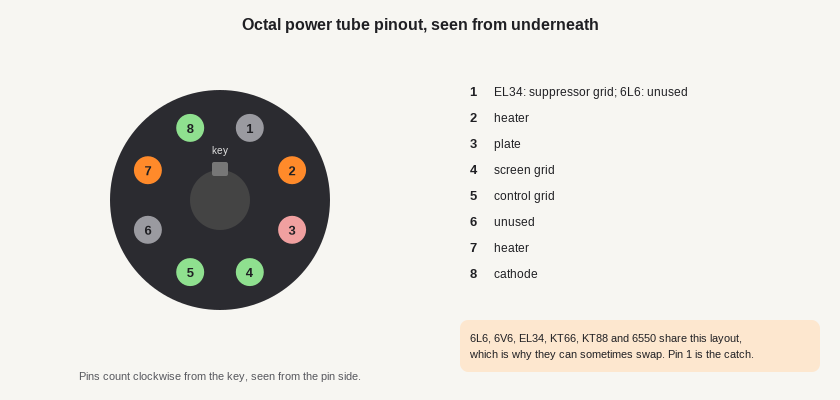
- Pin 1 unused: like a 6L6, unlike an EL34, where pin 1 is the suppressor grid.
- A more negative bias: they need a more negative grid voltage to set the same idle, which is the most common reason they can't simply be dropped into another amp.
The pinout is the standard octal power tube layout:
What They Ask of the Amp
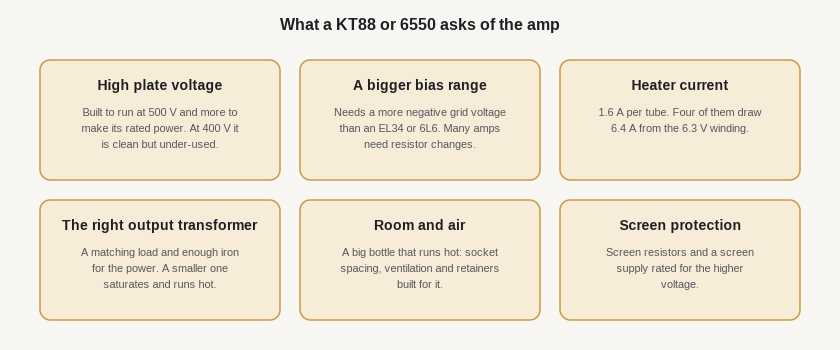
| Need | Why |
|---|---|
| High plate voltage | to make their rated power. At 400 V they work, cleanly, but nowhere near their limit. |
| A wide bias range | the bias supply has to reach a more negative voltage than an EL34 or 6L6 amp provides. Marshall changed bias resistors for its 6550 export amps for this reason. |
| Heater current | 1.6 A each: 6.4 A for a quad, 9.6 A for a sextet, from the power transformer's 6.3 V winding (see the Power Transformers series). |
| The right output transformer | big enough to pass the power without saturating, with a primary impedance that suits the tubes. |
| Room and air | they are the largest common power tubes and run hot. Socket spacing, ventilation and tube retainers have to suit them. |
| Screen protection | screen resistors and a screen supply that can take the higher voltages. |
Biasing
These tubes are almost always fixed bias, set with a bias pot. The usual target for class AB is 60% to 70% of maximum plate dissipation, worked out from the plate voltage. Use the rating of the tubes you actually have: 35 W if unsure, as some versions are rated 42 W. The Tube Bias Calculator works out the target current, and the Power (W) Calculator checks the watts from a measured voltage and current.
Buy them as matched sets: a matched pair, quad or sextet, so both sides of the output transformer draw the same current.
Life
Run within their ratings, KT88s and 6550s are tough, long-lived tubes. Their ruggedness is one reason a US distributor fitted 6550s to Marshalls in the 1970s: they survived shipping and warranty periods better than the EL34s of the day. In a big bass amp played hard every night, a sextet will still wear out; the signs are the same as any power tube (see the Vacuum Tubes series, Level 3B).
Try It
In the Tube Bias Calculator, set two KT88s at 480 V and read the 70% target. Then switch to 6550 and to KT88 at 400 V: the target current rises as the plate voltage falls, for the same percentage.
Level 3 covers where the KT88 and 6550 shine, where they don't, swapping them into other amps, and buying them.